
NEWS

How SAH tripled cassava seed multiplication in Rwanda
octobre 16, 2026
Trainees displaying their certificates of participation at the close of the training alongside facilitators and IITA staff.

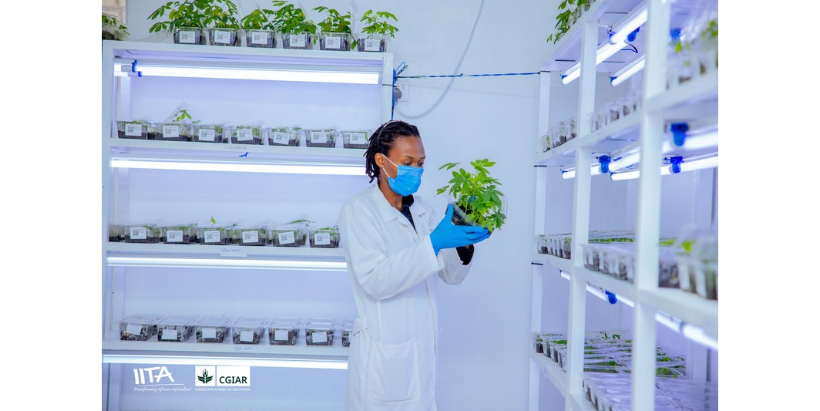
IITA introduced Semi-Autotrophic Hydroponics (SAH) at the RAB Rubona station to increase multiplication rates while improving the quality and survival of tissue-culture-derived cassava plantlets. The technology has provided a faster, more efficient approach to multiplying clean planting materials within a relatively small space and a short period. Since its introduction in Rwanda in 2019, SAH has revolutionized cassava seed multiplication by enabling the national seed system to produce up to three times as much clean cassava planting material.

This increased capacity is important for the young cassava seed system in Rwanda, where access to sufficient quantities of healthy planting material is essential for farmers to grow productive crops. Cassava is particularly vulnerable to the accumulation and spread of viral diseases through vegetative planting materials, making the availability of clean seed critical to maintaining crop health.

At the Rwanda Agriculture and Animal Resources Development Board (RAB)-Rubona station, the SAH laboratory provides a controlled environment for rapidly multiplying clean cassava planting materials. RAB technicians report that the technology has increased the laboratory’s annual multiplication capacity from about 100,000 plantlets produced by conventional methods to as many as 300,000.

“In one year here in SAH, we are now able to at least produce 300,000 plantlets, an impressive increase from 100,000 cuttings previously produced with the conventional method under a screenhouse. So, this has enabled us to multiply an increased number of cassava seeds in a very limited space and short time, as well as limiting the spread of diseases and increasing the quantity of plantlets produced,” said Severin Ntivuguruzwa, Cassava Breeder Research Fellow at RAB.

Beyond establishing the laboratory, IITA has supported the development of national capacity by training RAB technicians in SAH operation and management. This approach has helped ensure that the technology and expertise are available to Rwanda’s national agricultural research system.

Sabrine Umugwaneza, one of the RAB technicians trained at IITA headquarters in Ibadan, Nigeria, in 2019, has been operating the SAH laboratory in Rwanda and has accumulated tangible experience. “I received SAH training in 2019 at IITA headquarters in Ibadan, Nigeria. I learned about SAH operations and how it’s used to produce clean cassava planting materials. I immediately started operating the SAH lab in Rwanda, and since then, the plantlet multiplication rate has increased considerably. We are producing more seeds. The most important aspect of SAH is that it’s cheap and uses fewer, simpler materials (no laminar flow for sterilization). It’s multiplying faster than the traditional approach,” said Umugwaneza.

Watch this vidéo about how Semi-Autotrophic Hydroponics (SAH) is transforming Rwanda’s cassava seed system.

“SAH is a novel technology that has been acquired and used by IITA to increase the rapid multiplication of cassava seedlings. The technology has been very important in increasing cassava multiplication rates. It has also been very useful in reducing the cost of cassava seed production. With these two dimensions, we can to generate more affordable planting materials,” said Dr Silver Tumwegamire, IITA Cassava Breeder.

The technology is part of a broader effort by IITA and its partners to strengthen Rwanda’s cassava seed system, from the production of clean pre-basic materials to their field multiplication and distribution to farmers. IITA has worked with RAB on cassava seed systems, plant health, and improved resistant varieties, with SAH serving as one component of the clean seed production pathway.

From the SAH laboratory and screenhouse, the planting materials move through a network of seed multipliers who further multiply them under inspected field conditions to produce and supply larger quantities of clean cassava seeds closer to farmers. Through the ViRCA Deployment project, 52 cassava seed entrepreneurs across Rwanda have been trained and supported to multiply clean cassava seed and distribute it to farmers while maintaining its quality.

For Mukamusoni Alexia, a cassava seed entrepreneur in Ruhango District, local seed multipliers play an important role in making clean planting materials more accessible to farming communities. “This technology has helped to increase the availability of clean cassava planting materials in our community. As a seed multiplier, I am connected with other seed entrepreneurs in the cassava seed system, and we ensure we multiply as many seeds as possible. We have been trained by various partners, including MEDA, RAB, IITA, and Ingabo Syndicate, to effectively perform the multiplication of cassava seeds,” said Mukamusoni.

She is a certified seed entrepreneur currently multiplying more than 32,000 plantlets during the agricultural season and expects to produce more than 300,000 plantlets at harvest. These will be distributed to other seed multipliers, who will continue multiplication to produce quality-declared seeds (QDS) that will provide cassava growers with disease-free, affordable seeds.

The growing demand for clean cassava planting materials is also prompting further expansion of the technology. RAB is building additional SAH facilities in collaboration with its partners to increase multiplication capacity and improve the availability of clean cassava planting materials nationwide. With four SAH facilities already built across Rwanda, the expansion provides an opportunity to further strengthen Rwanda’s cassava seed system by increasing the volume of clean planting materials available for multiplication and distribution to farmers.


Contribué par

Ritha Bumwe, Silver Tumwegamire and Yvonne Ishimwe

Retour en haut
Olaosebikan, Olamide

Olamide Deborah Nwanze est une chercheuse principale spécialisée dans la recherche sur l'approche "genre" afin d'éclairer les politiques de sélection participative et inclusive, de développement de variétés et de systèmes semenciers concernant les cultures de racines, tubercules et bananes (RTB) au siège de l'Institut International d'Agriculture Tropicale, à Ibadan, au Nigeria. Elle est candidate au doctorat à l'Université d'Ibadan et titulaire d'un master et d'un diplôme d'ingénieur agronome en vulgarisation agricole et développement rural. Olamide est membre du programme African Women in Agricultural Research and Development – Gender Responsive Agricultural Systems Policy (SAISIE DE RÉCOMPENSEet les Chercheuses Sensibles au Genre Équipées pour la Transformation Agricole (SUPER. Elle cherche à appliquer ses apprentissages en matière d’approche genre, recherche sensible au genre, et expertise en développement et examen de politiques pour faciliter l’accès et l’adoption par les femmes, les jeunes, les enfants et les groupes sociaux vulnérables aux innovations agricoles qui garantissent la sécurité alimentaire, nutritionnelle, des revenus et des moyens de subsistance en Afrique. Ses rôles actuels comprennent le mentorat de chercheurs stagiaires, le développement de guides et manuels de formation, la mise en œuvre et l'adaptation de cadres et d'outils genre, l'engagement des acteurs de la chaîne de valeur en tant que partenaires de la science citoyenne, l'examen et la refonte des politiques, la gestion et l'analyse des données. Ses recherches actuelles portent sur les méthodes mixtes ainsi que sur les approches participatives et interdisciplinaires pour saisir et mettre en évidence les dynamiques de genre, les besoins, les préférences et les défis rencontrés par les parties prenantes au sein de la chaîne de valeur des moyens de subsistance agricoles afin de prioriser des stratégies axées sur le genre dans les programmes de sélection, la conception et la mise en œuvre des politiques.

À l'IITA, elle contribue à la mise en œuvre du CGIAR Initiative d'Élevage Accéléré et Innovation génétique Programmes ; recherche participative et genre au sein des Prochaine Génération Manioc, HarvestPlus, RTBAliments, et Tricot-ClimMob 1000Fermes Projets ; et la communication des connaissances sur le genre via le Série de webinaires G-LENS, vidéo documentaire, notes de politique, publications, et blogs.


Publications récentes

de Sousa, K., van Etten, J., Manners, R. Bello, A., Teeken, B., Olaosebikan, O., et al. 2024. L'approche tricot : un cadre agile pour les essais décentralisés à la ferme soutenus par la science citoyenne. Une rétrospective. Agron. Sustain. Dev. 44, 8. https://doi.org/10.1007/s13593-023-00937-1

Madu, T., Onwuka, S., Nwafor, S., Onyemauwa, N., Ejechi, M., Ofoeze, M., Ukeje, B., Eluagu, C., Olaosebikan, O., Okoye, B., 2024. Les études sur les consommateurs inclusifs en matière de genre améliorent l'amélioration du manioc au Nigeria dans : Frontiers in Sociology, volume 9, numéro : 1224504, doi : 10.3389/fsoc.2024.1224504

Olaosebikan, O. ; Bello, A. ; Utoblo, O. ; Okoye, B. ; Olutegbe, N. ; Garner, E. ; Teeken, B. ; Bryan, E. ; Forsythe, L. ; Cole, S. ; Madu, T. 2023. Facteurs de stress et résilience au sein de la chaîne de valeur du manioc au Nigeria : Caractéristiques préférées des variétés de manioc et stratégies de réponse des hommes et des femmes pour informer l'amélioration variétale. Sustainability 15, 7837. https://doi.org/10.3390/su15107837

Okoye, B., Ofoeze, M., Ejechi, M., Onwuka, S., Nwafor, S., Onyemauwa, N., Ukeje, B., Eluagu, C., Obidiegwu, J.*, Olaosebikan, O., Madu, T.* 2023. Priorisation des traits préférés dans la chaîne de valeur de l'igname au Nigeria : une analyse de la situation en matière de genre in: Frontiers in Sociology, volume 8, numéro : 1232626, pages 1 – 9, ISSN 2297-7775, 2023. https://www.frontiersin.org/articles/10.3389/fsoc.2023.1232626/full

Olaosebikan, O., Bello, A. A., de Sousa, K., Ndjouenkeu, R., Adesokan, M., Alamu, E. O., Agbona, A., van Etten, J., Kegah, F. N.*, Dufour, D., Bouniol, A., Teeken, B. 2023. Acceptabilité par les consommateurs des produits alimentaires à base de gari-eba de manioc dans des contextes culturels et environnementaux variés en utilisant l'approche triade de comparaison des technologies (tricot) dans : Journal of the Science of Food and Agriculture,

Teeken, B., Olaosebikan, O., Bello, A. A., Madu, T.*, Cole, S. M. 2023. Évaluation qualitative de la positionnalité et des préférences des dyades en relation avec les activités liées au manioc : travailler avec des scientifiques citoyens du procès tricot https://hdl.handle.net/10568/138326 Type : Manuel

Bouniol, A., Ceballos, H., Bello, A. A., Teeken, B., Olaosebikan, O., Owoade, D., Agbona, A., Fotso Kuate, A., Madu, T.*, Okoye, B.*, Ofoeze, M.*, Nwafor, S.*, Onyemauwa, N.*, Adinsi, L.*, Forsythe, L., Dufour, D. 2023. Impact variétal sur le travail des femmes, la charge de travail et la pénibilité associée dans le traitement des plantes à racines, tubercules et bananes : focus sur le manioc en Afrique subsaharienne dans : Journal of the Science of Food and Agriculture, pages 1 – 25, ISSN 0022-5142,

Bello, A. A., Agbona, A., Olaosebikan, O., Edughaen, G., Dufour, D., Bouniol, A., Iluebbey, P., Ndjouenkeu, R.*, Rabbi, I. Y., Teeken, B. 2023. Effets génétiques et environnementaux sur la productivité de la transformation et le rendement des produits alimentaires : la pénibilité du travail des femmes dans : Journal of the Science of Food and Agriculture, pages 1 – 32, ISSN 0022-5142, 5

Cavicchioli, M., Zimbiti, T., Teeken, B., Nwanze, D.O., Liani, M., Parkes, E. & Bello, A. 2023. Rapport sur la formation en sélection génétique sensible au genre à l'IITA. Genetic Resources Center, IITA-HQ, Ibadan, 21-23 septembre 2022. Ibadan, Nigéria : IITA, (34 p.).https://hdl.handle.net/10568/131368

Agbona, A. Peteti P., Teeken B., Olaosebikan O. Bello, A. A., Parkes, E., Rabbi, I. Y., Mueller, L., Egesi, C., Kulakow, P. 2022. Gestion des données dans les programmes d'amélioration des cultures RTB africaines multidisciplinaires. In : Williamson, H.F., Leonelli, S. (eds) Towards Responsible Plant Data Linkage: Data Challenges for Agricultural Research and Development. Springer, Cham. https://doi.org/10.1007/978-3-031-13276-6_5

Lora Forsythe, Pricilla Marimo, Sarah Mayanja, Olamide D. Olaosebikan, Esme Stuart, Bela Teeken, Benjamin Okoye, Tessy Madu, (2021). Analyse transversale du genre dans RTBfoods Étape 2 Cartographie des genres sur les produits RTB. Comprendre les moteurs des préférences en matière de traits et le développement de profils de produits RTB multi-utilisateurs, WP1. Londres, Royaume-Uni : Rapport scientifique de terrain RTBfoods, 30 p.

Teeken, B., Garner, E., Agbona, A., Balogun, I., Olaosebikan, O., Bello, A., Madu, T., Okoye, B., Egesi, C., Kulakow, P. et Tufan, H.A. 2021. Au-delà des “ traits des femmes ” : explorer comment le genre, les différences sociales et les caractéristiques des ménages influencent les préférences pour les traits. Frontiers Systèmes alimentaires durables 5:740926. https://doi.org/10.3389/fsufs.2021.740926

Teeken, B., Agbona, A., Bello, A., Olaosebikan, O., Alamu, E., Adesokan, M., Awoyale, W., Madu, T., Okoye, B., Chijioke, U., Owoade, D., Okoro, M., Bouniol, A., Dufour, D., Hershey, C., Rabbi, I., Maziya‐Dixon, B., Egesi, C., Tufan, H. et Kulakow, P. (020. Comprendre les préférences variétales du manioc par le classement par paires du gari-eba et du fufu préparés par des agriculteurs-transformateurs locaux. Int J Food Sci Technol. https://doi.org/10.1111/ijfs.14862

Bela Teeken, Olamide Olaosebikan, Ireti Balogun, Benjamin Okoye, Tessy Madu, Steven Cole, Abolore Bello, Elizabeth Parkes. (2020). Pilotage des outils de profil client et produit G+ pour l'amélioration sensible au genre du manioc au Nigeria. Nigeria : Institut international d'agriculture tropicale (IIAT). https://hdl.handle.net/20.500.11766/13000