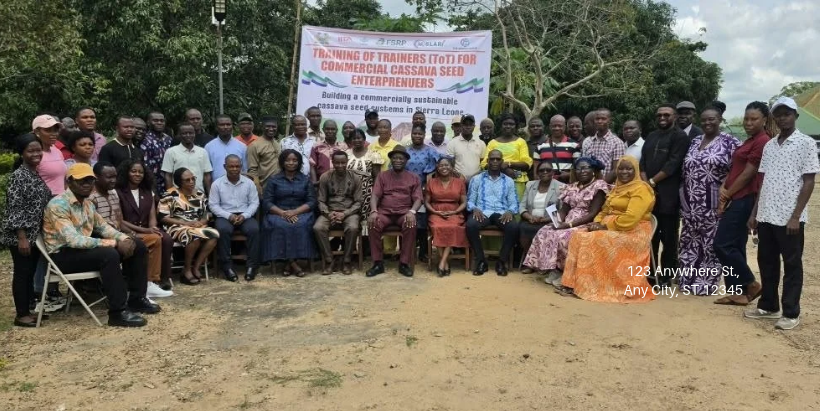
Sierra Leone’s cassava potential will not be unlocked by improved varieties alone. It also needs a reliable seed system that carries research breakthroughs to farmers. That idea guided a two-day Training of Trainers for Commercial Cassava Seed Entrepreneurs (CSEs), held at Taiama Lodge in Moyamba District on 5-6 October.
The training was organized by IITA, the Food System Resilience Program (FSRP), in partnership with the Sierra Leone Ministry of Agriculture and Food Security (MAFS) and the Institut de Recherche Agricole de la Sierra Leone (SLARI).
To equip participants with the skills to train others on cassava seed multiplication and Semi-Autotrophic Hydroponics (SAH) technology, the training brought together 95 participants from government agencies, universities, farmer organizations and the private sector. The participants will take what they learned from the training to farms and agribusinesses in Sierra Leone, thereby strengthening the country’s cassava seed systems.
Speaking during the training, Dr Jebeh Samba, team lead for the Semi-Autotrophic Hydroponics (SAH) Lab, told participants that the knowledge they gain would only translate to development when it is applied and shared. Dr Alfred Dixon, Chairman of the SLARI Board of Directors, stressed that lasting impact depends on putting the national seed roadmap into action.
For Isatu Bailey, Station Administrator at IITA Sierra Leone, the real engine of transformation is the certified seed entrepreneur. These entrepreneurs bridge the gap between research and farmers, helping improved varieties reach communities through trusted seed systems and market linkages. Her message was clear: innovation does not succeed on technology alone. It requires entrepreneurs who can deliver it, standards that safeguard quality, and partnerships that enable scale.
That point was backed by the experience of Bintu Monika Nyanda Jibao, a seed entrepreneur whose enterprise has raised cassava yields and trained more than 1,300 farmers. Her experience sharing during the training showed that cassava can serve as both a crop and a business opportunity that many other farmers in the country can leverage.
The Taiama training built more than skills. It created a community of practice where research, extension, enterprise, and farmer organizations meet. The future of Sierra Leone’s cassava seed system will be judged not by the number of training sessions held, but by the enterprises, partnerships, and farmer adoption that follow.
Contribué par
Timilehin Osunde and Isatu Bailey