150 Farmer Promoters trained and empowered with a digital tool for BXW surveillance and control in Rwanda
11 décembre 2021
“It was not easy to identify BXW symptoms on a banana plant. We confused it with fusarium wilt or any other banana disease that shows similar symptoms like wilting of leaves and rotting,” says Etienne Hakizimana, a Farmer Promoter from Rusizi District, Western Province. Hakizimana is one of the Scaling Champions, working with the ICT4BXW project to scale digital tools such as the BXW App and non-digital tools, mainly USSD, SMS, and chatbot, to curb the Banana Xanthomonas Wilt (BXW) disease in banana plantations in Rwanda.
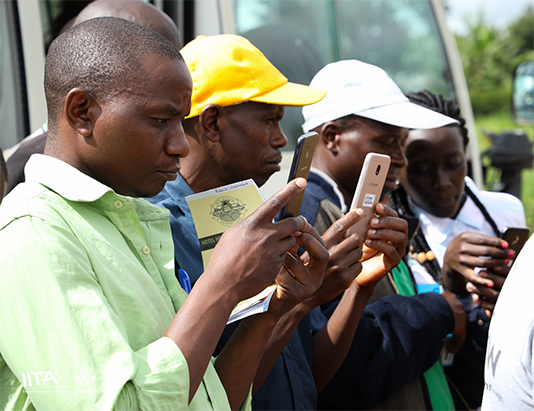
Farmer Promoters using BXW App for BXW control and general banana agronomy.
He describes BXW as a threat to banana farming and productivity since its first occurrence in his banana fields. He highlights that the BXW App is an adequate solution to curb BXW disease and help improve banana farming.
A recent survey by Viamo, one of the ICT4BXW project partners, demonstrates that more than 89% of banana farmers find BXW disease the most devastating disease affecting banana production in Rwanda. Moreover, 87% of the banana farmers who contributed to the survey agree that digital tools can help farmers increase banana productivity.
The Projet ICT4BXW Team, co-led by IITA and Rwanda Agriculture and Animal Resource Development Board (RAB), introduced digital tools to mitigate Banana Xanthomonas Wilt (BXW) disease—the most devastating disease for banana plants in Rwanda.
The Team and partners have developed, piloted, and deployed digital tools for surveillance and control of banana diseases in Rwanda, including a smartphone-based android application called the BXW App.
“After the introduction of the BXW App, I am now able to diagnose BXW disease on banana plants through photos and video that showcase the actual signs of the disease. And the App provides a tangible remedy to curb the spread of the disease, such as the Single Diseased-Stem Removal technique,” Hakizimana continues.
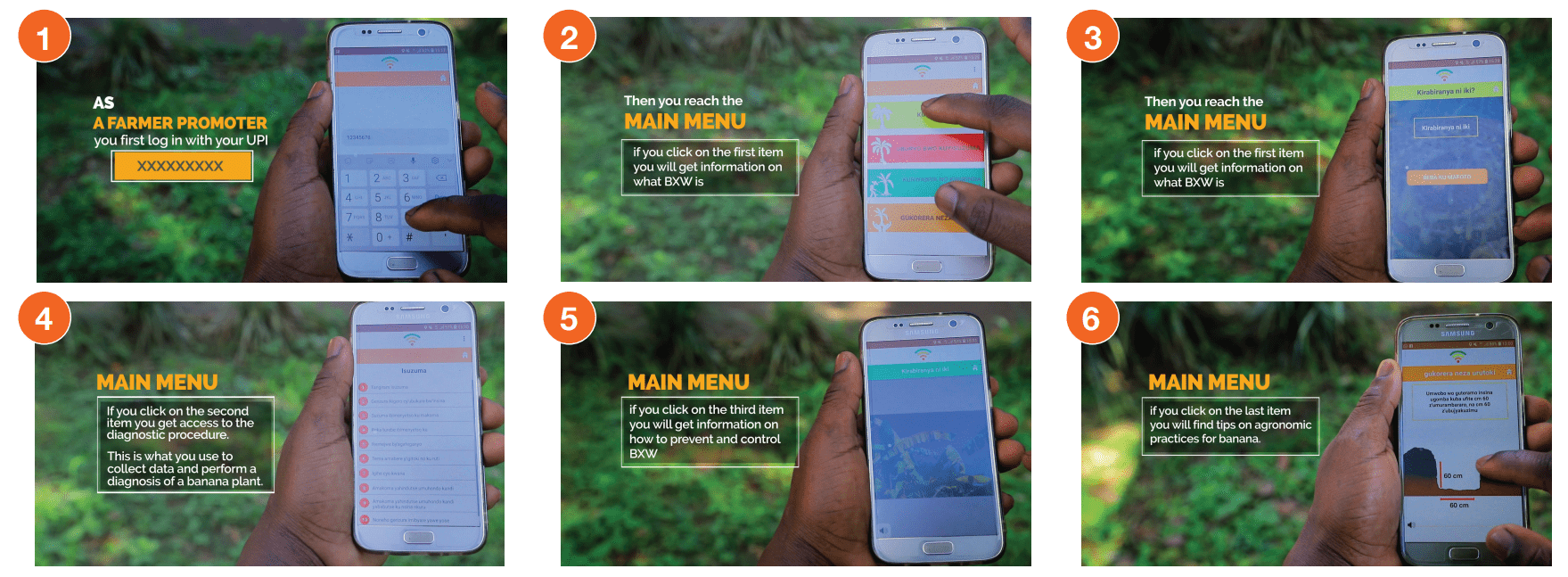
The App is a stepwise digital approach that guides farmers, farmer promoters, and other users to diagnose and control BXW in banana plantations.
The project’s first phase (2018–2020) focused on co-development and co-validation of this smartphone-based tool with various stakeholders and partners, including Farmer Promoters and RAB’s Banana Team. The BXW App has multiple functions, including information about BXW threat, a stepwise module for standardized diagnosis of BXW incidence, and best management and control of the disease.
Scaling the reach and use of ICT4BXW tools
Following the successful co-validation of the BXW App, the ICT4BXW project progressed into the second phase of implementation (2021–2023) to disseminate the BXW App nationally and diversify the reach of the tool’s multiple functions in digital and non-digital forms. This phase aims to reach 250,000 farmers and extension delivery personnel (including Farmer Promoters) across the country, empowering them with relevant decision-support knowledge and tools to control BXW disease and implement the best banana management practices.
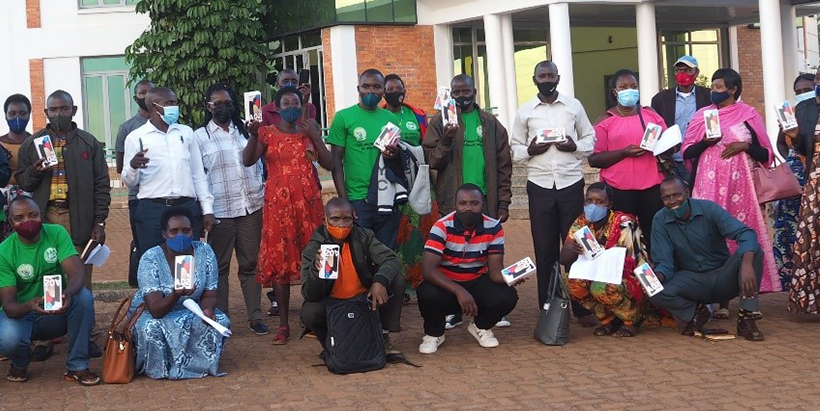
To encourage access to the BXW App and other tools (such as Extension Remote Training and Banana Agronomy Guide), RAB and IITA equipped 150 farmer promoters and RAB Technicians with smartphones and training to inspire and mentor their peers (and farmers) for broader tool adoption.
This cohort of farmer promoters, designated as “Scaling Champions,” were selected across 25 Districts of Rwanda based on a systematic survey that assessed their existing basic digital skills such as using a smartphone and level of literacy.
Before receiving the smartphones, the Scaling Champions were trained to use the BXW App and understand their critical role as mentors for their peers, designated as (Scaling Enablers), with major responsibility towards banana farmers within their respective villages.
Dubbed “Scaling Champions,” the Farmer Promoters were selected from 25 Districts of Rwanda based on a systematic survey.
Each Scaling Champion is to train and mentor seven to nine Scaling Enablers on using the BXW App in their banana farming. They will report monthly on progress, including the number of farmers who used the BXW App to diagnose and monitor BXW disease in their banana fields. The report will automatically be channeled into RAB’s system to support policy engagement and decision-making to improve banana farming in Rwanda.
Additionally, Scaling Champions will be engaged and progressively incentivized for nine months to maximize their support to scaling enablers.
You can find more details about the BXW-App on https://www.ict4bxw.com/
Olamide Deborah Nwanze est une chercheuse principale spécialisée dans la recherche sur l'approche "genre" afin d'éclairer les politiques de sélection participative et inclusive, de développement de variétés et de systèmes semenciers concernant les cultures de racines, tubercules et bananes (RTB) au siège de l'Institut International d'Agriculture Tropicale, à Ibadan, au Nigeria. Elle est candidate au doctorat à l'Université d'Ibadan et titulaire d'un master et d'un diplôme d'ingénieur agronome en vulgarisation agricole et développement rural. Olamide est membre du programme African Women in Agricultural Research and Development – Gender Responsive Agricultural Systems Policy (SAISIE DE RÉCOMPENSEet les Chercheuses Sensibles au Genre Équipées pour la Transformation Agricole (SUPER. Elle cherche à appliquer ses apprentissages en matière d’approche genre, recherche sensible au genre, et expertise en développement et examen de politiques pour faciliter l’accès et l’adoption par les femmes, les jeunes, les enfants et les groupes sociaux vulnérables aux innovations agricoles qui garantissent la sécurité alimentaire, nutritionnelle, des revenus et des moyens de subsistance en Afrique. Ses rôles actuels comprennent le mentorat de chercheurs stagiaires, le développement de guides et manuels de formation, la mise en œuvre et l'adaptation de cadres et d'outils genre, l'engagement des acteurs de la chaîne de valeur en tant que partenaires de la science citoyenne, l'examen et la refonte des politiques, la gestion et l'analyse des données. Ses recherches actuelles portent sur les méthodes mixtes ainsi que sur les approches participatives et interdisciplinaires pour saisir et mettre en évidence les dynamiques de genre, les besoins, les préférences et les défis rencontrés par les parties prenantes au sein de la chaîne de valeur des moyens de subsistance agricoles afin de prioriser des stratégies axées sur le genre dans les programmes de sélection, la conception et la mise en œuvre des politiques.
de Sousa, K., van Etten, J., Manners, R. Bello, A., Teeken, B., Olaosebikan, O., et al. 2024. L'approche tricot : un cadre agile pour les essais décentralisés à la ferme soutenus par la science citoyenne. Une rétrospective. Agron. Sustain. Dev. 44, 8. https://doi.org/10.1007/s13593-023-00937-1
Madu, T., Onwuka, S., Nwafor, S., Onyemauwa, N., Ejechi, M., Ofoeze, M., Ukeje, B., Eluagu, C., Olaosebikan, O., Okoye, B., 2024. Les études sur les consommateurs inclusifs en matière de genre améliorent l'amélioration du manioc au Nigeria dans : Frontiers in Sociology, volume 9, numéro : 1224504, doi : 10.3389/fsoc.2024.1224504
Olaosebikan, O. ; Bello, A. ; Utoblo, O. ; Okoye, B. ; Olutegbe, N. ; Garner, E. ; Teeken, B. ; Bryan, E. ; Forsythe, L. ; Cole, S. ; Madu, T. 2023. Facteurs de stress et résilience au sein de la chaîne de valeur du manioc au Nigeria : Caractéristiques préférées des variétés de manioc et stratégies de réponse des hommes et des femmes pour informer l'amélioration variétale. Sustainability 15, 7837. https://doi.org/10.3390/su15107837
Okoye, B., Ofoeze, M., Ejechi, M., Onwuka, S., Nwafor, S., Onyemauwa, N., Ukeje, B., Eluagu, C., Obidiegwu, J.*, Olaosebikan, O., Madu, T.* 2023. Priorisation des traits préférés dans la chaîne de valeur de l'igname au Nigeria : une analyse de la situation en matière de genre in: Frontiers in Sociology, volume 8, numéro : 1232626, pages 1 – 9, ISSN 2297-7775, 2023. https://www.frontiersin.org/articles/10.3389/fsoc.2023.1232626/full
Olaosebikan, O., Bello, A. A., de Sousa, K., Ndjouenkeu, R., Adesokan, M., Alamu, E. O., Agbona, A., van Etten, J., Kegah, F. N.*, Dufour, D., Bouniol, A., Teeken, B. 2023. Acceptabilité par les consommateurs des produits alimentaires à base de gari-eba de manioc dans des contextes culturels et environnementaux variés en utilisant l'approche triade de comparaison des technologies (tricot) dans : Journal of the Science of Food and Agriculture,
Teeken, B., Olaosebikan, O., Bello, A. A., Madu, T.*, Cole, S. M. 2023. Évaluation qualitative de la positionnalité et des préférences des dyades en relation avec les activités liées au manioc : travailler avec des scientifiques citoyens du procès tricot https://hdl.handle.net/10568/138326 Type : Manuel
Bouniol, A., Ceballos, H., Bello, A. A., Teeken, B., Olaosebikan, O., Owoade, D., Agbona, A., Fotso Kuate, A., Madu, T.*, Okoye, B.*, Ofoeze, M.*, Nwafor, S.*, Onyemauwa, N.*, Adinsi, L.*, Forsythe, L., Dufour, D. 2023. Impact variétal sur le travail des femmes, la charge de travail et la pénibilité associée dans le traitement des plantes à racines, tubercules et bananes : focus sur le manioc en Afrique subsaharienne dans : Journal of the Science of Food and Agriculture, pages 1 – 25, ISSN 0022-5142,
Bello, A. A., Agbona, A., Olaosebikan, O., Edughaen, G., Dufour, D., Bouniol, A., Iluebbey, P., Ndjouenkeu, R.*, Rabbi, I. Y., Teeken, B. 2023. Effets génétiques et environnementaux sur la productivité de la transformation et le rendement des produits alimentaires : la pénibilité du travail des femmes dans : Journal of the Science of Food and Agriculture, pages 1 – 32, ISSN 0022-5142, 5
Cavicchioli, M., Zimbiti, T., Teeken, B., Nwanze, D.O., Liani, M., Parkes, E. & Bello, A. 2023. Rapport sur la formation en sélection génétique sensible au genre à l'IITA. Genetic Resources Center, IITA-HQ, Ibadan, 21-23 septembre 2022. Ibadan, Nigéria : IITA, (34 p.).https://hdl.handle.net/10568/131368
Agbona, A. Peteti P., Teeken B., Olaosebikan O. Bello, A. A., Parkes, E., Rabbi, I. Y., Mueller, L., Egesi, C., Kulakow, P. 2022. Gestion des données dans les programmes d'amélioration des cultures RTB africaines multidisciplinaires. In : Williamson, H.F., Leonelli, S. (eds) Towards Responsible Plant Data Linkage: Data Challenges for Agricultural Research and Development. Springer, Cham. https://doi.org/10.1007/978-3-031-13276-6_5
Lora Forsythe, Pricilla Marimo, Sarah Mayanja, Olamide D. Olaosebikan, Esme Stuart, Bela Teeken, Benjamin Okoye, Tessy Madu, (2021). Analyse transversale du genre dans RTBfoods Étape 2 Cartographie des genres sur les produits RTB. Comprendre les moteurs des préférences en matière de traits et le développement de profils de produits RTB multi-utilisateurs, WP1. Londres, Royaume-Uni : Rapport scientifique de terrain RTBfoods, 30 p.
Teeken, B., Garner, E., Agbona, A., Balogun, I., Olaosebikan, O., Bello, A., Madu, T., Okoye, B., Egesi, C., Kulakow, P. et Tufan, H.A. 2021. Au-delà des “ traits des femmes ” : explorer comment le genre, les différences sociales et les caractéristiques des ménages influencent les préférences pour les traits. Frontiers Systèmes alimentaires durables 5:740926. https://doi.org/10.3389/fsufs.2021.740926
Teeken, B., Agbona, A., Bello, A., Olaosebikan, O., Alamu, E., Adesokan, M., Awoyale, W., Madu, T., Okoye, B., Chijioke, U., Owoade, D., Okoro, M., Bouniol, A., Dufour, D., Hershey, C., Rabbi, I., Maziya‐Dixon, B., Egesi, C., Tufan, H. et Kulakow, P. (020. Comprendre les préférences variétales du manioc par le classement par paires du gari-eba et du fufu préparés par des agriculteurs-transformateurs locaux. Int J Food Sci Technol.https://doi.org/10.1111/ijfs.14862
Bela Teeken, Olamide Olaosebikan, Ireti Balogun, Benjamin Okoye, Tessy Madu, Steven Cole, Abolore Bello, Elizabeth Parkes. (2020). Pilotage des outils de profil client et produit G+ pour l'amélioration sensible au genre du manioc au Nigeria. Nigeria : Institut international d'agriculture tropicale (IIAT). https://hdl.handle.net/20.500.11766/13000