150 Farmer Promoters trained and empowered with a digital tool for BXW surveillance and control in Rwanda
December 11, 2021
“It was not easy to identify BXW symptoms on a banana plant. We confused it with fusarium wilt or any other banana disease that shows similar symptoms like wilting of leaves and rotting,” says Etienne Hakizimana, a Farmer Promoter from Rusizi District, Western Province. Hakizimana is one of the Scaling Champions, working with the ICT4BXW project to scale digital tools such as the BXW App and non-digital tools, mainly USSD, SMS, and chatbot, to curb the Banana Xanthomonas Wilt (BXW) disease in banana plantations in Rwanda.
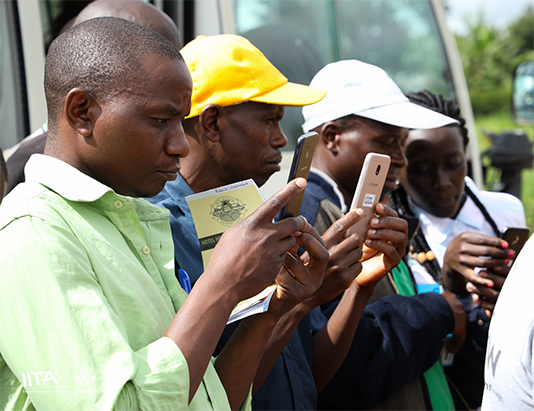
Farmer Promoters using BXW App for BXW control and general banana agronomy.
He describes BXW as a threat to banana farming and productivity since its first occurrence in his banana fields. He highlights that the BXW App is an adequate solution to curb BXW disease and help improve banana farming.
A recent survey by Viamo, one of the ICT4BXW project partners, demonstrates that more than 89% of banana farmers find BXW disease the most devastating disease affecting banana production in Rwanda. Moreover, 87% of the banana farmers who contributed to the survey agree that digital tools can help farmers increase banana productivity.
The ICT4BXW Project Team, co-led by IITA and Rwanda Agriculture and Animal Resource Development Board (RAB), introduced digital tools to mitigate Banana Xanthomonas Wilt (BXW) disease—the most devastating disease for banana plants in Rwanda.
The Team and partners have developed, piloted, and deployed digital tools for surveillance and control of banana diseases in Rwanda, including a smartphone-based android application called the BXW App.
“After the introduction of the BXW App, I am now able to diagnose BXW disease on banana plants through photos and video that showcase the actual signs of the disease. And the App provides a tangible remedy to curb the spread of the disease, such as the Single Diseased-Stem Removal technique,” Hakizimana continues.
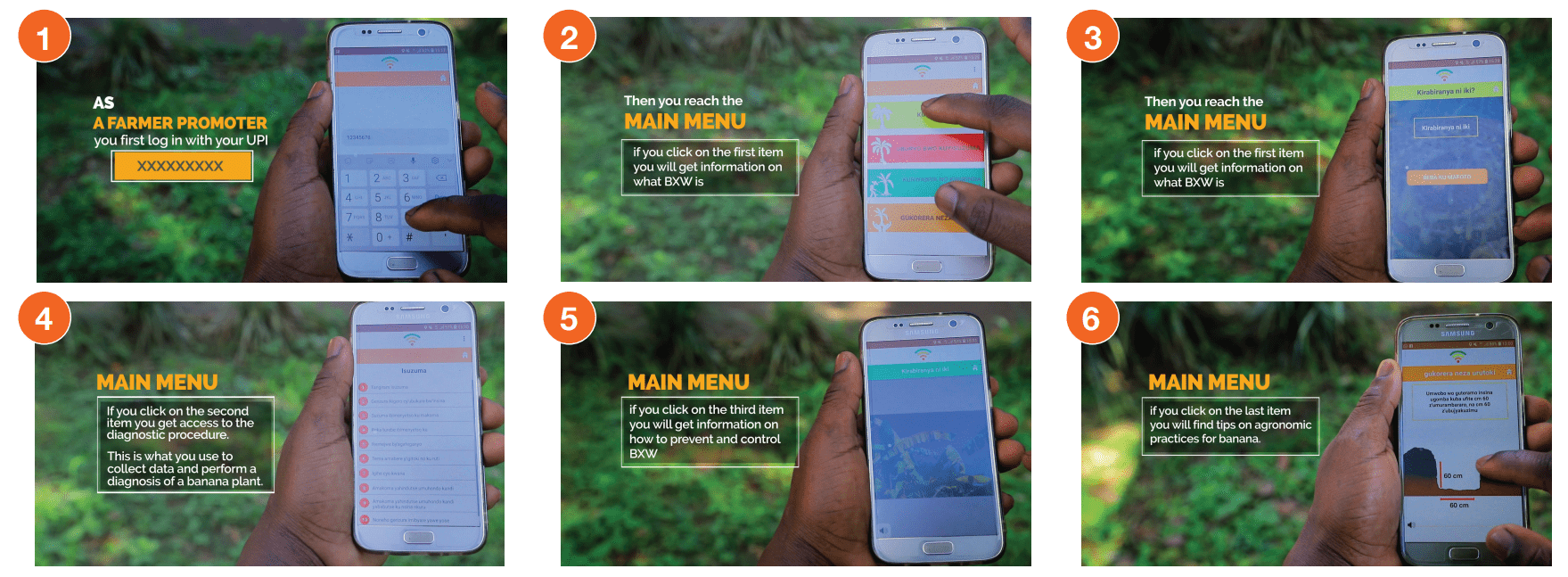
The App is a stepwise digital approach that guides farmers, farmer promoters, and other users to diagnose and control BXW in banana plantations.
The project’s first phase (2018–2020) focused on co-development and co-validation of this smartphone-based tool with various stakeholders and partners, including Farmer Promoters and RAB’s Banana Team. The BXW App has multiple functions, including information about BXW threat, a stepwise module for standardized diagnosis of BXW incidence, and best management and control of the disease.
Scaling the reach and use of ICT4BXW tools
Following the successful co-validation of the BXW App, the ICT4BXW project progressed into the second phase of implementation (2021–2023) to disseminate the BXW App nationally and diversify the reach of the tool’s multiple functions in digital and non-digital forms. This phase aims to reach 250,000 farmers and extension delivery personnel (including Farmer Promoters) across the country, empowering them with relevant decision-support knowledge and tools to control BXW disease and implement the best banana management practices.
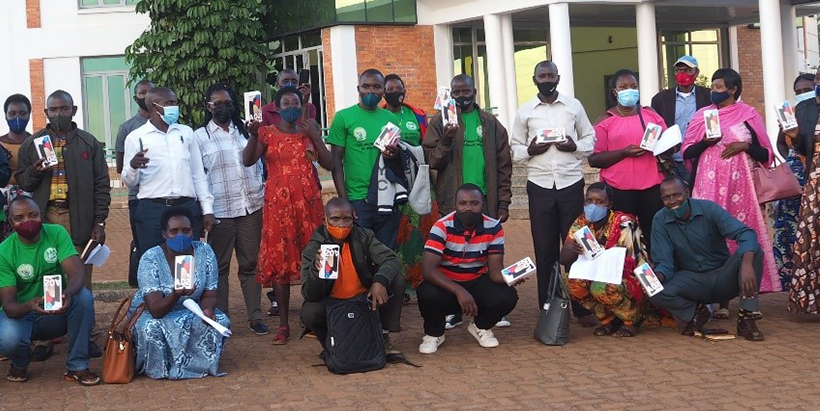
To encourage access to the BXW App and other tools (such as Extension Remote Training and Banana Agronomy Guide), RAB and IITA equipped 150 farmer promoters and RAB Technicians with smartphones and training to inspire and mentor their peers (and farmers) for broader tool adoption.
This cohort of farmer promoters, designated as “Scaling Champions,” were selected across 25 Districts of Rwanda based on a systematic survey that assessed their existing basic digital skills such as using a smartphone and level of literacy.
Before receiving the smartphones, the Scaling Champions were trained to use the BXW App and understand their critical role as mentors for their peers, designated as (Scaling Enablers), with major responsibility towards banana farmers within their respective villages.
Dubbed “Scaling Champions,” the Farmer Promoters were selected from 25 Districts of Rwanda based on a systematic survey.
Each Scaling Champion is to train and mentor seven to nine Scaling Enablers on using the BXW App in their banana farming. They will report monthly on progress, including the number of farmers who used the BXW App to diagnose and monitor BXW disease in their banana fields. The report will automatically be channeled into RAB’s system to support policy engagement and decision-making to improve banana farming in Rwanda.
Additionally, Scaling Champions will be engaged and progressively incentivized for nine months to maximize their support to scaling enablers.
You can find more details about the BXW-App on https://www.ict4bxw.com/
Olamide Deborah Nwanze is a Senior Research Associate specializing in gender mainstreaming research to inform participatory and inclusive breeding, variety development, and seed systems policies regarding root, tuber, and banana (RTB) crops in the International Institute of Tropical Agriculture Headquarters, Ibadan, Nigeria. She is a PhD candidate at the University of Ibadan and holds an MSc and B. Agric in Agricultural Extension and Rural Development. Olamide is a fellow of the African Women in Agricultural Research and Development – Gender Responsive Agricultural Systems Policy (AWARD-GRASP) and the Gender Responsive Researchers Equipped for Agricultural Transformation (GREAT). She seeks to apply her gender-mainstreaming learnings, gender-responsive research, and policy development, and review expertise to facilitate women, youth, children, and vulnerable social group’s access to and adoption of agricultural Innovations that guarantee food, nutrition, income, and livelihood security in Africa. Her current roles include mentoring research fellows, development of guides and training manuals, implementation and adaptation of gender frameworks and tools, value chain actors’ engagement as citizen science partners, policy review and redesign, data management, and analysis. Her current research explores mixed methods and participatory and interdisciplinary approaches to capture and highlight gender dynamics, needs, preferences, and challenges stakeholders face within the agricultural livelihood value chain to prioritize gender-inclusive strategies in breeding programs, policy design, and implementation.
de Sousa, K., van Etten, J., Manners, R. Bello, A., Teeken, B., Olaosebikan, O., et al. 2024. The tricot approach: an agile framework for decentralized on-farm testing supported by citizen science. A retrospective. Agron. Sustain. Dev. 44, 8. https://doi.org/10.1007/s13593-023-00937-1
Madu, T., Onwuka, S., Nwafor, S., Onyemauwa, N., Ejechi, M., Ofoeze, M., Ukeje, B., Eluagu, C., Olaosebikan, O., Okoye, B., 2024. Gender-Inclusive Consumer Studies Improve Cassava Breeding in Nigeria in: Frontiers in Sociology, volume 9, number: 1224504, doi: 10.3389/fsoc.2024.1224504
Olaosebikan, O.; Bello, A.; Utoblo, O.; Okoye, B.; Olutegbe, N.; Garner, E.; Teeken, B.; Bryan, E.; Forsythe, L.; Cole, S.; Madu, T. 2023. Stressors and Resilience within the Cassava Value Chain in Nigeria: Preferred Cassava Variety Traits and Response Strategies of Men and Women to Inform Breeding. Sustainability 15, 7837. https://doi.org/10.3390/su15107837
Okoye, B., Ofoeze, M., Ejechi, M., Onwuka, S., Nwafor, S., Onyemauwa, N., Ukeje, B., Eluagu, C., Obidiegwu, J.*, Olaosebikan, O., Madu, T.* 2023. Prioritizing preferred traits in the yam value chain in Nigeria: a gender situation analysis in: Frontiers in Sociology, volume 8, number: 1232626, pages 1 – 9, ISSN 2297-7775, 2023. https://www.frontiersin.org/articles/10.3389/fsoc.2023.1232626/full
Olaosebikan, O., Bello, A. A., de Sousa, K., Ndjouenkeu, R., Adesokan, M., Alamu, E. O., Agbona, A., van Etten, J., Kegah, F. N.*, Dufour, D., Bouniol, A., Teeken, B. 2023. Consumer acceptability of cassava gari-eba food products across cultural and environmental settings using the triadic comparison of technologies approach (tricot) in: Journal of the Science of Food and Agriculture,
Teeken, B., Olaosebikan, O., Bello, A. A., Madu, T.*, Cole, S. M. 2023. Qualitative assessment on the positionality and preferences of dyads in relation to cassava-related activities: working with tricot trial citizen scientists https://hdl.handle.net/10568/138326 Type: Manual
Bouniol, A., Ceballos, H., Bello, A. A., Teeken, B., Olaosebikan, O., Owoade, D., Agbona, A., Fotso Kuate, A., Madu, T.*, Okoye, B.*, Ofoeze, M.*, Nwafor, S.*, Onyemauwa, N.*, Adinsi, L.*, Forsythe, L., Dufour, D. 2023. Varietal impact on women’s labour, workload and related drudgery in processing root, tuber and banana crops: focus on cassava in sub-Saharan Africa in: Journal of the Science of Food and Agriculture, pages 1 – 25, ISSN 0022-5142,
Bello, A. A., Agbona, A., Olaosebikan, O., Edughaen, G., Dufour, D., Bouniol, A., Iluebbey, P., Ndjouenkeu, R.*, Rabbi, I. Y., Teeken, B. 2023. Genetic and environmental effects on processing productivity and food product yield: drudgery of women’s work in: Journal of the Science of Food and Agriculture, pages 1 – 32, ISSN 0022-5142, 5
Cavicchioli, M., Zimbiti, T., Teeken, B., Nwanze, D.O., Liani, M., Parkes, E. & Bello, A. 2023. IITA-Gender Responsive Breeding Training Report. Genetic Resources Center, IITA-HQ, Ibadan, 21-23 September, 2022. Ibadan, Nigeria: IITA, (34 p.).https://hdl.handle.net/10568/131368
Agbona, A. Peteti P., Teeken B., Olaosebikan O. Bello, A. A., Parkes, E., Rabbi, I. Y., Mueller, L., Egesi, C., Kulakow, P. 2022. Data Management in Multi-disciplinary African RTB Crop Breeding Programs. In: Williamson, H.F., Leonelli, S. (eds) Towards Responsible Plant Data Linkage: Data Challenges for Agricultural Research and Development. Springer, Cham. https://doi.org/10.1007/978-3-031-13276-6_5
Lora Forsythe, Pricilla Marimo, Sarah Mayanja, Olamide D. Olaosebikan, Esme Stuart, Bela Teeken, Benjamin Okoye, Tessy Madu, (2021). Cross-product Gender Analysis of RTBfoods Step 2 Gendered Food Mapping on RTB Products. Understanding the Drivers of Trait Preferences and the Development of Multi-user RTB Product Profiles, WP1. London, UK: RTBfoods Field Scientific Report, 30 p.
Teeken, B., Garner, E., Agbona, A., Balogun, I., Olaosebikan, O., Bello, A., Madu, T., Okoye, B., Egesi, C., Kulakow, P. and Tufan, H.A. 2021. Beyond “Women’s Traits”: Exploring How Gender, Social Difference, and Household Characteristics Influence Trait Preferences. Frontiers Sustainable Food Systems 5:740926. https://doi.org/10.3389/fsufs.2021.740926
Teeken, B., Agbona, A., Bello, A., Olaosebikan, O., Alamu, E., Adesokan, M., Awoyale, W., Madu, T., Okoye, B., Chijioke, U., Owoade, D., Okoro, M., Bouniol, A., Dufour, D., Hershey, C., Rabbi, I., Maziya‐Dixon, B., Egesi, C., Tufan, H. and Kulakow, P. (020. Understanding cassava varietal preferences through pairwise ranking of gari‐eba and fufu prepared by local farmer–processors. Int J Food Sci Technol.https://doi.org/10.1111/ijfs.14862
Bela Teeken, Olamide Olaosebikan, Ireti Balogun, Benjamin Okoye, Tessy Madu, Steven Cole, Abolore Bello, Elizabeth Parkes. (2020). Piloting the G+ customer and product profile tools for gender-responsive cassava breeding in Nigeria. Nigeria: International Institute of Tropical Agriculture (IITA). https://hdl.handle.net/20.500.11766/13000