
Akilimo decision support system for cassava farmers in Nigeria and Tanzania
juillet 13, 2019
Le African Cassava Agronomy Initiative (ACAI) has released its first field test version of the Akilimo decision support system in paper and application format. Extension agents will use these to help cassava farmers in Nigeria and Tanzania optimize their productivity and income from growing cassava.
 The name Akilimo is coined from a combination of two Swahili words, Akili meaning Smart/Intelligent and Kilimo meaning Agriculture, which loosely translates to smart agriculture. The Akilimo is an ingenious system developed over the course of a three to four-year research and development process to provide site-specific recommendations depending on the farmers’ needs and cropping objectives.
The Akilimo decision support system encompasses the infrastructure supporting the data curating, data analysis, and information output.
Akilimo uses a series of information input by a farmer or extension agent to provide advice on fertilizer application depending on location and cropping system, the best planting practices and weed control, and intercropping. It also advises on improving the quality of cassava root starch and maintaining a constant supply of cassava root to processing industries throughout the year.
Reflecting on the progress made in the development of the tool, ACAI Project Leader Pieter Pypers lauded the ACAI team of researchers who have worked tirelessly to create such a versatile tool that is accessible in various forms. He also commended the development partners for their invaluable input through field trials, data collection, and feedback during the development process of the Akilimo decision support system.
“We have a data-intensive prediction engine in the background co-relating a number of variables that influence the crop performance, which then gives recommendation with high accuracy on sophisticated apps as well as simple printed paper,” said Pypers.
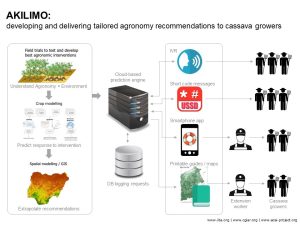
Farmers will receive Akilimono recommendations through a smartphone app, printed maps, and recommendation tables (paper-based tools), Unstructured Supplementary Service Data (USSD), and Interactive Voice Response (IVR) format. The initial field test version released only features the mobile application and the paper-based tool while the prediction engine is being calibrated for other formats.
At the heart of the Akilimo prediction engine is the culmination of the precision research examining several factors that determine the cassava crop nutrient uptake, growth, root yield, and the quality of the starch in the roots. To set up the prediction engine, ACAI integrates results from field trials with various crop models to evaluate cassava response under varying environmental conditions as well as nutrient supply.
The name Akilimo is coined from a combination of two Swahili words, Akili meaning Smart/Intelligent and Kilimo meaning Agriculture, which loosely translates to smart agriculture. The Akilimo is an ingenious system developed over the course of a three to four-year research and development process to provide site-specific recommendations depending on the farmers’ needs and cropping objectives.
The Akilimo decision support system encompasses the infrastructure supporting the data curating, data analysis, and information output.
Akilimo uses a series of information input by a farmer or extension agent to provide advice on fertilizer application depending on location and cropping system, the best planting practices and weed control, and intercropping. It also advises on improving the quality of cassava root starch and maintaining a constant supply of cassava root to processing industries throughout the year.
Reflecting on the progress made in the development of the tool, ACAI Project Leader Pieter Pypers lauded the ACAI team of researchers who have worked tirelessly to create such a versatile tool that is accessible in various forms. He also commended the development partners for their invaluable input through field trials, data collection, and feedback during the development process of the Akilimo decision support system.
“We have a data-intensive prediction engine in the background co-relating a number of variables that influence the crop performance, which then gives recommendation with high accuracy on sophisticated apps as well as simple printed paper,” said Pypers.
Farmers will receive Akilimono recommendations through a smartphone app, printed maps, and recommendation tables (paper-based tools), Unstructured Supplementary Service Data (USSD), and Interactive Voice Response (IVR) format. The initial field test version released only features the mobile application and the paper-based tool while the prediction engine is being calibrated for other formats.
At the heart of the Akilimo prediction engine is the culmination of the precision research examining several factors that determine the cassava crop nutrient uptake, growth, root yield, and the quality of the starch in the roots. To set up the prediction engine, ACAI integrates results from field trials with various crop models to evaluate cassava response under varying environmental conditions as well as nutrient supply.
 Besides the tailored fertilizer recommendation, the tool will also be used to advise farmers on land preparation methods, weed management, planting densities, and fertilizer application for intercropped cassava fields as well as planting and harvest dates for high cassava root starch quality and sustainable raw material supply.
Akilimo is highly interactive, requiring the user to provide information to improve the accuracy of the recommendations. The user, in this case, a farmer, will be required to give their accurate GPS location, cropping system, current yield, and investment capacity. Akilimo will predict the yield of cassava root and compare with the net income for the farmer from the sale of the roots to provide recommendations that help the farmer optimize their income.
The development of the Akilimo tool was a collaboration between IITA scientists and partners from various sectors of the cassava value chain in Nigeria and Tanzania. At the research level, IITA collaborated with the Centre international d'agriculture tropicale (CIAT), CAB International (CABI), Agroforesterie mondiale (ICRAF), Wageningen University, University of Florida, the Federal University of Agriculture in Abeokuta, Nigeria, Institut de recherche agricole de Tanzanie, National Root Crops Research Institute Nigeria, and the Katholik University of Leuven.
The objectives of the ACAI project are to address the needs expressed by key players in the cassava value chain in Nigeria and Tanzania. In Nigeria, ACAI is partnering with SASAKAWA Global 2000, Notore Chemicals Limited, Psaltry International, Oyo State Cassava Growers Association (OYSCGA), CAVA II project, and 2Scale project. In Tanzania ACAI is partnering with Minjingu Fertilizer, FJS Africa Starch, Best Cassava Project by MEDA, Farm Concern International, and Yara.
Besides the tailored fertilizer recommendation, the tool will also be used to advise farmers on land preparation methods, weed management, planting densities, and fertilizer application for intercropped cassava fields as well as planting and harvest dates for high cassava root starch quality and sustainable raw material supply.
Akilimo is highly interactive, requiring the user to provide information to improve the accuracy of the recommendations. The user, in this case, a farmer, will be required to give their accurate GPS location, cropping system, current yield, and investment capacity. Akilimo will predict the yield of cassava root and compare with the net income for the farmer from the sale of the roots to provide recommendations that help the farmer optimize their income.
The development of the Akilimo tool was a collaboration between IITA scientists and partners from various sectors of the cassava value chain in Nigeria and Tanzania. At the research level, IITA collaborated with the Centre international d'agriculture tropicale (CIAT), CAB International (CABI), Agroforesterie mondiale (ICRAF), Wageningen University, University of Florida, the Federal University of Agriculture in Abeokuta, Nigeria, Institut de recherche agricole de Tanzanie, National Root Crops Research Institute Nigeria, and the Katholik University of Leuven.
The objectives of the ACAI project are to address the needs expressed by key players in the cassava value chain in Nigeria and Tanzania. In Nigeria, ACAI is partnering with SASAKAWA Global 2000, Notore Chemicals Limited, Psaltry International, Oyo State Cassava Growers Association (OYSCGA), CAVA II project, and 2Scale project. In Tanzania ACAI is partnering with Minjingu Fertilizer, FJS Africa Starch, Best Cassava Project by MEDA, Farm Concern International, and Yara.
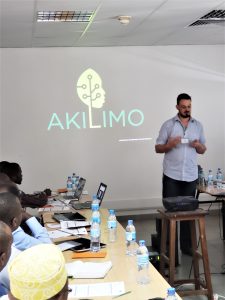
ACAI project leader Pieter Pypers introducing the Akilimo tool to project partners in Tanzania.
Prediction Engine diagram showing the process of generating recommendations in the Akilimo Cassava agronomy advice tool back end.
Contribué par
Histoires récentes
Aucun article trouvé