
Another PhD for the Breeding Better Banana project as Michael Batte successfully defends his thesis
juin 14, 2019
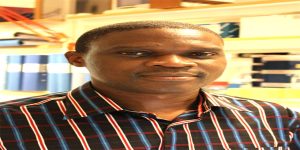 Michael Batte successfully defended his PhD thesis titled Increasing efficiency of the breeding pipeline for East African highland bananas on 4 June at the Swedish University of Agricultural Sciences (SLU) Alnarp campus. His studies were sponsored by the Améliorer la culture de la banane project that is led by IITA as part of its capacity building program. This brings the number of completed PhD studies under the project to three.
The project seeks to strengthen banana breeding programs in Uganda and Tanzania and speed up the development of high-yielding and disease-resistant hybrid varieties of the East Africa Highland banana (EAHB). Its focus is on the two most popular cooking banana in the two countries—‘Matooke’ and ‘Mchare’ for Uganda and Tanzania, respectively.
Dr Batte works with IITA in Uganda and his main supervisor was Professor Rodomiro Ortiz from SLU, co-supervised by Dr Helena Persson Hovmalm and Dr Mulatu Geleta, also from SLU. At IITA, his co-supervisors were Rony Swennen, Brigitte Uwimana, et Allan Brown.
In his study, Batte looked at innovations to tackle the technical challenges of breeding banana that stem the crop’s low fertility, low seed germination, long selection cycle period, and large space requirement for field evaluation.
He also looked at innovations to improve the efficiency of banana breeding programs to quickly deliver to farmers improved banana, which are high yielding and resistant to production constraints to boost their livelihoods. He analyzed the practices that were used for the first 21 years of the banana breeding program of IITA in Uganda.
He focused on five approaches to tackle this challenge:
Michael Batte successfully defended his PhD thesis titled Increasing efficiency of the breeding pipeline for East African highland bananas on 4 June at the Swedish University of Agricultural Sciences (SLU) Alnarp campus. His studies were sponsored by the Améliorer la culture de la banane project that is led by IITA as part of its capacity building program. This brings the number of completed PhD studies under the project to three.
The project seeks to strengthen banana breeding programs in Uganda and Tanzania and speed up the development of high-yielding and disease-resistant hybrid varieties of the East Africa Highland banana (EAHB). Its focus is on the two most popular cooking banana in the two countries—‘Matooke’ and ‘Mchare’ for Uganda and Tanzania, respectively.
Dr Batte works with IITA in Uganda and his main supervisor was Professor Rodomiro Ortiz from SLU, co-supervised by Dr Helena Persson Hovmalm and Dr Mulatu Geleta, also from SLU. At IITA, his co-supervisors were Rony Swennen, Brigitte Uwimana, et Allan Brown.
In his study, Batte looked at innovations to tackle the technical challenges of breeding banana that stem the crop’s low fertility, low seed germination, long selection cycle period, and large space requirement for field evaluation.
He also looked at innovations to improve the efficiency of banana breeding programs to quickly deliver to farmers improved banana, which are high yielding and resistant to production constraints to boost their livelihoods. He analyzed the practices that were used for the first 21 years of the banana breeding program of IITA in Uganda.
He focused on five approaches to tackle this challenge:
- An assessment of the available minimum descriptor list for suitability to characterize the EAHB germplasm.
- Analysis of crossbreeding data of EAHB for the first 21 years (from 1995 to 2015) at IITA as a basis for designing future interventions.
- Path analysis to determine a breeding ideotype for EAHB.
- Estimation of heterobeltiosis (hybrid vigor) for the NARITA hybrids (mostly secondary triploids ensuing from the 4x × 2x).
- Phenotyping a diploid banana population for resistance to the nematode Radopholus similis.
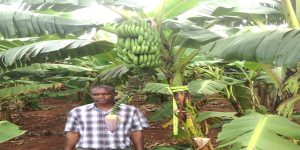
Michael Batte in a banana field..
Contribué par
Histoires récentes
Aucun article trouvé