
NOUVELLES DE L'IITA

Decade-long trials prove efficacy of Nigeria’s aflatoxin biocontrol product
novembre 29, 2019

An IITA-led partnership has honed aflatoxin biocontrol for sub-Saharan Africa (SSA) for over 15 years. Recently, the team published a landmark journal article reporting a 10-year study on the efficacy of Aflasafe®, a registered biocontrol product for aflatoxin management in Nigeria. This is the longest-running, most extensive study on efficacy of any biocontrol product or management practice for aflatoxin alleviation. The study firmly establishes Aflasafe® as a vital tool in the fight against aflatoxins.
Decade-long trials prove efficacy of Nigeria’s aflatoxin biocontrol product
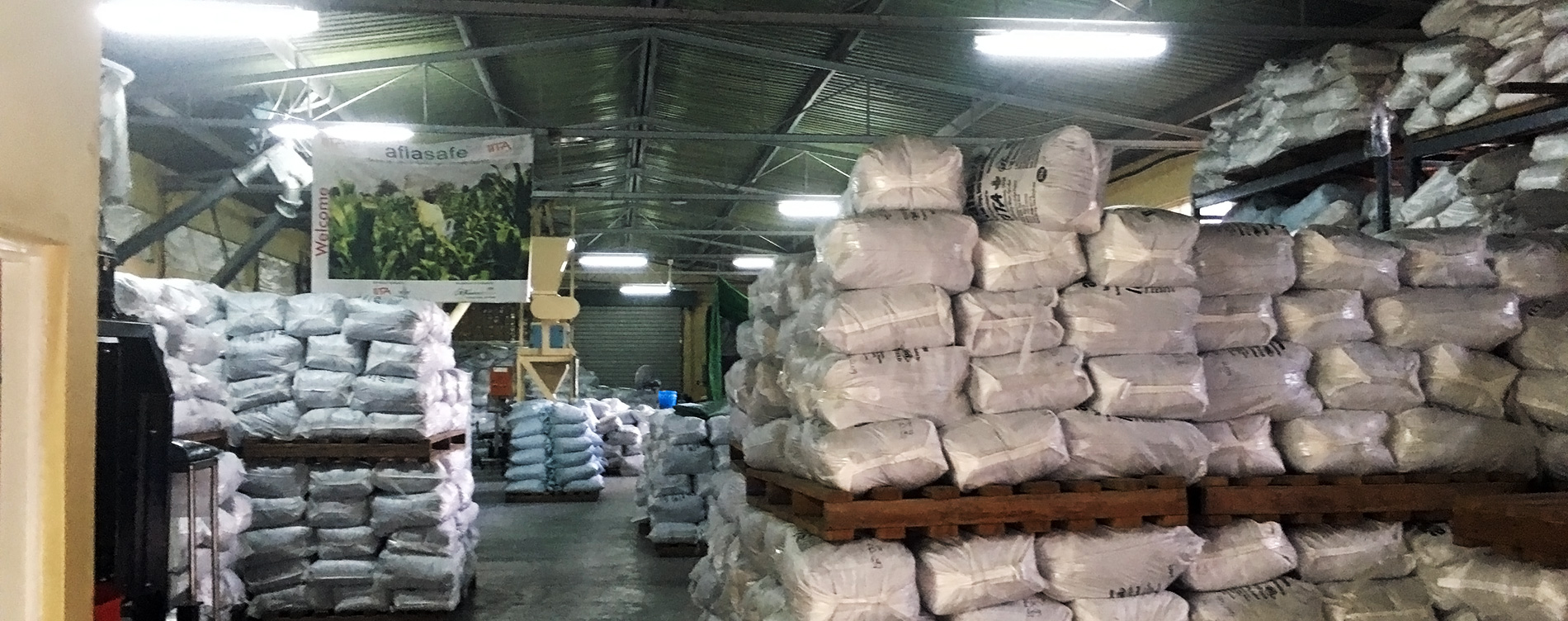
Aflasafe in the factory

Aflatoxin contamination of crops in SSA, especially maize and groundnut, is common. It has a profound negative impact on Sustainable Development Goals (SDGs) related to personal, social, economic, and national development opportunities.

People become exposed to aflatoxins through food, with devastating effects. Children have reduced growth and a weakened immune system. Adults develop liver diseases and cancer. Animal productivity is curtailed. People and animals die if food/feed aflatoxin content is high. Income and trade sectors suffer too because farmers cannot sell crops contaminated above tolerance thresholds in premium markets. Aflatoxin contamination of crops in SSA, especially maize and groundnut, is common.

The aflatoxin biocontrol technology employs a deceptively simple natural principle: Raising the proportion of Aspergillus flavus strains incapable of producing aflatoxins (called atoxigenic) in a field lowers aflatoxin accumulation in crops produced there. This biocontrol technology increases the frequency of native atoxigenic strains in the field before the aflatoxin-producers become established. This creates an aflatoxin-safe environment.
Decade-long trials prove efficacy of Nigeria’s aflatoxin biocontrol product
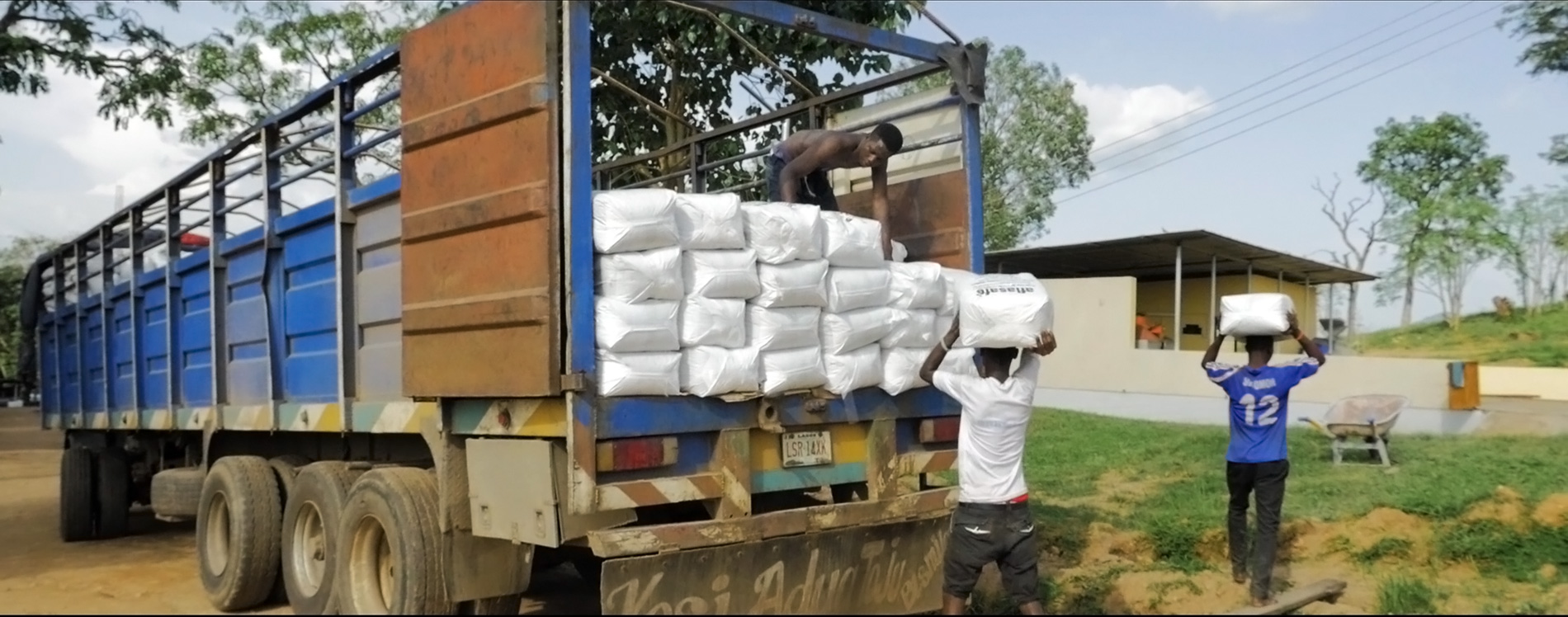
Offloading Aflasafe

The biocontrol technology development process began with IITA scientists, together with United States Department of Agriculture – Agriculture Research Service and national partners collecting more than 4,000 A. flavus strains from crops and soil in Nigeria in 2003. Through a well-designed but laborious selection process, four safe, competitive, et widely distributed atoxigenic strains native to Nigeria were selected. These four strains serve as active ingredients of Aflasafe®, the first registered natural aflatoxin biocontrol product for Africa and third globally. So far, 12 Aflasafe products have been developed and registered for use in 9 African nations. Each contains four atoxigenic A. flavus active ingredients native to the target nation.

These active ingredients are coated on roasted, sterile sorghum, which is spread in fields while crops are developing. When conditions are favorable, the active ingredients grow on the sorghum and spread across the crop to outcompete aflatoxin producers that would otherwise dominate the field. This results in less aflatoxin-producers which are displaced by the safe atoxigenic active ingredients. Treated fields contain significantly less aflatoxins—sometimes 100% less than nontreated crops.

Biocontrol products can be commercialized only after the product is registered by regulatory authorities following mandatory extensive efficacy testing, safety evaluations, and demonstrated value in food/feed systems, and substantial interactions with regulators. Commercialization requires development of processes and infrastructure to produce the biocontrol product, development of tailored commercialization strategies, and technology transfer to appropriate manufacturing and distribution partners. The emphasis on registration and scaling-up biocontrol to improve food safety, increase income, and enhance trade has resulted in delayed publication of results of efficacy trials in peer-reviewed scientific journals. Lack of efficacy data in the public domain has caused ambiguous and sometimes negative perceptions about effectiveness, adoption, and sustainability of biocontrol in African contexts.

Publications of efficacy trials and large-scale biocontrol adoption are now emerging after building a solid base for large-scale biocontrol usage in several nations. In October 2019, scientists from the Aflasafe initiative published the longest-term study of any aflatoxin biocontrol product across the globe. The team reported on an extensive 10-year study that combined results of efficacy trials required for registration (2 years) with data from both large-scale trials to demonstrate product value (2 years), and commercial use by thousands of maize farmers (6 years). The data from commercial usage came from aflatoxin analyses on >213,000 tons of maize harvested in 15 states in Nigeria by over 90,000 farmers who applied Aflasafe to their crops!

Nearly 95% of over 7,000 grain samples, each representing 30-ton grain lots, from treated fields had <10 ppb of aflatoxins. “It was a massive effort to collect samples from thousands of places and  transport them to the lab, perform rapid aflatoxin analysis and microbiological/molecular tests, and report the results in a timely manner,” says Adebowale Akande, Manager of the AgResults Nigeria Aflasafe™ Challenge Project.

According to Ranajit Bandyopadhyay, the lead author of the Nigeria study, “The results show that biocontrol is a stable, effective aflatoxin management tool for crops grown by smallholder farmers. In addition, the study provides evidence of large-scale adoption of the biocontrol product in Nigeria.” The papers reporting efficacy of biocontrol in West Africa put to rest all doubts on efficacy, usefulness, and adoption of aflatoxin biocontrol for SSA nations.

“Very few peer-reviewed published studies have monitored efficacy of biocontrol products against plant diseases on a continuous basis over a long-time horizon. These classical studies were primarily in crown gall et tree disease settings. The Nigeria aflatoxin biocontrol study can be counted among them and, to the best of my knowledge, is the most extensive among field crops,” says Jürgen Kohl, a world renowned biocontrol specialist from the Wageningen University & Research, The Netherlands.

In addition to the 10-year Nigeria study, other recent publications on efficacy of biocontrol products include those on groundnut and maize in Senegal, chili pepper in Nigeria, et maize and groundnut in Ghana. These Open Access peer-reviewed journal articles show the efficacy of biocontrol in multiple environments, during multiple years, in diverse cropping systems, under a variety of challenges that smallholder farmers face in SSA. More studies will soon be published reporting biocontrol efficacy in Ghana, Burkina Faso, The Gambia, Mozambique, Malawi, Zambia, Kenya, Tanzania, among other countries (Mali, Rwanda) where Aflasafe products are being tested.

The large-scale use of biocontrol as a centerpiece of holistic aflatoxin management programs has the potential to significantly reduce hunger, malnutrition, poverty, unrest, and economic underdevelopment. These major impacts can help meet several targets of many SDGs.


Contribué par

Nouvelles connexes

Aucun article trouvé

Laisser un commentaire

Votre adresse e-mail ne sera pas publiée. Les champs obligatoires sont indiqués avec *

Retour en haut
Olaosebikan, Olamide

Olamide Deborah Nwanze est une chercheuse principale spécialisée dans la recherche sur l'approche "genre" afin d'éclairer les politiques de sélection participative et inclusive, de développement de variétés et de systèmes semenciers concernant les cultures de racines, tubercules et bananes (RTB) au siège de l'Institut International d'Agriculture Tropicale, à Ibadan, au Nigeria. Elle est candidate au doctorat à l'Université d'Ibadan et titulaire d'un master et d'un diplôme d'ingénieur agronome en vulgarisation agricole et développement rural. Olamide est membre du programme African Women in Agricultural Research and Development – Gender Responsive Agricultural Systems Policy (SAISIE DE RÉCOMPENSEet les Chercheuses Sensibles au Genre Équipées pour la Transformation Agricole (SUPER. Elle cherche à appliquer ses apprentissages en matière d’approche genre, recherche sensible au genre, et expertise en développement et examen de politiques pour faciliter l’accès et l’adoption par les femmes, les jeunes, les enfants et les groupes sociaux vulnérables aux innovations agricoles qui garantissent la sécurité alimentaire, nutritionnelle, des revenus et des moyens de subsistance en Afrique. Ses rôles actuels comprennent le mentorat de chercheurs stagiaires, le développement de guides et manuels de formation, la mise en œuvre et l'adaptation de cadres et d'outils genre, l'engagement des acteurs de la chaîne de valeur en tant que partenaires de la science citoyenne, l'examen et la refonte des politiques, la gestion et l'analyse des données. Ses recherches actuelles portent sur les méthodes mixtes ainsi que sur les approches participatives et interdisciplinaires pour saisir et mettre en évidence les dynamiques de genre, les besoins, les préférences et les défis rencontrés par les parties prenantes au sein de la chaîne de valeur des moyens de subsistance agricoles afin de prioriser des stratégies axées sur le genre dans les programmes de sélection, la conception et la mise en œuvre des politiques.

À l'IITA, elle contribue à la mise en œuvre du CGIAR Initiative d'Élevage Accéléré et Innovation génétique Programmes ; recherche participative et genre au sein des Prochaine Génération ManiocHarvestPlusRTBAliments, et Tricot-ClimMob 1000Fermes Projets ; et la communication des connaissances sur le genre via le Série de webinaires G-LENS, vidéo documentaire, notes de politiquepublications, et blogs.


Publications récentes

de Sousa, K., van Etten, J., Manners, R. Bello, A., Teeken, B., Olaosebikan, O., et al. 2024. L'approche tricot : un cadre agile pour les essais décentralisés à la ferme soutenus par la science citoyenne. Une rétrospective. Agron. Sustain. Dev. 44, 8. https://doi.org/10.1007/s13593-023-00937-1

Madu, T., Onwuka, S., Nwafor, S., Onyemauwa, N., Ejechi, M., Ofoeze, M., Ukeje, B., Eluagu, C., Olaosebikan, O., Okoye, B., 2024. Les études sur les consommateurs inclusifs en matière de genre améliorent l'amélioration du manioc au Nigeria dans : Frontiers in Sociology, volume 9, numéro : 1224504, doi : 10.3389/fsoc.2024.1224504

Olaosebikan, O. ; Bello, A. ; Utoblo, O. ; Okoye, B. ; Olutegbe, N. ; Garner, E. ; Teeken, B. ; Bryan, E. ; Forsythe, L. ; Cole, S. ; Madu, T. 2023. Facteurs de stress et résilience au sein de la chaîne de valeur du manioc au Nigeria : Caractéristiques préférées des variétés de manioc et stratégies de réponse des hommes et des femmes pour informer l'amélioration variétale. Sustainability 15, 7837. https://doi.org/10.3390/su15107837

Okoye, B., Ofoeze, M., Ejechi, M., Onwuka, S., Nwafor, S., Onyemauwa, N., Ukeje, B., Eluagu, C., Obidiegwu, J.*, Olaosebikan, O., Madu, T.* 2023. Priorisation des traits préférés dans la chaîne de valeur de l'igname au Nigeria : une analyse de la situation en matière de genre in: Frontiers in Sociology, volume 8, numéro : 1232626, pages 1 – 9, ISSN 2297-7775, 2023. https://www.frontiersin.org/articles/10.3389/fsoc.2023.1232626/full

Olaosebikan, O., Bello, A. A., de Sousa, K., Ndjouenkeu, R., Adesokan, M., Alamu, E. O., Agbona, A., van Etten, J., Kegah, F. N.*, Dufour, D., Bouniol, A., Teeken, B. 2023. Acceptabilité par les consommateurs des produits alimentaires à base de gari-eba de manioc dans des contextes culturels et environnementaux variés en utilisant l'approche triade de comparaison des technologies (tricot) dans : Journal of the Science of Food and Agriculture,

Teeken, B., Olaosebikan, O., Bello, A. A., Madu, T.*, Cole, S. M. 2023. Évaluation qualitative de la positionnalité et des préférences des dyades en relation avec les activités liées au manioc : travailler avec des scientifiques citoyens du procès tricot https://hdl.handle.net/10568/138326 Type : Manuel

Bouniol, A., Ceballos, H., Bello, A. A., Teeken, B., Olaosebikan, O., Owoade, D., Agbona, A., Fotso Kuate, A., Madu, T.*, Okoye, B.*, Ofoeze, M.*, Nwafor, S.*, Onyemauwa, N.*, Adinsi, L.*, Forsythe, L., Dufour, D. 2023. Impact variétal sur le travail des femmes, la charge de travail et la pénibilité associée dans le traitement des plantes à racines, tubercules et bananes : focus sur le manioc en Afrique subsaharienne dans : Journal of the Science of Food and Agriculture, pages 1 – 25, ISSN 0022-5142,

Bello, A. A., Agbona, A., Olaosebikan, O., Edughaen, G., Dufour, D., Bouniol, A., Iluebbey, P., Ndjouenkeu, R.*, Rabbi, I. Y., Teeken, B. 2023. Effets génétiques et environnementaux sur la productivité de la transformation et le rendement des produits alimentaires : la pénibilité du travail des femmes dans : Journal of the Science of Food and Agriculture, pages 1 – 32, ISSN 0022-5142, 5

Cavicchioli, M., Zimbiti, T., Teeken, B., Nwanze, D.O., Liani, M., Parkes, E. & Bello, A. 2023. Rapport sur la formation en sélection génétique sensible au genre à l'IITA. Genetic Resources Center, IITA-HQ, Ibadan, 21-23 septembre 2022. Ibadan, Nigéria : IITA, (34 p.).https://hdl.handle.net/10568/131368

Agbona, A. Peteti P., Teeken B., Olaosebikan O. Bello, A. A., Parkes, E., Rabbi, I. Y., Mueller, L., Egesi, C., Kulakow, P. 2022. Gestion des données dans les programmes d'amélioration des cultures RTB africaines multidisciplinaires. In : Williamson, H.F., Leonelli, S. (eds) Towards Responsible Plant Data Linkage: Data Challenges for Agricultural Research and Development. Springer, Cham. https://doi.org/10.1007/978-3-031-13276-6_5

Lora Forsythe, Pricilla Marimo, Sarah Mayanja, Olamide D. Olaosebikan, Esme Stuart, Bela Teeken, Benjamin Okoye, Tessy Madu, (2021). Analyse transversale du genre dans RTBfoods Étape 2 Cartographie des genres sur les produits RTB. Comprendre les moteurs des préférences en matière de traits et le développement de profils de produits RTB multi-utilisateurs, WP1. Londres, Royaume-Uni : Rapport scientifique de terrain RTBfoods, 30 p.

Teeken, B., Garner, E., Agbona, A., Balogun, I., Olaosebikan, O., Bello, A., Madu, T., Okoye, B., Egesi, C., Kulakow, P. et Tufan, H.A. 2021. Au-delà des “ traits des femmes ” : explorer comment le genre, les différences sociales et les caractéristiques des ménages influencent les préférences pour les traits. Frontiers Systèmes alimentaires durables 5:740926. https://doi.org/10.3389/fsufs.2021.740926

Teeken, B., Agbona, A., Bello, A., Olaosebikan, O., Alamu, E., Adesokan, M., Awoyale, W., Madu, T., Okoye, B., Chijioke, U., Owoade, D., Okoro, M., Bouniol, A., Dufour, D., Hershey, C., Rabbi, I., Maziya‐Dixon, B., Egesi, C., Tufan, H. et Kulakow, P. (020. Comprendre les préférences variétales du manioc par le classement par paires du gari-eba et du fufu préparés par des agriculteurs-transformateurs locaux. Int J Food Sci Technol. https://doi.org/10.1111/ijfs.14862

Bela Teeken, Olamide Olaosebikan, Ireti Balogun, Benjamin Okoye, Tessy Madu, Steven Cole, Abolore Bello, Elizabeth Parkes. (2020). Pilotage des outils de profil client et produit G+ pour l'amélioration sensible au genre du manioc au Nigeria. Nigeria : Institut international d'agriculture tropicale (IIAT). https://hdl.handle.net/20.500.11766/13000