
One CGIAR—the newly restructured consortium—held its first Informational and Consultative Meeting on 9 September in Bukavu, the capital of the South-Kivu province of the Democratic Republic of the Congo (DR Congo).
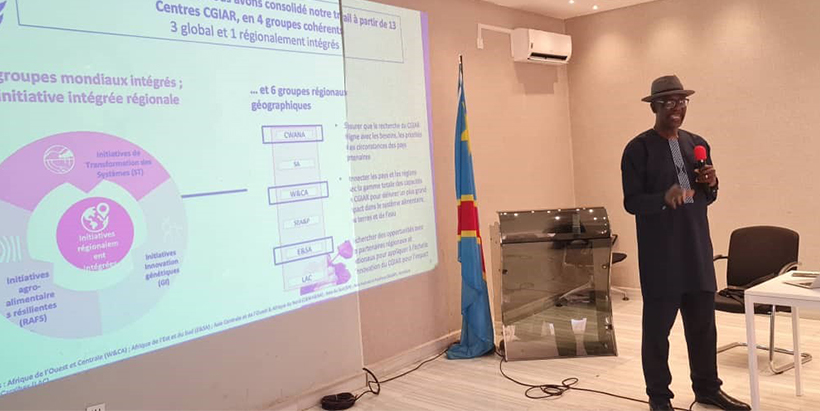
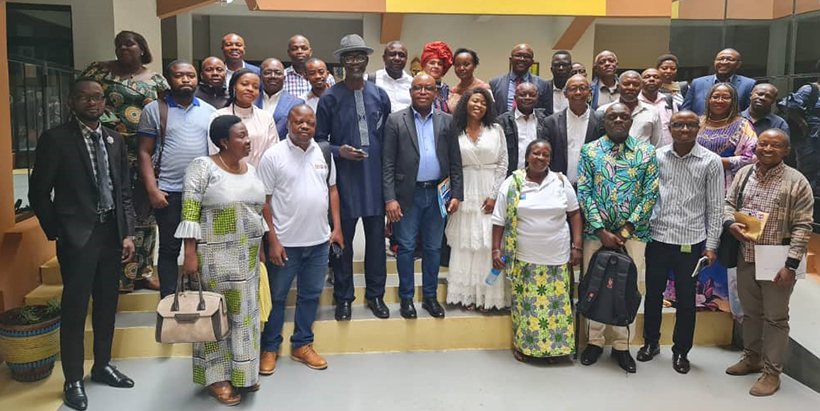
Hosted and led by One CGIAR’s centers operating in DR Congo—IITA and the International Center for Tropical Agriculture and Bioversity International Alliance (CIAT-Bioversity Alliance)—the one-day session brought together the diverse partners and stakeholders in the agropastoral sector at its various value chain levels. Besides representatives of civil society bodies, academic institutions, and developmental, entrepreneurial, and associative structures attending the meeting, guests also included officials from the provincial government of the South-Kivu led by the Chief of Staff of the Provincial Minister of Agriculture, Fishing and Livestock.
The session briefed and enlightened attendees on the rationale, implications, and prospects of the transition to One CGIAR, touching on the process of change, the structuring of the revamped consortium’s initiatives, and the planned modus operandi at the global, regional, and country levels. It was also about building and strengthening interactions and relationships with officials, government-led bodies, and local partners committed to ensuring that agriculture leads to food and nutrition security in DR Congo.
The moderator of the day, Dr David Bugeme, recalled that the One CGIAR transition consists of a dynamic re-framing of CGIAR’s partnerships, knowledge, assets, and global presence, aimed at greater integration and impact in the face of the interrelated challenges facing the world today.
Representing the One CGIAR’s Regional Director for West and Central Africa (WCAR), Dr Nteranya Sanginga, Dr Kwesi Atta-Krah highlighted a vital aspect of the “reshaped” consortium. “CGIAR’s centers are coming together under a single organizational structure to enable better resource management and allocation, more cohesive research undertakings, and closer interactions among partnering structures,” he stated. He added that this would maximize the adoption of ensuing outcomes and development-oriented resolutions for optimum economic growth, among other goals.
Furthering Atta-Krah’s clarification, One CGIAR’s Country Convener (Focal Point) for DR Congo, Liliane Togogo, noted that part of the innovative geo-administrative pattern of One CGIAR includes ʺscrutinizing specific issues, thinking through possible solutions, planning and implementing appropriate action/interventions in the frame of ‘Initiatives’.ʺ
“For DR Congo, the said Initiatives will be spearheaded in various locations by two of the thirteen One CGIAR centers established in the country to date, that is, IITA and the newly formed CIAT-Bioversity Alliance,” she said. In DR Congo, the three selected Initiatives would relate to 1) Excellence in agronomy for sustainable intensification and adaptation to climate change, 2) Plant health and rapid response to ensure food security and improved livelihoods, and 3) Transforming agro-food systems in West and Central Africa.
Responding to questions from participants, a panel comprising Atta-Krah, Dr Antoine Lubobo (representing CIAT-Bioversity Alliance), Bugeme, and Togogo, reiterated that the revisited perspective of One CGIAR is to ensure the focus and actions of staff and partners match the specific challenges to revolutionize engagement-related practice and decision-making processes for more sustainable development.
Atta-Krah commended the DRC Government’s commitment through its Ministry of Agriculture, observing that the move has great potential to help the country attract and host more centers and programs soon.
Enlightened on the proposed functioning, features, partnership approach, and research directions of the One CGIAR, participants expressed the wish to have further interactive opportunities to allow for the harmonization of actions to be carried out by the various stakeholders. These would also bring all key stakeholders to gather and analyze identified challenges, set the prerequisites, and design all-inclusive strategies for optimal results.
The official launch of One CGIAR in DR Congo will take place soon in Kinshasa after holding the much-desired sessions—as suggested by the participants—to bridge differences and agree on the way forward.
Contributed by Isabelle Buhoro and Gabriel Dunia
Contribué par
Histoires récentes