EU delegation visits DeSIRA project field experiments in Malawi
avril 6, 2023
The EU-DeSIRA Malawi team comprising Program Manager Marco Vacirca and Finance Manager Chapresto Cortes Maria visited on-farm trials at Mulanje and Salima and on-station at Chitala Research Station from 6 to 9 March. The CGIAR centers showcasing their trials were IITA, CIMMYT, CIP, CIAT, ICRISAT, IFPRI, WorldFish, and ICRAF.
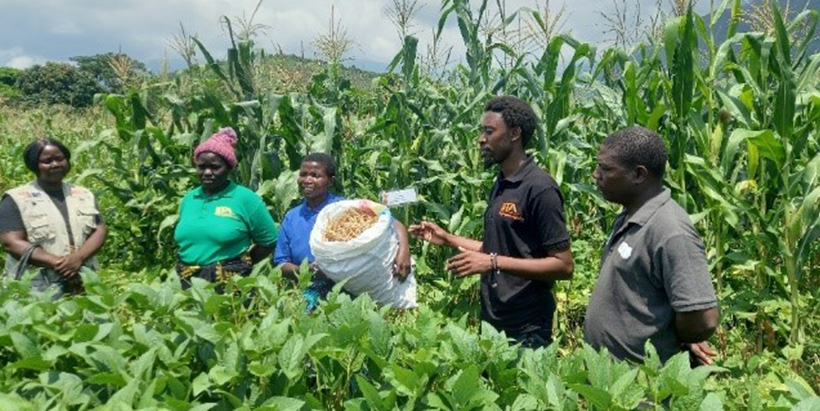
Farmers—Margret Khotani (in green t-shirt), Jenesi Mukhitho (in blue t-shirt)—of Thuchira EPA in Mulanje and IITA Research Technician Peter Kadwala (in black t-shirt) explaining the benefits of IITA’s maize-cowpea intercropping to the EU delegation.
DeSIRA (Climate-smart innovations to improve productivity, profitability, and sustainability of agriculture and food systems in Malawi through multidisciplinary research) is a five-year European Union-funded research project that seeks to address challenges in the smallholder agri-food system in Malawi by developing climate-smart integrated technological options adapted to local conditions and the farmers’ realities. The goal of the project is to improve productivity, profitability, and sustainability of agriculture and food systems in Malawi through three key objectives:
Develop climate-resilient integrated technological innovations to address the complex and diverse challenges affecting the agricultural and food systems in Malawi.
Enhance understanding of the opportunities and constraints for the uptake of integrated technology options by farmers.
Inform policymakers and scaling partners about the potential of integrated technological options to contribute to climate resilience and sustainability, and the enabling environment required for adoption.
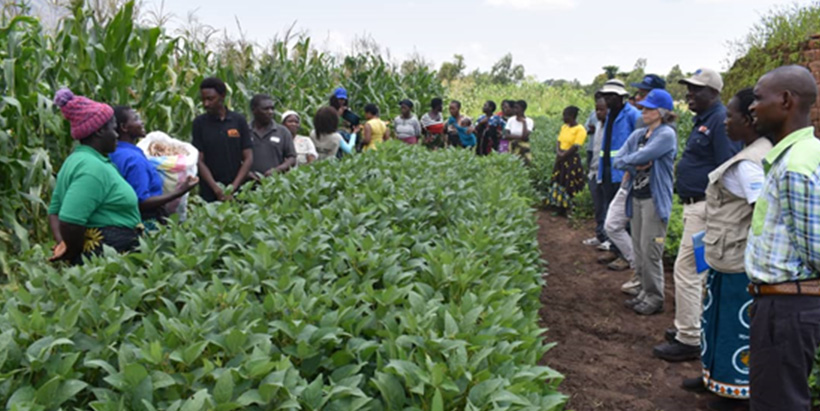
The EU delegation and DeSIRA team listening to the farmers’ standing in front of the maize-cowpea trial.
Eight CGIAR centers—Alliance Bioversity-CIAT, CIMMYT, CIP, ICRAF, ICRISAT, IFPRI, IITA, and WFC—and a European partner—University of Liege—are implementing the action, working closely with the Department of Agricultural Research Services (DARS). The activities of the CGIAR centers and the EU partners are being coordinated by The International Potato Center (CIP), which is leading the consortium.
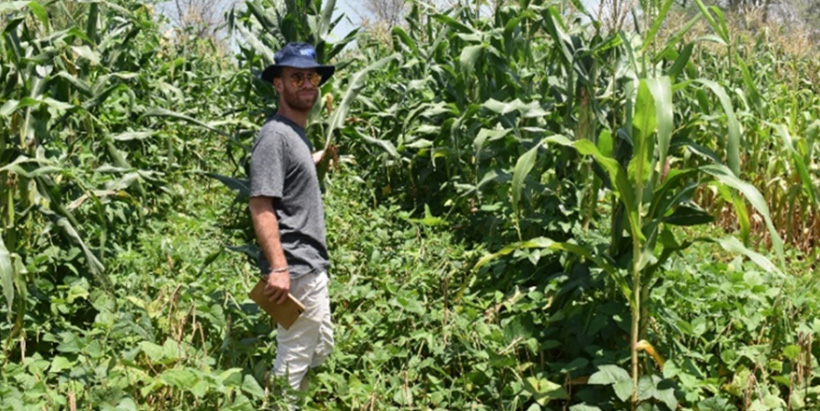
The EU DeSIRA Program Manager in Malawi, Marco Vacirca, on one of the on-farm trials in Salima at Levson Chulu’s farm.
The IITA-Malawi DeSIRA team presented two trials on integrated soil fertility management solutions in maize-cowpea and cassava-cowpea intercropping arrangements. These technologies are in the advanced stage of being released to the Malawi smallholder farmers. They have undergone two seasons of on-station and one season of mother-baby on-farm trial evaluations. Currently, on-farm baby trials are being implemented in seven districts of Malawi, representing various agro-ecological zones. The study also involves farmer participatory evaluation and economic evaluation of the technologies.
During the EU delegation visits, farmers interacted with the team. A smallholder farmer in Mulanje, Rose Maluwa of Thuchira Extension Planning Area (EPA), when asked which of the cassava-cowpea technologies she would prefer and why, said: “The 1:1 and 2:2 arrangement of cassava-cowpea with 60 kg N/ha applied to cassava and 30 kg N/ha applied to cowpea were the best. This is because the biomass from cowpea is robust and would later drop off, thus forming manure and adding nutrients to the soil; this type of vegetative growth also offers soil cover and smothers weeds. In addition, the green larges leaves from cassava and cowpea are vegetables.”
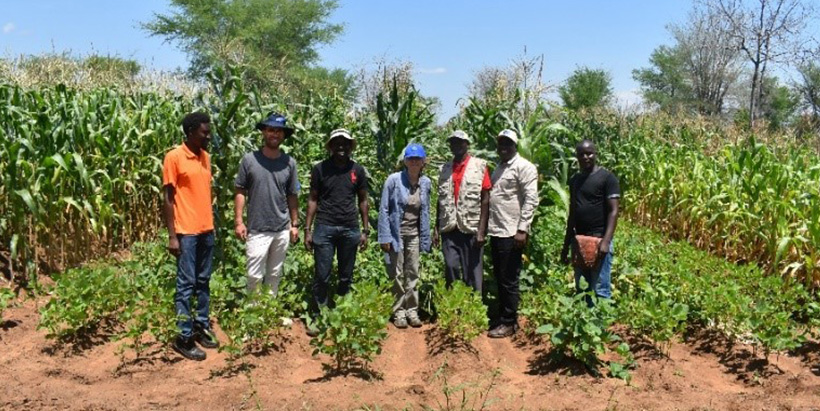
The farmer, Levson Chulu (in a red t-shirt and brown jacket), the EU delegation, and some of the DeSIRA team members.
At Salima, a smallholder farmer, Levson Chulu of Chinguluwe EPA, noted: “Cowpea is a legume that supplements our diet and gives us proteins. It also reduces the Striga population: look at the sole cropping maize without fertilizer application versus the maize-cowpea receiving 200 kg N/ha for maize and 30 kg N/ha for cowpea; the Striga population in the sole maize crop is more, yet the intercropping has none.”
During the visit, the EU-Malawi delegation commended CGIAR centers, emphasizing the need for some of the technologies to be released by the Malawi Agricultural Technology Clearing Committee (ATCC) before the project winds up in 2024. The IITA-Malawi team is on course to finalize the requirements of the Malawi government to release a technology—the second season of on-farm trials. IITA is also tasked with conducting farmer participatory evaluation of all the DeSIRA-Malawi trials and economic evaluations of all the technologies from all the participating CGIAR centers (IITA, CIMMYT, CIP, CIAT, ICRISAT, IFPRI, WorldFish and ICRAF).
Contributed by John Okoth Omondi
Olamide Deborah Nwanze est une chercheuse principale spécialisée dans la recherche sur l'approche "genre" afin d'éclairer les politiques de sélection participative et inclusive, de développement de variétés et de systèmes semenciers concernant les cultures de racines, tubercules et bananes (RTB) au siège de l'Institut International d'Agriculture Tropicale, à Ibadan, au Nigeria. Elle est candidate au doctorat à l'Université d'Ibadan et titulaire d'un master et d'un diplôme d'ingénieur agronome en vulgarisation agricole et développement rural. Olamide est membre du programme African Women in Agricultural Research and Development – Gender Responsive Agricultural Systems Policy (SAISIE DE RÉCOMPENSEet les Chercheuses Sensibles au Genre Équipées pour la Transformation Agricole (SUPER. Elle cherche à appliquer ses apprentissages en matière d’approche genre, recherche sensible au genre, et expertise en développement et examen de politiques pour faciliter l’accès et l’adoption par les femmes, les jeunes, les enfants et les groupes sociaux vulnérables aux innovations agricoles qui garantissent la sécurité alimentaire, nutritionnelle, des revenus et des moyens de subsistance en Afrique. Ses rôles actuels comprennent le mentorat de chercheurs stagiaires, le développement de guides et manuels de formation, la mise en œuvre et l'adaptation de cadres et d'outils genre, l'engagement des acteurs de la chaîne de valeur en tant que partenaires de la science citoyenne, l'examen et la refonte des politiques, la gestion et l'analyse des données. Ses recherches actuelles portent sur les méthodes mixtes ainsi que sur les approches participatives et interdisciplinaires pour saisir et mettre en évidence les dynamiques de genre, les besoins, les préférences et les défis rencontrés par les parties prenantes au sein de la chaîne de valeur des moyens de subsistance agricoles afin de prioriser des stratégies axées sur le genre dans les programmes de sélection, la conception et la mise en œuvre des politiques.
de Sousa, K., van Etten, J., Manners, R. Bello, A., Teeken, B., Olaosebikan, O., et al. 2024. L'approche tricot : un cadre agile pour les essais décentralisés à la ferme soutenus par la science citoyenne. Une rétrospective. Agron. Sustain. Dev. 44, 8. https://doi.org/10.1007/s13593-023-00937-1
Madu, T., Onwuka, S., Nwafor, S., Onyemauwa, N., Ejechi, M., Ofoeze, M., Ukeje, B., Eluagu, C., Olaosebikan, O., Okoye, B., 2024. Les études sur les consommateurs inclusifs en matière de genre améliorent l'amélioration du manioc au Nigeria dans : Frontiers in Sociology, volume 9, numéro : 1224504, doi : 10.3389/fsoc.2024.1224504
Olaosebikan, O. ; Bello, A. ; Utoblo, O. ; Okoye, B. ; Olutegbe, N. ; Garner, E. ; Teeken, B. ; Bryan, E. ; Forsythe, L. ; Cole, S. ; Madu, T. 2023. Facteurs de stress et résilience au sein de la chaîne de valeur du manioc au Nigeria : Caractéristiques préférées des variétés de manioc et stratégies de réponse des hommes et des femmes pour informer l'amélioration variétale. Sustainability 15, 7837. https://doi.org/10.3390/su15107837
Okoye, B., Ofoeze, M., Ejechi, M., Onwuka, S., Nwafor, S., Onyemauwa, N., Ukeje, B., Eluagu, C., Obidiegwu, J.*, Olaosebikan, O., Madu, T.* 2023. Priorisation des traits préférés dans la chaîne de valeur de l'igname au Nigeria : une analyse de la situation en matière de genre in: Frontiers in Sociology, volume 8, numéro : 1232626, pages 1 – 9, ISSN 2297-7775, 2023. https://www.frontiersin.org/articles/10.3389/fsoc.2023.1232626/full
Olaosebikan, O., Bello, A. A., de Sousa, K., Ndjouenkeu, R., Adesokan, M., Alamu, E. O., Agbona, A., van Etten, J., Kegah, F. N.*, Dufour, D., Bouniol, A., Teeken, B. 2023. Acceptabilité par les consommateurs des produits alimentaires à base de gari-eba de manioc dans des contextes culturels et environnementaux variés en utilisant l'approche triade de comparaison des technologies (tricot) dans : Journal of the Science of Food and Agriculture,
Teeken, B., Olaosebikan, O., Bello, A. A., Madu, T.*, Cole, S. M. 2023. Évaluation qualitative de la positionnalité et des préférences des dyades en relation avec les activités liées au manioc : travailler avec des scientifiques citoyens du procès tricot https://hdl.handle.net/10568/138326 Type : Manuel
Bouniol, A., Ceballos, H., Bello, A. A., Teeken, B., Olaosebikan, O., Owoade, D., Agbona, A., Fotso Kuate, A., Madu, T.*, Okoye, B.*, Ofoeze, M.*, Nwafor, S.*, Onyemauwa, N.*, Adinsi, L.*, Forsythe, L., Dufour, D. 2023. Impact variétal sur le travail des femmes, la charge de travail et la pénibilité associée dans le traitement des plantes à racines, tubercules et bananes : focus sur le manioc en Afrique subsaharienne dans : Journal of the Science of Food and Agriculture, pages 1 – 25, ISSN 0022-5142,
Bello, A. A., Agbona, A., Olaosebikan, O., Edughaen, G., Dufour, D., Bouniol, A., Iluebbey, P., Ndjouenkeu, R.*, Rabbi, I. Y., Teeken, B. 2023. Effets génétiques et environnementaux sur la productivité de la transformation et le rendement des produits alimentaires : la pénibilité du travail des femmes dans : Journal of the Science of Food and Agriculture, pages 1 – 32, ISSN 0022-5142, 5
Cavicchioli, M., Zimbiti, T., Teeken, B., Nwanze, D.O., Liani, M., Parkes, E. & Bello, A. 2023. Rapport sur la formation en sélection génétique sensible au genre à l'IITA. Genetic Resources Center, IITA-HQ, Ibadan, 21-23 septembre 2022. Ibadan, Nigéria : IITA, (34 p.).https://hdl.handle.net/10568/131368
Agbona, A. Peteti P., Teeken B., Olaosebikan O. Bello, A. A., Parkes, E., Rabbi, I. Y., Mueller, L., Egesi, C., Kulakow, P. 2022. Gestion des données dans les programmes d'amélioration des cultures RTB africaines multidisciplinaires. In : Williamson, H.F., Leonelli, S. (eds) Towards Responsible Plant Data Linkage: Data Challenges for Agricultural Research and Development. Springer, Cham. https://doi.org/10.1007/978-3-031-13276-6_5
Lora Forsythe, Pricilla Marimo, Sarah Mayanja, Olamide D. Olaosebikan, Esme Stuart, Bela Teeken, Benjamin Okoye, Tessy Madu, (2021). Analyse transversale du genre dans RTBfoods Étape 2 Cartographie des genres sur les produits RTB. Comprendre les moteurs des préférences en matière de traits et le développement de profils de produits RTB multi-utilisateurs, WP1. Londres, Royaume-Uni : Rapport scientifique de terrain RTBfoods, 30 p.
Teeken, B., Garner, E., Agbona, A., Balogun, I., Olaosebikan, O., Bello, A., Madu, T., Okoye, B., Egesi, C., Kulakow, P. et Tufan, H.A. 2021. Au-delà des “ traits des femmes ” : explorer comment le genre, les différences sociales et les caractéristiques des ménages influencent les préférences pour les traits. Frontiers Systèmes alimentaires durables 5:740926. https://doi.org/10.3389/fsufs.2021.740926
Teeken, B., Agbona, A., Bello, A., Olaosebikan, O., Alamu, E., Adesokan, M., Awoyale, W., Madu, T., Okoye, B., Chijioke, U., Owoade, D., Okoro, M., Bouniol, A., Dufour, D., Hershey, C., Rabbi, I., Maziya‐Dixon, B., Egesi, C., Tufan, H. et Kulakow, P. (020. Comprendre les préférences variétales du manioc par le classement par paires du gari-eba et du fufu préparés par des agriculteurs-transformateurs locaux. Int J Food Sci Technol.https://doi.org/10.1111/ijfs.14862
Bela Teeken, Olamide Olaosebikan, Ireti Balogun, Benjamin Okoye, Tessy Madu, Steven Cole, Abolore Bello, Elizabeth Parkes. (2020). Pilotage des outils de profil client et produit G+ pour l'amélioration sensible au genre du manioc au Nigeria. Nigeria : Institut international d'agriculture tropicale (IIAT). https://hdl.handle.net/20.500.11766/13000