EU delegation visits DeSIRA project field experiments in Malawi
April 6, 2023
The EU-DeSIRA Malawi team comprising Program Manager Marco Vacirca and Finance Manager Chapresto Cortes Maria visited on-farm trials at Mulanje and Salima and on-station at Chitala Research Station from 6 to 9 March. The CGIAR centers showcasing their trials were IITA, CIMMYT, CIP, CIAT, ICRISAT, IFPRI, WorldFish, and ICRAF.
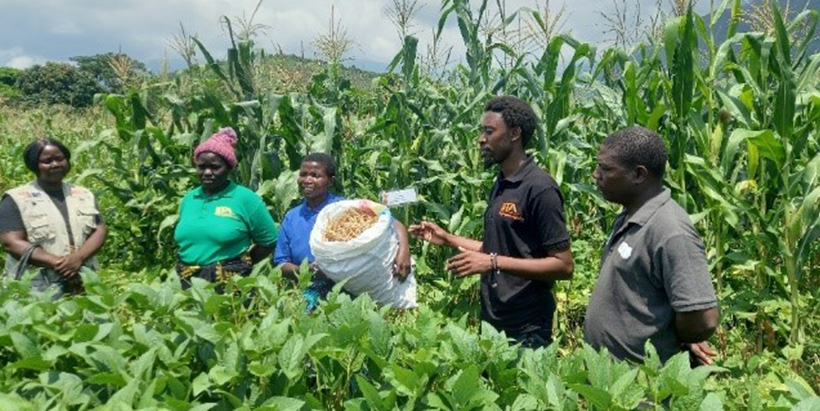
Farmers—Margret Khotani (in green t-shirt), Jenesi Mukhitho (in blue t-shirt)—of Thuchira EPA in Mulanje and IITA Research Technician Peter Kadwala (in black t-shirt) explaining the benefits of IITA’s maize-cowpea intercropping to the EU delegation.
DeSIRA (Climate-smart innovations to improve productivity, profitability, and sustainability of agriculture and food systems in Malawi through multidisciplinary research) is a five-year European Union-funded research project that seeks to address challenges in the smallholder agri-food system in Malawi by developing climate-smart integrated technological options adapted to local conditions and the farmers’ realities. The goal of the project is to improve productivity, profitability, and sustainability of agriculture and food systems in Malawi through three key objectives:
Develop climate-resilient integrated technological innovations to address the complex and diverse challenges affecting the agricultural and food systems in Malawi.
Enhance understanding of the opportunities and constraints for the uptake of integrated technology options by farmers.
Inform policymakers and scaling partners about the potential of integrated technological options to contribute to climate resilience and sustainability, and the enabling environment required for adoption.
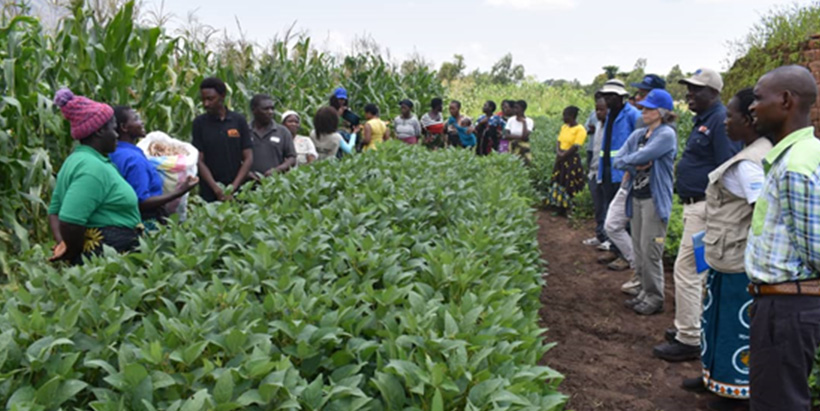
The EU delegation and DeSIRA team listening to the farmers’ standing in front of the maize-cowpea trial.
Eight CGIAR centers—Alliance Bioversity-CIAT, CIMMYT, CIP, ICRAF, ICRISAT, IFPRI, IITA, and WFC—and a European partner—University of Liege—are implementing the action, working closely with the Department of Agricultural Research Services (DARS). The activities of the CGIAR centers and the EU partners are being coordinated by The International Potato Center (CIP), which is leading the consortium.
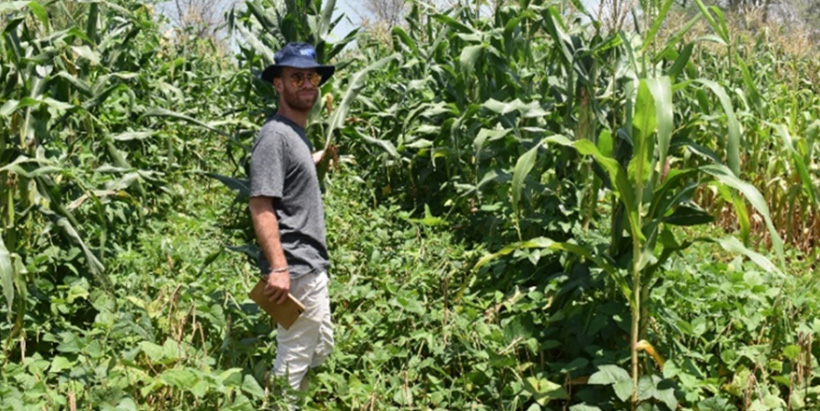
The EU DeSIRA Program Manager in Malawi, Marco Vacirca, on one of the on-farm trials in Salima at Levson Chulu’s farm.
The IITA-Malawi DeSIRA team presented two trials on integrated soil fertility management solutions in maize-cowpea and cassava-cowpea intercropping arrangements. These technologies are in the advanced stage of being released to the Malawi smallholder farmers. They have undergone two seasons of on-station and one season of mother-baby on-farm trial evaluations. Currently, on-farm baby trials are being implemented in seven districts of Malawi, representing various agro-ecological zones. The study also involves farmer participatory evaluation and economic evaluation of the technologies.
During the EU delegation visits, farmers interacted with the team. A smallholder farmer in Mulanje, Rose Maluwa of Thuchira Extension Planning Area (EPA), when asked which of the cassava-cowpea technologies she would prefer and why, said: “The 1:1 and 2:2 arrangement of cassava-cowpea with 60 kg N/ha applied to cassava and 30 kg N/ha applied to cowpea were the best. This is because the biomass from cowpea is robust and would later drop off, thus forming manure and adding nutrients to the soil; this type of vegetative growth also offers soil cover and smothers weeds. In addition, the green larges leaves from cassava and cowpea are vegetables.”
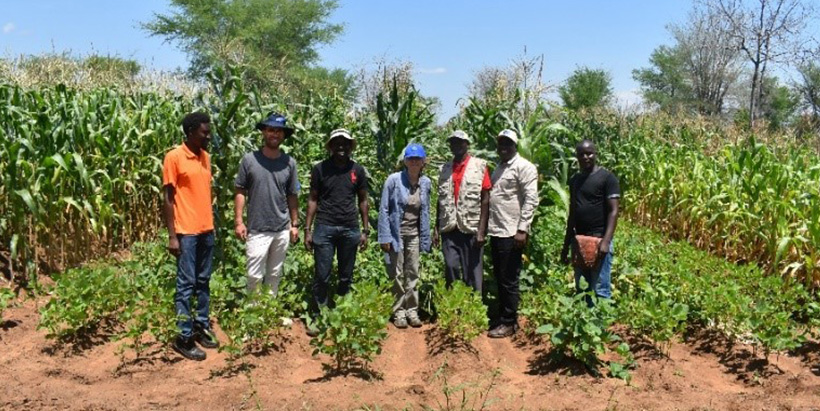
The farmer, Levson Chulu (in a red t-shirt and brown jacket), the EU delegation, and some of the DeSIRA team members.
At Salima, a smallholder farmer, Levson Chulu of Chinguluwe EPA, noted: “Cowpea is a legume that supplements our diet and gives us proteins. It also reduces the Striga population: look at the sole cropping maize without fertilizer application versus the maize-cowpea receiving 200 kg N/ha for maize and 30 kg N/ha for cowpea; the Striga population in the sole maize crop is more, yet the intercropping has none.”
During the visit, the EU-Malawi delegation commended CGIAR centers, emphasizing the need for some of the technologies to be released by the Malawi Agricultural Technology Clearing Committee (ATCC) before the project winds up in 2024. The IITA-Malawi team is on course to finalize the requirements of the Malawi government to release a technology—the second season of on-farm trials. IITA is also tasked with conducting farmer participatory evaluation of all the DeSIRA-Malawi trials and economic evaluations of all the technologies from all the participating CGIAR centers (IITA, CIMMYT, CIP, CIAT, ICRISAT, IFPRI, WorldFish and ICRAF).
Contributed by John Okoth Omondi
Olamide Deborah Nwanze is a Senior Research Associate specializing in gender mainstreaming research to inform participatory and inclusive breeding, variety development, and seed systems policies regarding root, tuber, and banana (RTB) crops in the International Institute of Tropical Agriculture Headquarters, Ibadan, Nigeria. She is a PhD candidate at the University of Ibadan and holds an MSc and B. Agric in Agricultural Extension and Rural Development. Olamide is a fellow of the African Women in Agricultural Research and Development – Gender Responsive Agricultural Systems Policy (AWARD-GRASP) and the Gender Responsive Researchers Equipped for Agricultural Transformation (GREAT). She seeks to apply her gender-mainstreaming learnings, gender-responsive research, and policy development, and review expertise to facilitate women, youth, children, and vulnerable social group’s access to and adoption of agricultural Innovations that guarantee food, nutrition, income, and livelihood security in Africa. Her current roles include mentoring research fellows, development of guides and training manuals, implementation and adaptation of gender frameworks and tools, value chain actors’ engagement as citizen science partners, policy review and redesign, data management, and analysis. Her current research explores mixed methods and participatory and interdisciplinary approaches to capture and highlight gender dynamics, needs, preferences, and challenges stakeholders face within the agricultural livelihood value chain to prioritize gender-inclusive strategies in breeding programs, policy design, and implementation.
de Sousa, K., van Etten, J., Manners, R. Bello, A., Teeken, B., Olaosebikan, O., et al. 2024. The tricot approach: an agile framework for decentralized on-farm testing supported by citizen science. A retrospective. Agron. Sustain. Dev. 44, 8. https://doi.org/10.1007/s13593-023-00937-1
Madu, T., Onwuka, S., Nwafor, S., Onyemauwa, N., Ejechi, M., Ofoeze, M., Ukeje, B., Eluagu, C., Olaosebikan, O., Okoye, B., 2024. Gender-Inclusive Consumer Studies Improve Cassava Breeding in Nigeria in: Frontiers in Sociology, volume 9, number: 1224504, doi: 10.3389/fsoc.2024.1224504
Olaosebikan, O.; Bello, A.; Utoblo, O.; Okoye, B.; Olutegbe, N.; Garner, E.; Teeken, B.; Bryan, E.; Forsythe, L.; Cole, S.; Madu, T. 2023. Stressors and Resilience within the Cassava Value Chain in Nigeria: Preferred Cassava Variety Traits and Response Strategies of Men and Women to Inform Breeding. Sustainability 15, 7837. https://doi.org/10.3390/su15107837
Okoye, B., Ofoeze, M., Ejechi, M., Onwuka, S., Nwafor, S., Onyemauwa, N., Ukeje, B., Eluagu, C., Obidiegwu, J.*, Olaosebikan, O., Madu, T.* 2023. Prioritizing preferred traits in the yam value chain in Nigeria: a gender situation analysis in: Frontiers in Sociology, volume 8, number: 1232626, pages 1 – 9, ISSN 2297-7775, 2023. https://www.frontiersin.org/articles/10.3389/fsoc.2023.1232626/full
Olaosebikan, O., Bello, A. A., de Sousa, K., Ndjouenkeu, R., Adesokan, M., Alamu, E. O., Agbona, A., van Etten, J., Kegah, F. N.*, Dufour, D., Bouniol, A., Teeken, B. 2023. Consumer acceptability of cassava gari-eba food products across cultural and environmental settings using the triadic comparison of technologies approach (tricot) in: Journal of the Science of Food and Agriculture,
Teeken, B., Olaosebikan, O., Bello, A. A., Madu, T.*, Cole, S. M. 2023. Qualitative assessment on the positionality and preferences of dyads in relation to cassava-related activities: working with tricot trial citizen scientists https://hdl.handle.net/10568/138326 Type: Manual
Bouniol, A., Ceballos, H., Bello, A. A., Teeken, B., Olaosebikan, O., Owoade, D., Agbona, A., Fotso Kuate, A., Madu, T.*, Okoye, B.*, Ofoeze, M.*, Nwafor, S.*, Onyemauwa, N.*, Adinsi, L.*, Forsythe, L., Dufour, D. 2023. Varietal impact on women’s labour, workload and related drudgery in processing root, tuber and banana crops: focus on cassava in sub-Saharan Africa in: Journal of the Science of Food and Agriculture, pages 1 – 25, ISSN 0022-5142,
Bello, A. A., Agbona, A., Olaosebikan, O., Edughaen, G., Dufour, D., Bouniol, A., Iluebbey, P., Ndjouenkeu, R.*, Rabbi, I. Y., Teeken, B. 2023. Genetic and environmental effects on processing productivity and food product yield: drudgery of women’s work in: Journal of the Science of Food and Agriculture, pages 1 – 32, ISSN 0022-5142, 5
Cavicchioli, M., Zimbiti, T., Teeken, B., Nwanze, D.O., Liani, M., Parkes, E. & Bello, A. 2023. IITA-Gender Responsive Breeding Training Report. Genetic Resources Center, IITA-HQ, Ibadan, 21-23 September, 2022. Ibadan, Nigeria: IITA, (34 p.).https://hdl.handle.net/10568/131368
Agbona, A. Peteti P., Teeken B., Olaosebikan O. Bello, A. A., Parkes, E., Rabbi, I. Y., Mueller, L., Egesi, C., Kulakow, P. 2022. Data Management in Multi-disciplinary African RTB Crop Breeding Programs. In: Williamson, H.F., Leonelli, S. (eds) Towards Responsible Plant Data Linkage: Data Challenges for Agricultural Research and Development. Springer, Cham. https://doi.org/10.1007/978-3-031-13276-6_5
Lora Forsythe, Pricilla Marimo, Sarah Mayanja, Olamide D. Olaosebikan, Esme Stuart, Bela Teeken, Benjamin Okoye, Tessy Madu, (2021). Cross-product Gender Analysis of RTBfoods Step 2 Gendered Food Mapping on RTB Products. Understanding the Drivers of Trait Preferences and the Development of Multi-user RTB Product Profiles, WP1. London, UK: RTBfoods Field Scientific Report, 30 p.
Teeken, B., Garner, E., Agbona, A., Balogun, I., Olaosebikan, O., Bello, A., Madu, T., Okoye, B., Egesi, C., Kulakow, P. and Tufan, H.A. 2021. Beyond “Women’s Traits”: Exploring How Gender, Social Difference, and Household Characteristics Influence Trait Preferences. Frontiers Sustainable Food Systems 5:740926. https://doi.org/10.3389/fsufs.2021.740926
Teeken, B., Agbona, A., Bello, A., Olaosebikan, O., Alamu, E., Adesokan, M., Awoyale, W., Madu, T., Okoye, B., Chijioke, U., Owoade, D., Okoro, M., Bouniol, A., Dufour, D., Hershey, C., Rabbi, I., Maziya‐Dixon, B., Egesi, C., Tufan, H. and Kulakow, P. (020. Understanding cassava varietal preferences through pairwise ranking of gari‐eba and fufu prepared by local farmer–processors. Int J Food Sci Technol.https://doi.org/10.1111/ijfs.14862
Bela Teeken, Olamide Olaosebikan, Ireti Balogun, Benjamin Okoye, Tessy Madu, Steven Cole, Abolore Bello, Elizabeth Parkes. (2020). Piloting the G+ customer and product profile tools for gender-responsive cassava breeding in Nigeria. Nigeria: International Institute of Tropical Agriculture (IITA). https://hdl.handle.net/20.500.11766/13000