
Le Interconnections for Making Africa Great Empowered and Sustainable (IMAGES) Initiative, in collaboration with Africa Circular Economy Research and Policy Network (ACERPiN), organized a week-long Circularity Africa Conference in May 2022 themed “Paradoxes of Natural Resources in Africa”. Members of this initiative and network, a group of sustainable development enthusiasts from all walks of life, took the opportunity to explore different sustainable approaches to minimize food waste and postharvest loss in Africa and beyond.
The President of IMAGES Initiative, Dr Olawale Olayide, said one of the group’s core interests is encouraging and developing a circular economy, where Africa’s resources are cyclically maximized, with zero tolerance for waste. The team began the conference by engaging in activities that offset carbon in the air before expending any. They did this through tree planting and rainwater harvesting at Abadina Grammar School, Ibadan, Nigeria. Other days focused on using robotics and artificial intelligence (AI) to deploy technology for sustainable agriculture, so agriculture can continue despite climate change or personnel availability challenges. They also had plenary sessions on avoiding the wastage of resources in Africa.
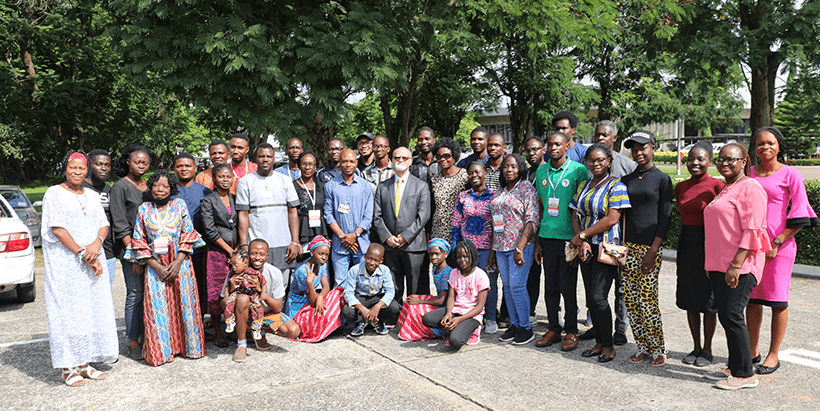
The last day of the conference brought them to IITA to relax and explore more ways to maximize Africa’s resources and avoid waste. The team was received by Kenton Dashiell, IITA’s Deputy Director General, Partnerships for Delivery, who emphasized IITA’s openness to partner with universities, private, governmental, and non-governmental organizations to develop and deliver agricultural innovations and solutions.
IITA’s Benin-based Molecular Entomologist, Rousseau Djouaka, presented the Institute’s contribution to circular agri-food systems in Africa, including converting organic wastes to organic fertilizers and biogas for cooking and power generation and producing protein for animal feeds with the Black Soldier Fly (BSF) technology. Dwelling on the BSF technology as a typical example of a circular economic system, Djouaka said, “The BSF is a fly. They lay their eggs in waste, and these grow into larvae. The larvae decompose the waste and convert it into fertilizer.” Ninety percent of the larvae are removed from the waste and processed into animal feed. The remaining substrate is used as fertilizers for plants and pressed into oil for running engines.
The team toured the IITA campus, stopping at the Lake and wastewater treatment facilities, where they learned valuable lessons on waste treatment and management in a circular economy.
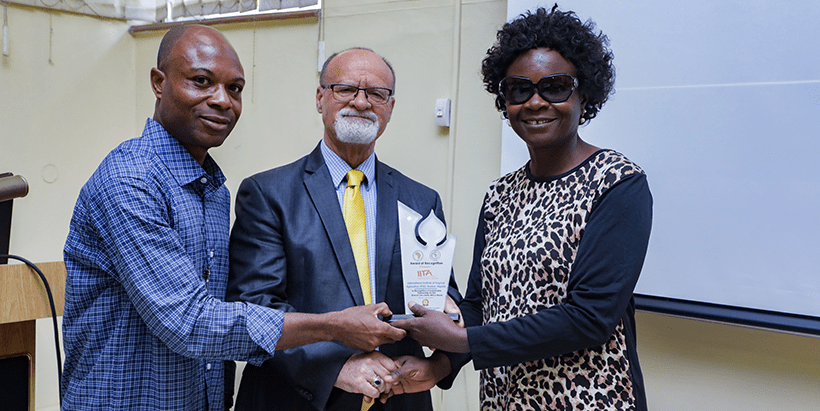
To wrap up the visit, the team presented an institutional award of excellence to IITA for its invaluable contributions to the progress of agriculture and agricultural systems in Africa. They also honored IITA Director General, Dr Nteranyan Sanginga, with a personal award for his outstanding contribution to sustainable agriculture and food systems transformation in Africa.
Proposé par Folake Oduntan
Contribué par
Histoires récentes