
NOUVELLES DE L'IITA

IITA and Kilimo Trust in the fight against post-harvest losses in Northern Uganda
mars 15, 2022

Post-harvest losses stemming from poor post-harvest handling of their crops is one of the challenges facing farmers in Lango sub-regions in districts of; Dokolo, Apac, Amolatar, Otuke, and Kwania and Teso sub-region in districts of Amuria and Kapelebyong in Northern Uganda.

Like their counterparts across sub-Saharan Africa, poor post-harvest handling is one of the main contributing factors to food insecurity, under-nutrition, and low market access due to poor quality of products in the region. The farmers lose up to 20-25% of their cassava to poor post-harvest handling. Where processing and value addition is done, it is rudimental and mostly done manually due to lack of appropriate processing technologies.

To address this challenge, as part of efforts to increase food availability, incomes and poverty reduction in Northern Uganda, the International Institute of Tropical Agriculture (IITA) and partner Kilimo Trust through the action Building Resilience to Enhance Food and Nutrition Security Income and Health in Northern Uganda (BRENU), are distributing post-harvest handling and processing equipment for major staples crops in the region to small holder farmers. BRENU is under the Development Initiative for Northern Uganda (DINU), a government of Uganda programme supported by the European Union (EU) and supervised by the Office of the Prime Minister (OPM). DINU’s goal is to consolidate stability in Northern Uganda, eradicate poverty and under-nutrition and strengthen the foundation for sustainable and inclusive socio-economic development.
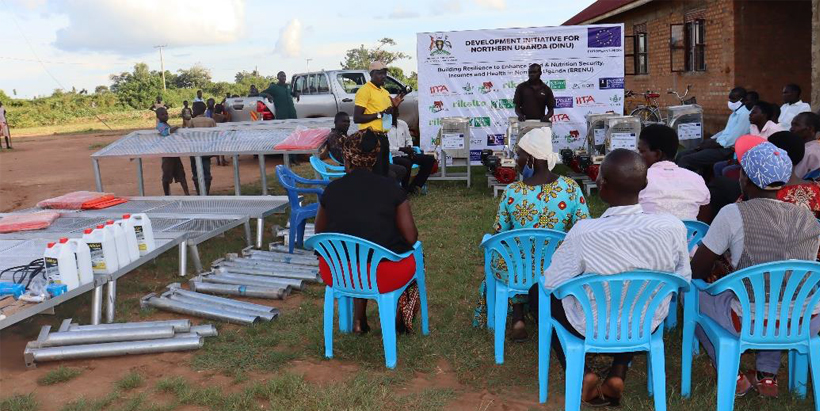
Dalson Twecan, the production specialist from IITA (In a yellow shirt) handing over the technology equipment to farmers of Awrotcek subcounty Amolatar district. Photo credit: Moureen Awori

The technologies targeting cassava, soybean and rice and valued at UGX 1,531,530,000, include 85 cassava chippers and 85 drying racks: 45 and 8 soybean and rice threshers respectively and 18 automatic grain cleaners. They are targeting especially youth groups, women groups, and cooperatives in seven districts in Lango sub region – Dokolo, Apac, Amolatar, Otuke, and Kwania districts, and Teso sub region – Kapelebyong and Amuria districts of Northern Uganda.

The Resident District Commissioner of Dokolo district, Anna Odongo Lumumba, who officially flagged off the distribution of 18 equipment (9 cassava chipping machine and 9 drying racks) to farmers in Dokolo districts on 6 October 2021, at the district headquarters, commended IITA for the initiative and for starting in the “baby” sub counties of Amwoma and Okwangodul. She noted that, “BRENU is not only promoting food security but also enhancing commercialization in Lango sub region where subsistence farming is common”. Anna said she was hopefully that the distribution of the equipment, will help curb post-harvest losses as one of the biggest challenges facing small holder farmers in Northern Uganda.
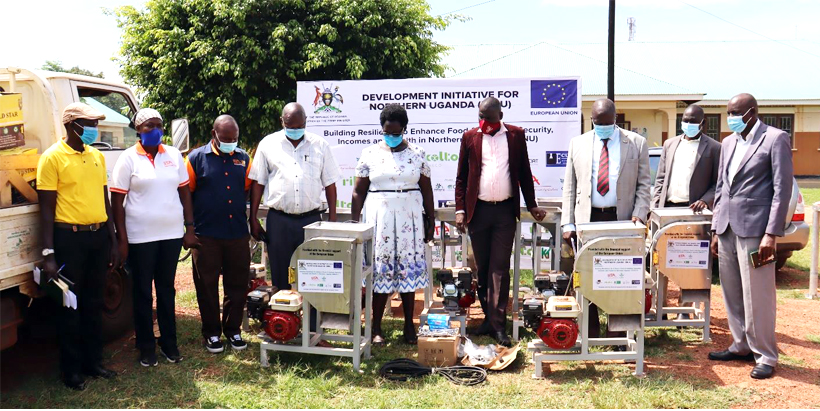
 

Dokolo district officials during flag off of distribution of post-harvest handling and processing technologies at Dokolo district headquarters. Photo credit: Moureen Awori

Meanwhile all the district officials present at the flag off event in Dokolo including the Deputy chief administrative officer – Mr. Richard Odoch Poromoi, Local Council V (LC V). chairperson – Mr. James Otto Apili, district production officer – Dr. Richard Enyang, Secretary production – Mr. Moses Ocen among others encouraged the project to continue with the cooperative/ group model for better impact as they pledged their technical support to the project.

Mr. Abdalla Awuye deputy chief administration officer in Amolatar district and who flagged off 24 cassava processing equipment (12 chippers and 12 drying racks) for distribution applauded the initiative and advised that, “BRENU should scale the project to all the 16 sub counties in Amolatar beyond Muntu and Arwotcek sub counties as most farmers in Amolatar grow cassava”.

Another district, Kwania also received 12 cassava chippers and 12 drying racks on 7 October 2021 distributed by the project. The flag off their distribution was officiated by the Resident District Commissioner (RDC) Mr Richard Ogwang Odyero. Other district and sub county stake holders present included LC V chairperson, district production officer, deputy CAO, DINU focal point person, district commercial officer and sub county chief. According to Richard, BRENU should be embraced as it comes to compliment government efforts. He appreciated BRENU and pledged full support in monitoring the technology equipment to ensure proper maintenance.
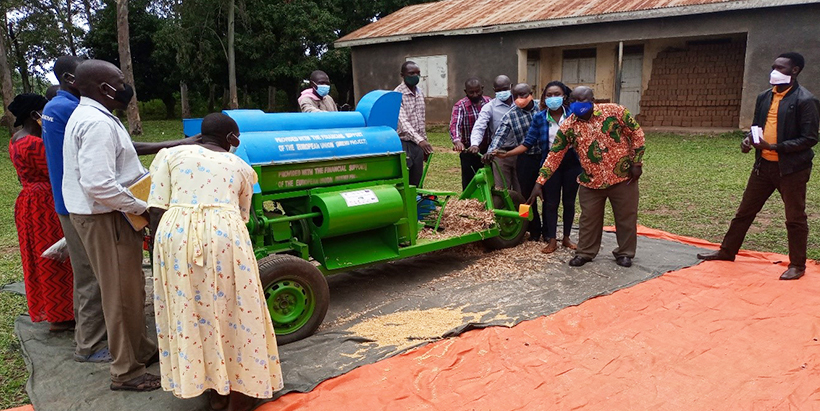
Kilimo Trust together with the sub county team on the rightside handing over a soybean thresher machine to Gwokere Nambieso growers cooperatives society Ltd, Kwania district, Nambieso sub county, Bung Parish.

Perez Muchunguzi the project manager of BRENU said that the project operates under three result areas: increasing production, improving market access and nutrition and public health and therefore seeks to ensure that farmers produce quality and diversified products to get sufficient market and better incomes. He noted that the cassava chippers will improve the quality of cassava chips for better market. He also promised more support to the farmer groups and cooperatives especially women and youth through distribution of other improved processing equipment to prevent post-harvest loses.

The team hopes these machines will not only help to prevent post-harvest losses but also promote the processing of value-added commercial products from cassava, soybean and rice which will help reduce the pressure for farmers to sell the crops at lower prices after the harvest and which will also earn them more money compared.

IITA leads the implementation of BRENU together with a consortium of five partners: (i) Voluntary Efforts for Development Concerns (VEDCO), (ii) Kilimo Trust (KT), (iii) Rikolto International, (iv) Bioversity International and (v) Ernest Cook Ultrasound Research and Education Institute (ECUREI).

Authors: Moureen Awori (IITA), Perez Muchunguzi (IITA), Catherine Njuguna (IITA)


Contribué par

Recent stories

Aucun article trouvé

Laisser un commentaire

Votre adresse e-mail ne sera pas publiée. Les champs obligatoires sont indiqués avec *

Retour en haut
Olaosebikan, Olamide

Olamide Deborah Nwanze est une chercheuse principale spécialisée dans la recherche sur l'approche "genre" afin d'éclairer les politiques de sélection participative et inclusive, de développement de variétés et de systèmes semenciers concernant les cultures de racines, tubercules et bananes (RTB) au siège de l'Institut International d'Agriculture Tropicale, à Ibadan, au Nigeria. Elle est candidate au doctorat à l'Université d'Ibadan et titulaire d'un master et d'un diplôme d'ingénieur agronome en vulgarisation agricole et développement rural. Olamide est membre du programme African Women in Agricultural Research and Development – Gender Responsive Agricultural Systems Policy (SAISIE DE RÉCOMPENSEet les Chercheuses Sensibles au Genre Équipées pour la Transformation Agricole (SUPER. Elle cherche à appliquer ses apprentissages en matière d’approche genre, recherche sensible au genre, et expertise en développement et examen de politiques pour faciliter l’accès et l’adoption par les femmes, les jeunes, les enfants et les groupes sociaux vulnérables aux innovations agricoles qui garantissent la sécurité alimentaire, nutritionnelle, des revenus et des moyens de subsistance en Afrique. Ses rôles actuels comprennent le mentorat de chercheurs stagiaires, le développement de guides et manuels de formation, la mise en œuvre et l'adaptation de cadres et d'outils genre, l'engagement des acteurs de la chaîne de valeur en tant que partenaires de la science citoyenne, l'examen et la refonte des politiques, la gestion et l'analyse des données. Ses recherches actuelles portent sur les méthodes mixtes ainsi que sur les approches participatives et interdisciplinaires pour saisir et mettre en évidence les dynamiques de genre, les besoins, les préférences et les défis rencontrés par les parties prenantes au sein de la chaîne de valeur des moyens de subsistance agricoles afin de prioriser des stratégies axées sur le genre dans les programmes de sélection, la conception et la mise en œuvre des politiques.

À l'IITA, elle contribue à la mise en œuvre du CGIAR Initiative d'Élevage Accéléré et Innovation génétique Programmes ; recherche participative et genre au sein des Prochaine Génération ManiocHarvestPlusRTBAliments, et Tricot-ClimMob 1000Fermes Projets ; et la communication des connaissances sur le genre via le Série de webinaires G-LENS, vidéo documentaire, notes de politiquepublications, et blogs.


Publications récentes

de Sousa, K., van Etten, J., Manners, R. Bello, A., Teeken, B., Olaosebikan, O., et al. 2024. L'approche tricot : un cadre agile pour les essais décentralisés à la ferme soutenus par la science citoyenne. Une rétrospective. Agron. Sustain. Dev. 44, 8. https://doi.org/10.1007/s13593-023-00937-1

Madu, T., Onwuka, S., Nwafor, S., Onyemauwa, N., Ejechi, M., Ofoeze, M., Ukeje, B., Eluagu, C., Olaosebikan, O., Okoye, B., 2024. Les études sur les consommateurs inclusifs en matière de genre améliorent l'amélioration du manioc au Nigeria dans : Frontiers in Sociology, volume 9, numéro : 1224504, doi : 10.3389/fsoc.2024.1224504

Olaosebikan, O. ; Bello, A. ; Utoblo, O. ; Okoye, B. ; Olutegbe, N. ; Garner, E. ; Teeken, B. ; Bryan, E. ; Forsythe, L. ; Cole, S. ; Madu, T. 2023. Facteurs de stress et résilience au sein de la chaîne de valeur du manioc au Nigeria : Caractéristiques préférées des variétés de manioc et stratégies de réponse des hommes et des femmes pour informer l'amélioration variétale. Sustainability 15, 7837. https://doi.org/10.3390/su15107837

Okoye, B., Ofoeze, M., Ejechi, M., Onwuka, S., Nwafor, S., Onyemauwa, N., Ukeje, B., Eluagu, C., Obidiegwu, J.*, Olaosebikan, O., Madu, T.* 2023. Priorisation des traits préférés dans la chaîne de valeur de l'igname au Nigeria : une analyse de la situation en matière de genre in: Frontiers in Sociology, volume 8, numéro : 1232626, pages 1 – 9, ISSN 2297-7775, 2023. https://www.frontiersin.org/articles/10.3389/fsoc.2023.1232626/full

Olaosebikan, O., Bello, A. A., de Sousa, K., Ndjouenkeu, R., Adesokan, M., Alamu, E. O., Agbona, A., van Etten, J., Kegah, F. N.*, Dufour, D., Bouniol, A., Teeken, B. 2023. Acceptabilité par les consommateurs des produits alimentaires à base de gari-eba de manioc dans des contextes culturels et environnementaux variés en utilisant l'approche triade de comparaison des technologies (tricot) dans : Journal of the Science of Food and Agriculture,

Teeken, B., Olaosebikan, O., Bello, A. A., Madu, T.*, Cole, S. M. 2023. Évaluation qualitative de la positionnalité et des préférences des dyades en relation avec les activités liées au manioc : travailler avec des scientifiques citoyens du procès tricot https://hdl.handle.net/10568/138326 Type : Manuel

Bouniol, A., Ceballos, H., Bello, A. A., Teeken, B., Olaosebikan, O., Owoade, D., Agbona, A., Fotso Kuate, A., Madu, T.*, Okoye, B.*, Ofoeze, M.*, Nwafor, S.*, Onyemauwa, N.*, Adinsi, L.*, Forsythe, L., Dufour, D. 2023. Impact variétal sur le travail des femmes, la charge de travail et la pénibilité associée dans le traitement des plantes à racines, tubercules et bananes : focus sur le manioc en Afrique subsaharienne dans : Journal of the Science of Food and Agriculture, pages 1 – 25, ISSN 0022-5142,

Bello, A. A., Agbona, A., Olaosebikan, O., Edughaen, G., Dufour, D., Bouniol, A., Iluebbey, P., Ndjouenkeu, R.*, Rabbi, I. Y., Teeken, B. 2023. Effets génétiques et environnementaux sur la productivité de la transformation et le rendement des produits alimentaires : la pénibilité du travail des femmes dans : Journal of the Science of Food and Agriculture, pages 1 – 32, ISSN 0022-5142, 5

Cavicchioli, M., Zimbiti, T., Teeken, B., Nwanze, D.O., Liani, M., Parkes, E. & Bello, A. 2023. Rapport sur la formation en sélection génétique sensible au genre à l'IITA. Genetic Resources Center, IITA-HQ, Ibadan, 21-23 septembre 2022. Ibadan, Nigéria : IITA, (34 p.).https://hdl.handle.net/10568/131368

Agbona, A. Peteti P., Teeken B., Olaosebikan O. Bello, A. A., Parkes, E., Rabbi, I. Y., Mueller, L., Egesi, C., Kulakow, P. 2022. Gestion des données dans les programmes d'amélioration des cultures RTB africaines multidisciplinaires. In : Williamson, H.F., Leonelli, S. (eds) Towards Responsible Plant Data Linkage: Data Challenges for Agricultural Research and Development. Springer, Cham. https://doi.org/10.1007/978-3-031-13276-6_5

Lora Forsythe, Pricilla Marimo, Sarah Mayanja, Olamide D. Olaosebikan, Esme Stuart, Bela Teeken, Benjamin Okoye, Tessy Madu, (2021). Analyse transversale du genre dans RTBfoods Étape 2 Cartographie des genres sur les produits RTB. Comprendre les moteurs des préférences en matière de traits et le développement de profils de produits RTB multi-utilisateurs, WP1. Londres, Royaume-Uni : Rapport scientifique de terrain RTBfoods, 30 p.

Teeken, B., Garner, E., Agbona, A., Balogun, I., Olaosebikan, O., Bello, A., Madu, T., Okoye, B., Egesi, C., Kulakow, P. et Tufan, H.A. 2021. Au-delà des “ traits des femmes ” : explorer comment le genre, les différences sociales et les caractéristiques des ménages influencent les préférences pour les traits. Frontiers Systèmes alimentaires durables 5:740926. https://doi.org/10.3389/fsufs.2021.740926

Teeken, B., Agbona, A., Bello, A., Olaosebikan, O., Alamu, E., Adesokan, M., Awoyale, W., Madu, T., Okoye, B., Chijioke, U., Owoade, D., Okoro, M., Bouniol, A., Dufour, D., Hershey, C., Rabbi, I., Maziya‐Dixon, B., Egesi, C., Tufan, H. et Kulakow, P. (020. Comprendre les préférences variétales du manioc par le classement par paires du gari-eba et du fufu préparés par des agriculteurs-transformateurs locaux. Int J Food Sci Technol. https://doi.org/10.1111/ijfs.14862

Bela Teeken, Olamide Olaosebikan, Ireti Balogun, Benjamin Okoye, Tessy Madu, Steven Cole, Abolore Bello, Elizabeth Parkes. (2020). Pilotage des outils de profil client et produit G+ pour l'amélioration sensible au genre du manioc au Nigeria. Nigeria : Institut international d'agriculture tropicale (IIAT). https://hdl.handle.net/20.500.11766/13000