
Post-harvest losses stemming from poor post-harvest handling of their crops is one of the challenges facing farmers in Lango sub-regions in districts of; Dokolo, Apac, Amolatar, Otuke, and Kwania and Teso sub-region in districts of Amuria and Kapelebyong in Northern Uganda.
Like their counterparts across sub-Saharan Africa, poor post-harvest handling is one of the main contributing factors to food insecurity, under-nutrition, and low market access due to poor quality of products in the region. The farmers lose up to 20-25% of their cassava to poor post-harvest handling. Where processing and value addition is done, it is rudimental and mostly done manually due to lack of appropriate processing technologies.
To address this challenge, as part of efforts to increase food availability, incomes and poverty reduction in Northern Uganda, the International Institute of Tropical Agriculture (IITA) and partner Kilimo Trust through the action Building Resilience to Enhance Food and Nutrition Security Income and Health in Northern Uganda (BRENU), are distributing post-harvest handling and processing equipment for major staples crops in the region to small holder farmers. BRENU is under the Development Initiative for Northern Uganda (DINU), a government of Uganda programme supported by the European Union (EU) and supervised by the Office of the Prime Minister (OPM). DINU’s goal is to consolidate stability in Northern Uganda, eradicate poverty and under-nutrition and strengthen the foundation for sustainable and inclusive socio-economic development.
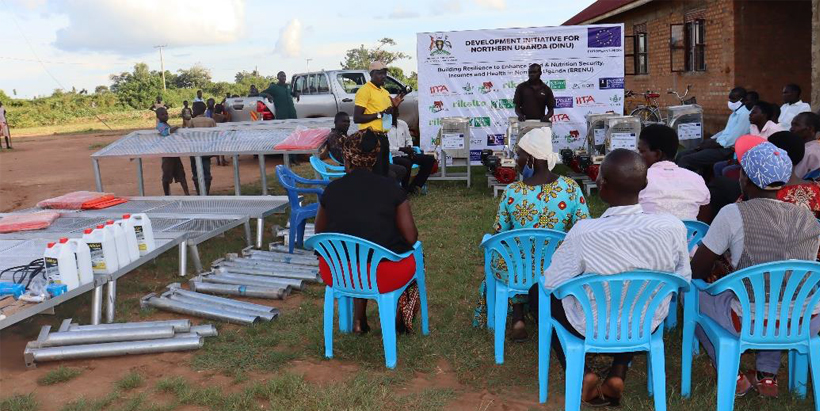
The technologies targeting cassava, soybean and rice and valued at UGX 1,531,530,000, include 85 cassava chippers and 85 drying racks: 45 and 8 soybean and rice threshers respectively and 18 automatic grain cleaners. They are targeting especially youth groups, women groups, and cooperatives in seven districts in Lango sub region – Dokolo, Apac, Amolatar, Otuke, and Kwania districts, and Teso sub region – Kapelebyong and Amuria districts of Northern Uganda.
The Resident District Commissioner of Dokolo district, Anna Odongo Lumumba, who officially flagged off the distribution of 18 equipment (9 cassava chipping machine and 9 drying racks) to farmers in Dokolo districts on 6 October 2021, at the district headquarters, commended IITA for the initiative and for starting in the “baby” sub counties of Amwoma and Okwangodul. She noted that, “BRENU is not only promoting food security but also enhancing commercialization in Lango sub region where subsistence farming is common”. Anna said she was hopefully that the distribution of the equipment, will help curb post-harvest losses as one of the biggest challenges facing small holder farmers in Northern Uganda.
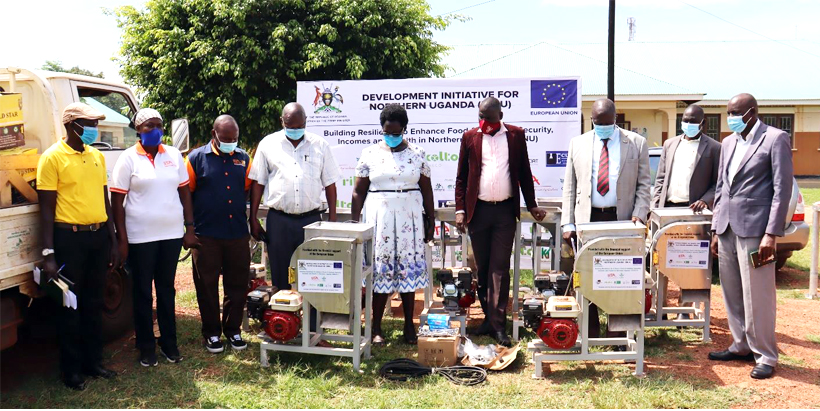
Meanwhile all the district officials present at the flag off event in Dokolo including the Deputy chief administrative officer – Mr. Richard Odoch Poromoi, Local Council V (LC V). chairperson – Mr. James Otto Apili, district production officer – Dr. Richard Enyang, Secretary production – Mr. Moses Ocen among others encouraged the project to continue with the cooperative/ group model for better impact as they pledged their technical support to the project.
Mr. Abdalla Awuye deputy chief administration officer in Amolatar district and who flagged off 24 cassava processing equipment (12 chippers and 12 drying racks) for distribution applauded the initiative and advised that, “BRENU should scale the project to all the 16 sub counties in Amolatar beyond Muntu and Arwotcek sub counties as most farmers in Amolatar grow cassava”.
Another district, Kwania also received 12 cassava chippers and 12 drying racks on 7 October 2021 distributed by the project. The flag off their distribution was officiated by the Resident District Commissioner (RDC) Mr Richard Ogwang Odyero. Other district and sub county stake holders present included LC V chairperson, district production officer, deputy CAO, DINU focal point person, district commercial officer and sub county chief. According to Richard, BRENU should be embraced as it comes to compliment government efforts. He appreciated BRENU and pledged full support in monitoring the technology equipment to ensure proper maintenance.
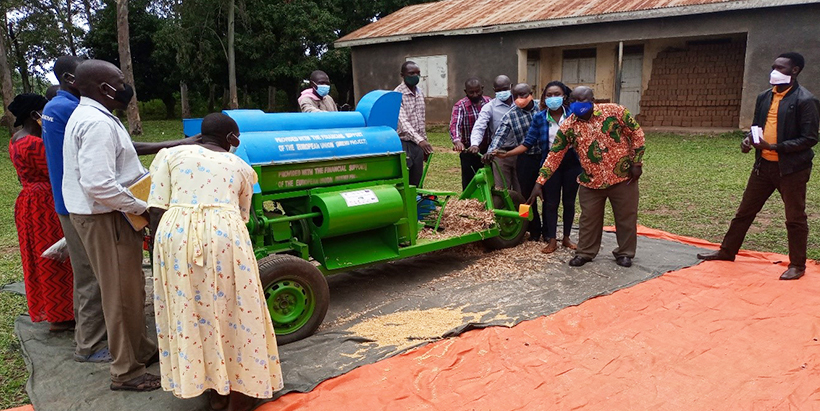
Perez Muchunguzi the project manager of BRENU said that the project operates under three result areas: increasing production, improving market access and nutrition and public health and therefore seeks to ensure that farmers produce quality and diversified products to get sufficient market and better incomes. He noted that the cassava chippers will improve the quality of cassava chips for better market. He also promised more support to the farmer groups and cooperatives especially women and youth through distribution of other improved processing equipment to prevent post-harvest loses.
The team hopes these machines will not only help to prevent post-harvest losses but also promote the processing of value-added commercial products from cassava, soybean and rice which will help reduce the pressure for farmers to sell the crops at lower prices after the harvest and which will also earn them more money compared.
IITA leads the implementation of BRENU together with a consortium of five partners: (i) Voluntary Efforts for Development Concerns (VEDCO), (ii) Kilimo Trust (KT), (iii) Rikolto International, (iv) Bioversity International and (v) Ernest Cook Ultrasound Research and Education Institute (ECUREI).
Authors: Moureen Awori (IITA), Perez Muchunguzi (IITA), Catherine Njuguna (IITA)
Contributed by
Recent stories