
NOUVELLES DE L'IITA

IITA and Rotary International explore new frontiers in partnership for community development
23 février 2026

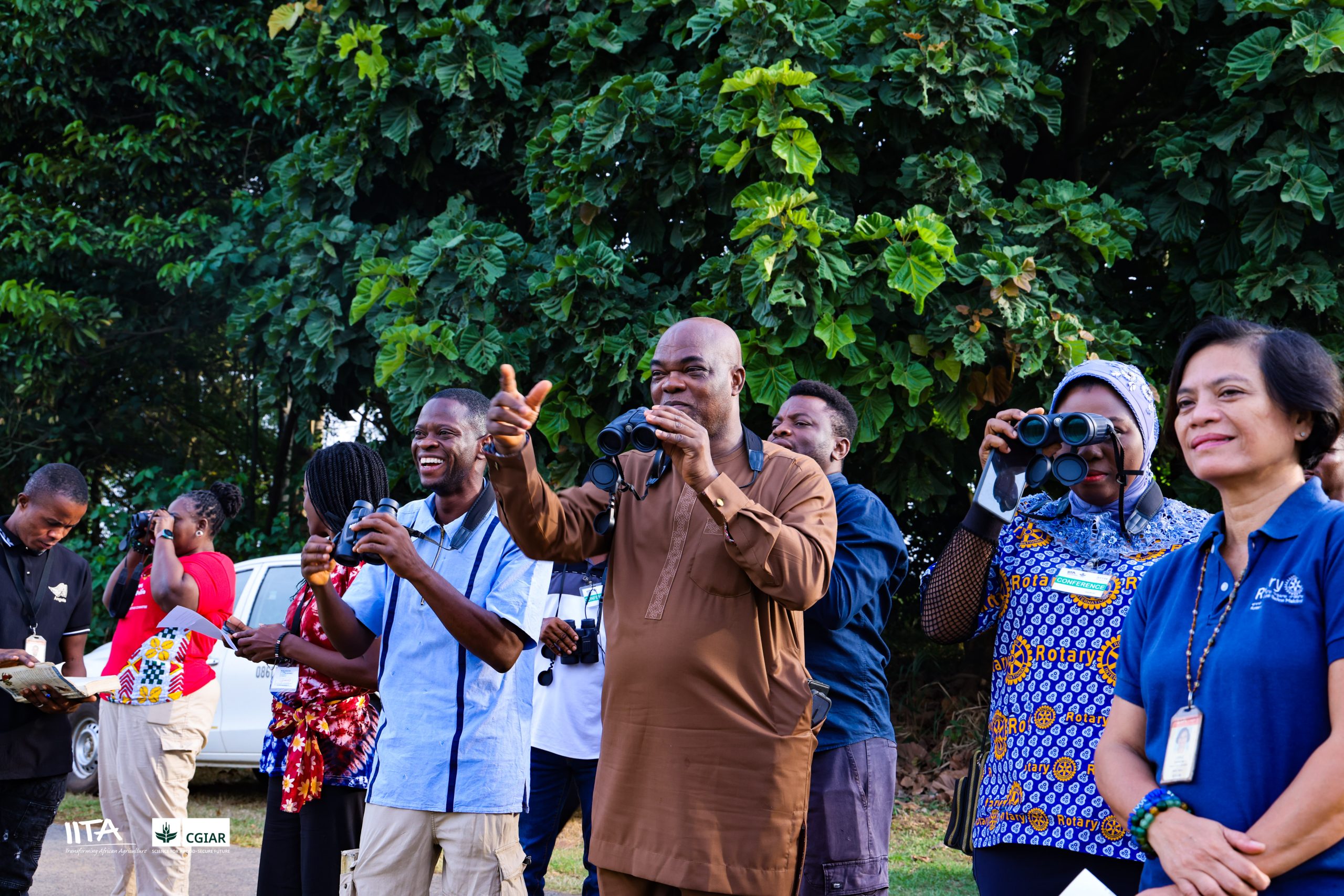
Rotary International President Elect (RIPE), Olayinka Babalola sights the pied kingfisher with his binoculars during the birdwatching exercise, guided by the Head of IITA Forest Center, Adewale Awoyemi, in the company of other Rotarians, the Head of Communication, Kathy Lopez and IITA staff.

Two presidents, IITACGIAR Director General, IITA scientists, and Nigerian Rotarians met on 15 February at IITA to discuss areas of mutual interest and opportunities for future collaboration in community development and peace building.

Earlier in the week, on 11 and 12 February, the Rotary International President Elect (RIPE), Olayinka Babalola, explored the grounds of the IITA campus, taking time out for an early-morning birdwatching session led by the Head of the IITA Forest Center, Adewale Awoyemi. He shared that his interest in birdwatching began during the COVID-19 lockdown, eventually leading him to join the fellowship of Rotarian birdwatchers, with IITA as his preferred base whenever he is in Ibadan.
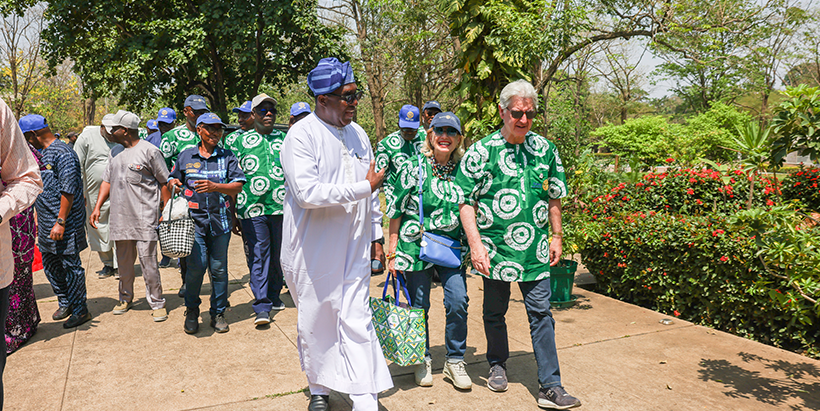
IITA Director General, Simeon Ehui, welcoming the Rotary International President, Francesco Arezzo, his wife, and other Rotarian delegates to IITA.

He was delighted to spot species such as the cormorant, African jacana (popularly called the “jesus bird” for its extraordinarily long toes that enable it to walk on floating vegetation), pied kingfisher, hadada ibis, and the common sandpiper, among others. The experience underscored IITA–CGIAR’s role not only as a hub for agricultural science but also as a center for biodiversity conservation and environmental stewardship.

Babalola later met with IITA–CGIAR Director General, Simeon Ehui, himself once a Rotarian, who expressed appreciation for Rotary International’s progress in polio eradication and other global humanitarian efforts. In his remarks, Dr Ehui provided a brief history of IITA and addressed key FAQs about the Institute. He emphasized the urgent need for food security that led to its founding by the Ford and Rockefeller Foundations. He reiterated IITA’s commitment to delivering cutting-edge science and research innovations that support economic development and food security across Africa and beyond. “Science, partnership, and impact—and accelerating transformative change in people’s lives—are key for us at IITA,” he stated.
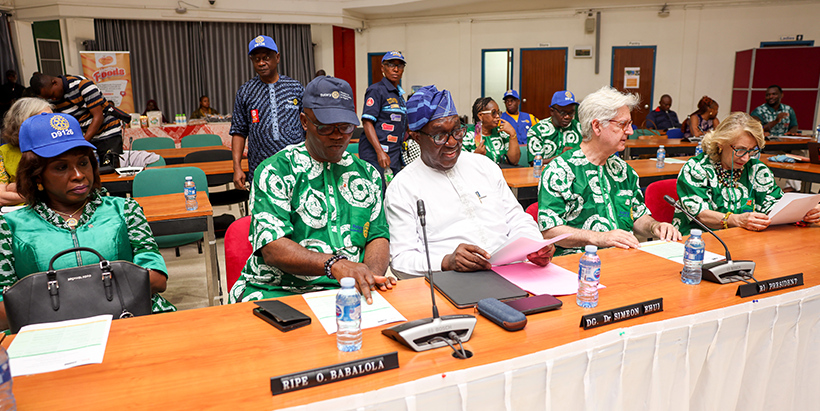
IITA DG, Simeon Ehui, with the Rotarian Incoming President Elect, Olayinka Babalola (L), and the outgoing President of Rotary International, Francesco Arezzo (R), during the partnership engagement meeting, at IITA headquarters, Ibadan.
IITA DG, Simeon Ehui, with the the Rotary International President Elect, Olayinka Babalola (L), and the outgoing President of Rotary International, Francesco Arezzo (R), during the partnership engagement meeting, at IITA headquarters, Ibadan.

Further insights on IITA’s research, innovations, and technologies were presented by Bernard Vanlauwe, Deputy Director General, Research for Development (DDGR4D); Tahirou Abdoulaye, Deputy Director General, Partnerships for Delivery (DDGP4D); and the DG’s Chief of Staff, Ibnou Dieng. They discussed IITA’s innovations and technologies, scaling approaches, and the Institute’s broader strategic impact pathways.

The outgoing President of Rotary International, Francesco Arezzo, expressed his pleasure at witnessing such a promising partnership opportunity between IITA-CGIAR and Rotary International. He highlighted areas of alignment for future collaboration, including youth empowerment, economic development, and environmental sustainability.

Tola Ademosun spoke about IITA-CGIAR’s youth-focused initiatives, that are transforming young people into agripreneurs through climate-smart practices, digital tools, and mechanization. These efforts, supported by partners such as the Banque Africaine de Développement (BAD) and the Mastercard Foundation, are tackling unemployment, promoting the dissemination of technology, and creating viable income streams in agribusiness. She expressed optimism about collaborating with Rotary International to further strengthen community development and youth economic empowerment.

RIPE Olayinka Babalola, while highlighting Rotary’s seven areas of focus, identified three to four potential areas of collaboration with IITA, including sustainable livelihoods, youth agribusiness ventures, environmental conservation, and water and sanitation initiatives. These are aimed at fostering peace and preventing conflict. He affirmed that his presidential theme for 2026, “to create lasting impact,” aligns seamlessly with IITA-CGIAR’s commitment to delivering agricultural innovations that positively transform lives.

The meeting concluded with proposals to establish Corporate Rotary Clubs to address shared concerns within corporate spaces—signaling a forward-looking partnership anchored on science, service, and sustainable impact.

Contributed by Folake Oduntan


Contribué par

Nouvelles connexes

Aucun article trouvé

Laisser un commentaire

Votre adresse e-mail ne sera pas publiée. Les champs obligatoires sont indiqués avec *

Retour en haut
Olaosebikan, Olamide

Olamide Deborah Nwanze est une chercheuse principale spécialisée dans la recherche sur l'approche "genre" afin d'éclairer les politiques de sélection participative et inclusive, de développement de variétés et de systèmes semenciers concernant les cultures de racines, tubercules et bananes (RTB) au siège de l'Institut International d'Agriculture Tropicale, à Ibadan, au Nigeria. Elle est candidate au doctorat à l'Université d'Ibadan et titulaire d'un master et d'un diplôme d'ingénieur agronome en vulgarisation agricole et développement rural. Olamide est membre du programme African Women in Agricultural Research and Development – Gender Responsive Agricultural Systems Policy (SAISIE DE RÉCOMPENSEet les Chercheuses Sensibles au Genre Équipées pour la Transformation Agricole (SUPER. Elle cherche à appliquer ses apprentissages en matière d’approche genre, recherche sensible au genre, et expertise en développement et examen de politiques pour faciliter l’accès et l’adoption par les femmes, les jeunes, les enfants et les groupes sociaux vulnérables aux innovations agricoles qui garantissent la sécurité alimentaire, nutritionnelle, des revenus et des moyens de subsistance en Afrique. Ses rôles actuels comprennent le mentorat de chercheurs stagiaires, le développement de guides et manuels de formation, la mise en œuvre et l'adaptation de cadres et d'outils genre, l'engagement des acteurs de la chaîne de valeur en tant que partenaires de la science citoyenne, l'examen et la refonte des politiques, la gestion et l'analyse des données. Ses recherches actuelles portent sur les méthodes mixtes ainsi que sur les approches participatives et interdisciplinaires pour saisir et mettre en évidence les dynamiques de genre, les besoins, les préférences et les défis rencontrés par les parties prenantes au sein de la chaîne de valeur des moyens de subsistance agricoles afin de prioriser des stratégies axées sur le genre dans les programmes de sélection, la conception et la mise en œuvre des politiques.

À l'IITA, elle contribue à la mise en œuvre du CGIAR Initiative d'Élevage Accéléré et Innovation génétique Programmes ; recherche participative et genre au sein des Prochaine Génération ManiocHarvestPlusRTBAliments, et Tricot-ClimMob 1000Fermes Projets ; et la communication des connaissances sur le genre via le Série de webinaires G-LENS, vidéo documentaire, notes de politiquepublications, et blogs.


Publications récentes

de Sousa, K., van Etten, J., Manners, R. Bello, A., Teeken, B., Olaosebikan, O., et al. 2024. L'approche tricot : un cadre agile pour les essais décentralisés à la ferme soutenus par la science citoyenne. Une rétrospective. Agron. Sustain. Dev. 44, 8. https://doi.org/10.1007/s13593-023-00937-1

Madu, T., Onwuka, S., Nwafor, S., Onyemauwa, N., Ejechi, M., Ofoeze, M., Ukeje, B., Eluagu, C., Olaosebikan, O., Okoye, B., 2024. Les études sur les consommateurs inclusifs en matière de genre améliorent l'amélioration du manioc au Nigeria dans : Frontiers in Sociology, volume 9, numéro : 1224504, doi : 10.3389/fsoc.2024.1224504

Olaosebikan, O. ; Bello, A. ; Utoblo, O. ; Okoye, B. ; Olutegbe, N. ; Garner, E. ; Teeken, B. ; Bryan, E. ; Forsythe, L. ; Cole, S. ; Madu, T. 2023. Facteurs de stress et résilience au sein de la chaîne de valeur du manioc au Nigeria : Caractéristiques préférées des variétés de manioc et stratégies de réponse des hommes et des femmes pour informer l'amélioration variétale. Sustainability 15, 7837. https://doi.org/10.3390/su15107837

Okoye, B., Ofoeze, M., Ejechi, M., Onwuka, S., Nwafor, S., Onyemauwa, N., Ukeje, B., Eluagu, C., Obidiegwu, J.*, Olaosebikan, O., Madu, T.* 2023. Priorisation des traits préférés dans la chaîne de valeur de l'igname au Nigeria : une analyse de la situation en matière de genre in: Frontiers in Sociology, volume 8, numéro : 1232626, pages 1 – 9, ISSN 2297-7775, 2023. https://www.frontiersin.org/articles/10.3389/fsoc.2023.1232626/full

Olaosebikan, O., Bello, A. A., de Sousa, K., Ndjouenkeu, R., Adesokan, M., Alamu, E. O., Agbona, A., van Etten, J., Kegah, F. N.*, Dufour, D., Bouniol, A., Teeken, B. 2023. Acceptabilité par les consommateurs des produits alimentaires à base de gari-eba de manioc dans des contextes culturels et environnementaux variés en utilisant l'approche triade de comparaison des technologies (tricot) dans : Journal of the Science of Food and Agriculture,

Teeken, B., Olaosebikan, O., Bello, A. A., Madu, T.*, Cole, S. M. 2023. Évaluation qualitative de la positionnalité et des préférences des dyades en relation avec les activités liées au manioc : travailler avec des scientifiques citoyens du procès tricot https://hdl.handle.net/10568/138326 Type : Manuel

Bouniol, A., Ceballos, H., Bello, A. A., Teeken, B., Olaosebikan, O., Owoade, D., Agbona, A., Fotso Kuate, A., Madu, T.*, Okoye, B.*, Ofoeze, M.*, Nwafor, S.*, Onyemauwa, N.*, Adinsi, L.*, Forsythe, L., Dufour, D. 2023. Impact variétal sur le travail des femmes, la charge de travail et la pénibilité associée dans le traitement des plantes à racines, tubercules et bananes : focus sur le manioc en Afrique subsaharienne dans : Journal of the Science of Food and Agriculture, pages 1 – 25, ISSN 0022-5142,

Bello, A. A., Agbona, A., Olaosebikan, O., Edughaen, G., Dufour, D., Bouniol, A., Iluebbey, P., Ndjouenkeu, R.*, Rabbi, I. Y., Teeken, B. 2023. Effets génétiques et environnementaux sur la productivité de la transformation et le rendement des produits alimentaires : la pénibilité du travail des femmes dans : Journal of the Science of Food and Agriculture, pages 1 – 32, ISSN 0022-5142, 5

Cavicchioli, M., Zimbiti, T., Teeken, B., Nwanze, D.O., Liani, M., Parkes, E. & Bello, A. 2023. Rapport sur la formation en sélection génétique sensible au genre à l'IITA. Genetic Resources Center, IITA-HQ, Ibadan, 21-23 septembre 2022. Ibadan, Nigéria : IITA, (34 p.).https://hdl.handle.net/10568/131368

Agbona, A. Peteti P., Teeken B., Olaosebikan O. Bello, A. A., Parkes, E., Rabbi, I. Y., Mueller, L., Egesi, C., Kulakow, P. 2022. Gestion des données dans les programmes d'amélioration des cultures RTB africaines multidisciplinaires. In : Williamson, H.F., Leonelli, S. (eds) Towards Responsible Plant Data Linkage: Data Challenges for Agricultural Research and Development. Springer, Cham. https://doi.org/10.1007/978-3-031-13276-6_5

Lora Forsythe, Pricilla Marimo, Sarah Mayanja, Olamide D. Olaosebikan, Esme Stuart, Bela Teeken, Benjamin Okoye, Tessy Madu, (2021). Analyse transversale du genre dans RTBfoods Étape 2 Cartographie des genres sur les produits RTB. Comprendre les moteurs des préférences en matière de traits et le développement de profils de produits RTB multi-utilisateurs, WP1. Londres, Royaume-Uni : Rapport scientifique de terrain RTBfoods, 30 p.

Teeken, B., Garner, E., Agbona, A., Balogun, I., Olaosebikan, O., Bello, A., Madu, T., Okoye, B., Egesi, C., Kulakow, P. et Tufan, H.A. 2021. Au-delà des “ traits des femmes ” : explorer comment le genre, les différences sociales et les caractéristiques des ménages influencent les préférences pour les traits. Frontiers Systèmes alimentaires durables 5:740926. https://doi.org/10.3389/fsufs.2021.740926

Teeken, B., Agbona, A., Bello, A., Olaosebikan, O., Alamu, E., Adesokan, M., Awoyale, W., Madu, T., Okoye, B., Chijioke, U., Owoade, D., Okoro, M., Bouniol, A., Dufour, D., Hershey, C., Rabbi, I., Maziya‐Dixon, B., Egesi, C., Tufan, H. et Kulakow, P. (020. Comprendre les préférences variétales du manioc par le classement par paires du gari-eba et du fufu préparés par des agriculteurs-transformateurs locaux. Int J Food Sci Technol. https://doi.org/10.1111/ijfs.14862

Bela Teeken, Olamide Olaosebikan, Ireti Balogun, Benjamin Okoye, Tessy Madu, Steven Cole, Abolore Bello, Elizabeth Parkes. (2020). Pilotage des outils de profil client et produit G+ pour l'amélioration sensible au genre du manioc au Nigeria. Nigeria : Institut international d'agriculture tropicale (IIAT). https://hdl.handle.net/20.500.11766/13000