
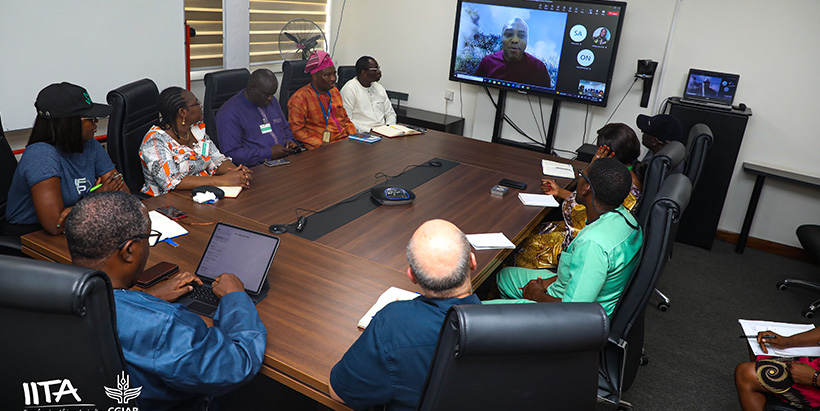
Following the meeting held in August regarding the implementation of the Nigeria for Women Program Scale-up Project (NFWP), delegates from World Bank and NFWP visited IITA-GIRCAR headquarters on 27 October. The visit aimed to broaden and strengthen their partnership with IITA to ensure the project’s goals are achieved.
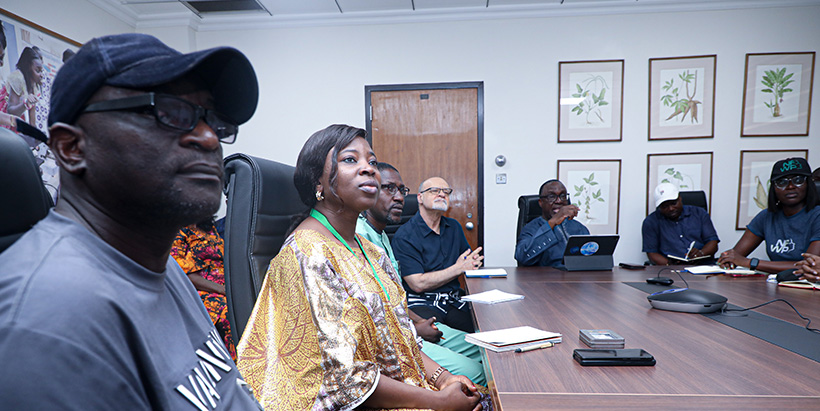
World Bank Senior Social Development Specialist and NFWP Task Team Leader Michael Ilesanmi commended the IITA and AfricaRice team for their immense support in the project implementation, particularly the grain quality-enhancer, energy efficient, and durable material (GEM) technology, which has improved the women’s livelihood tremendously.
The Nigerian women, the Federal Government, and the World Bank are excited at the project’s development. Ilesanmi said, “With this, we could expand the partnership with IITA to deliver these suitable innovations to the women to improve their livelihood significantly.”
Ilesanmi further elaborated that NFWP would be extended across the 36 states in Nigeria. Simultaneously, the GEM technology would be deployed in 71 locations, each receiving support from multi-collective cooperatives.
National Project Coordinator Ruth Mshelia and NFWP Ogun State Head of Operations Rasheed Ajibade shared some of their achievements that underscored the acceptability of the GEM technology. Of particular significance were the briquetting and steaming components, which were very insightful in the implementing states—Kebbi, Nasarawa, Niger, Ogun, and Taraba.
In addition, the women adopted the value chains—groundnut, maize, shea-butter, dairy, palm oil processing, and entrepreneurial activities such as tailoring.
Following the discussion, Ilesanmi requested IITA’s technical support and expertise to identify the type of technologies and processing that would improve productivity, reduce drudgery, and be gender friendly for the collectives which are crucial in achieving NFWP goals.
In response, IITA Deputy Director General, Partnerships for Delivery (DDG-P4D) Kenton Dashiell mentioned that NFWP’s team would be linked with equipment manufacturers and other essential institutes. While IITA Head of Capacity Development Office Sougrynoma Sore mentioned that in terms of training and assessment, NFWP would be supported with IITA standard training manuals that could be adapted to meet the women’s needs in alignment with the project’s goals.
IITA Technical Field Supervisor Julius Adedeji suggested that mobile cassava processing plants could be adopted to reduce the challenge of post-harvest loss on the field. IYA Business Development Officer Idowu Osun expatiated on the conscious effort of viability, profitability, and sustainability to ensure a successful agribusiness regardless of the technology that would be adopted.
IITA Director General Simeon Ehui stated, “Leveraging the Institute’s years of experience, I want IITA to partner with the World Bank, Federal Government, and NFWP to enhance the project’s impact across diverse value chains.”
Contribué par Anita AkinyomadeContribué par
Histoires récentes