
Former Nigerian President and IITA–CGIAR Goodwill Ambassador, Chief Olusegun Obasanjo, recently visited Democratic Republic of Congo (DRC) President Félix Tshisekedi on 22-24 August 2022, at the presidential palace “Cité de l’OUA”. Their discussions covered high-profile themes, including the Agenda for the Agricultural Transformation of the Democratic Republic of Congo (ATA-DRC), an initiative of the Head of State, which the Ministry of Agriculture began implementing in February 2022.
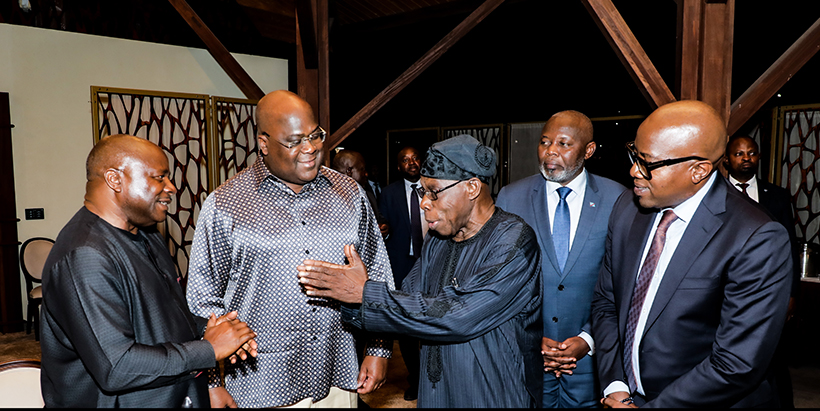
IITA-CGIAR and the African Agricultural Leadership Institute (AALI) provide technical assistance to the ATA-DRC program, which aims to transform DRC’s agro-silvopastoral and fishery sectors into competitive but environmentally sustainable ones. The multimillion-dollar project enables DRC to focus on reviving its agricultural production, particularly food crops, such as beans, cassava, maize, soybean, and rice, among other food crops.
During the visit, the former Nigerian President used the opportunity to congratulate President Tshisekedi on his accession to the presidency of the Southern African Development Community (SADC). Chief Obasanjo, a long-time friend of DRC, also discussed security problems in the eastern part of the country, particularly how it affects food and nutrition security in the region. He noted that efforts and interventions to improve the agricultural sector would be in vain if the nation continues to be at war.
“We cannot talk of food security and nutrition security without talking about agricultural transformation, which I call agribusiness because agribusiness moves from hoes and other equipment for land preparation through the value chains up to having food on the table. We are also talking about one of the problems we have in Africa today, which is another cause of insecurity—misbehavior on the part of the youth,” President Obasanjo said in an interview.
In addition to his crucial contribution to brokering peace in DRC, President Obasanjo has played an enormous role in mobilizing African Heads of State and development partners in transforming the agriculture sector in Africa that benefits many countries like DRC. These include the Zero Hunger project being implemented in Nigeria, also led by IITA with local government partners. It was within this framework that President Tshisekedi responded favorably to the IITA Director General and CGIAR Continental Director for Africa, Dr Nteranya Sanginga, to sponsor the Biotechnology Laboratory inauguration and support the President Olusegun Obasanjo IITA research campus located in South Kivu, Kalambo, DRC.
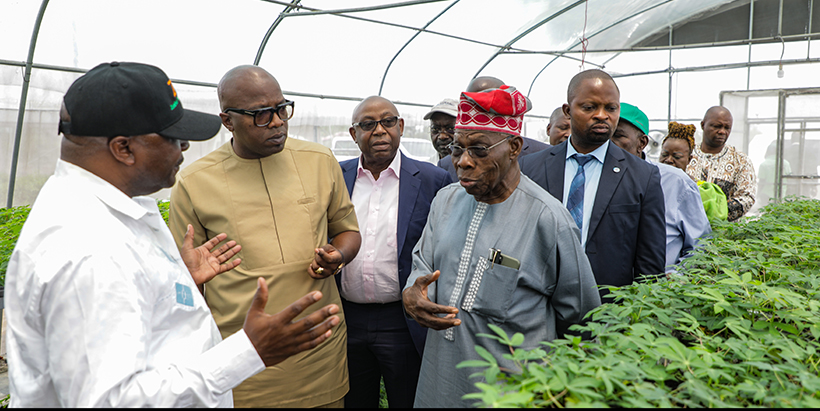
During his mission, Chief Obasanjo visited one of IITA’s partners, Centre de Recherche en Agrimuculture (CERAGRU), which produces healthy cassava seedlings using the IITA-CGIAR semi-autotrophic hydroponics (SAH, ex-vitro) technology as part of the ATA-DRC program.
The ATA-DRC program emphasizes the seed sector as the starting point for improving production. Its vision is to set up a guaranteed seed system with available, certified, and improved seeds with high yield potential. The cassava stems have proven to be resistant to diseases, drought, and the adverse effects of climate change.
Following his CERAGRU visit, former President Obasanjo said that what he had observed at CERAGRU inspired him with investment ideas for Nigeria. The former President, a major economic operator in the Nigerian cassava sector, lauded the DRC government’s efforts centered around strengthening the environmental structures for agricultural transformation in the DRC, developing improved seed systems across the DRC through engagement with the public and private sectors, and improving production systems for cassava, rice, maize, soybeans, beans, and plantain.
The government is also focusing on enhancing the value addition of priority agricultural products, especially those that lead to an increase in agro-industrialization and a reduction in dependence on food imports.
These activities by the government will enable the establishment of a favorable agricultural sector, attracting greater private sector participation and investment in DRC’s agricultural value chains because of the increased financial potential. This bodes well for the country’s agricultural transformation and would undoubtedly lead to a more robust economy.
Contribué par
Histoires récentes