
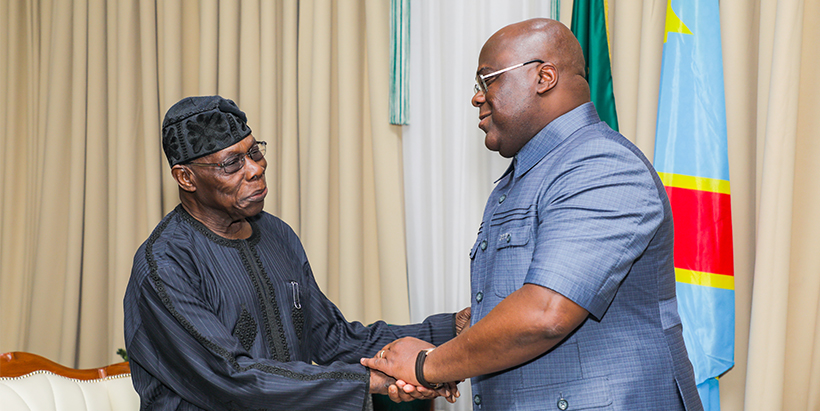
Former Nigerian President Olusegun Obasanjo, IITA’s Goodwill Ambassador, recently visited Democratic Republic of Congo (DRC) President Félix Tshisekedi, 22 to 24 August 2022, at the presidential palace “Cité de l’OUA”.
President Tshisekedi hosted former President Obasanjo in his office on 23 August. Their discussions focused on several high-profile themes, including the Agenda for the Agricultural Transformation of the Democratic Republic of Congo (ATA-DRC), an initiative of the Head of State, which the Ministry of Agriculture began implementing in February 2022. IITA-CGIAR and the African Agricultural Leadership Institute (AALI) provide technical assistance to the program.
In addition to his crucial contribution to brokering peace in DRC, President Obasanjo has played an enormous and active role in mobilizing African heads of state as well as development partners in transforming the agriculture sector in Africa that benefits many countries like DRC. These efforts include the Zero Hunger project being implemented in Nigeria with IITA. It was within this framework that DRC President Tshisekedi responded favorably to the request of IITA Director General and CGIAR Continental Director for Africa, Dr Nteranya Sanginga, to sponsor the inauguration of the Biotechnology Laboratory and support the IITA/CGIAR research campus located in South Kivu, Kalambo, DRC, named “President Olusegun Obasanjo IITA research campus” in 2019.
The ATA-DRC program is a multimillion-dollar project that aims to make the agro-sylvo-pastoral and fisheries sector in DRC competitive but not at the expense of the environment. The project allows DRC to focus on reviving its agricultural production, particularly food crops, such as beans, cassava, maize, soybeans, rice, etc. It is helping to create sustainable jobs around the agricultural value chains, contributing both to food and nutritional security and wealth creation. The DRC Government, through the Ministry of Agriculture, signed a technical assistance agreement with IITA for implementing ATA-DRC while building public sector capacity and facilitating public-private partnerships. The project covers six locations in DRC.
Work on the value chains of these crop sectors is expected to lead to the development of the animal protein sector, such as fish farming, poultry farming, pig production, sheep raising, and cattle farming because of the livestock feed. The country is giving impetus to agricultural transformation, and the involvement of the private sector will help spread successes and benefits to all segments of the population.
Story contributed by Michelle Kimpwene and Katherine Lopez.
Contribué par
Histoires récentes