
NEWS

IITA scientist Eyitayo Ogbon wins inaugural ICIPE special prize 2026
30 octobre 2026
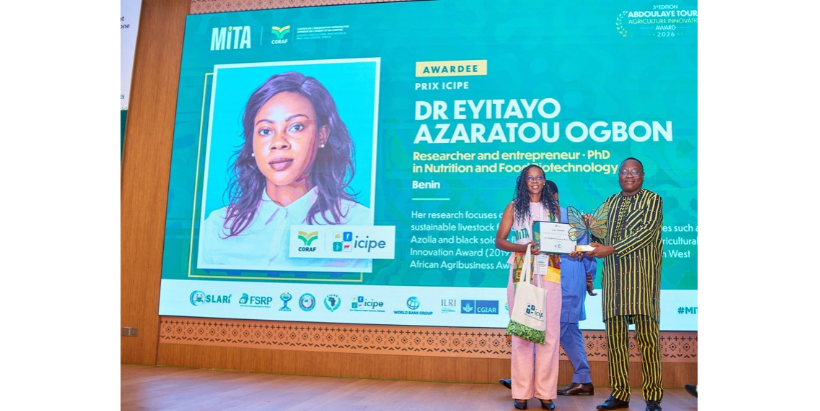
Dr Eyitayo Azaratou Ogbon receiving her award during the MITA 2026.

African agricultural research continues to explore practical ways to make livestock production more affordable and sustainable. One promising area is the use of insects to convert organic by-products into valuable sources of animal feed.

Dr Eyitayo Azaratou Ogbon has been named the recipient of the inaugural ICIPE Special Prize 2026 for her work in this field. This was presented during the MITA 2026 event organized by CORAF (West and Central African Council for Agricultural Research and Development) in Freetown, Sierra Leone, from 19 to 21 October 2026. The award recognizes research on the use of black soldier fly (Hermetia illucens) larvae in rabbit feed, an approach that aims to convert organic by-products into a protein-rich feed ingredient while contributing to more resource-efficient livestock production.

Dr Ogbon expressing gratitude to the International Centre of Insect Physiology and Ecology (ICIPE), CORAF, the award jury, the MITA 2026 partners, and the collaborators who supported the work, also acknowledged IITA-Benin, highlighting the contribution of the research team and its partners to the development of practical solutions for African agriculture.

Feed is a major consideration in livestock production, affecting farmers’ operating costs and the economic viability of their enterprises. Finding affordable, nutritious, and locally accessible feed ingredients is therefore important to the development of more resilient livestock systems in Africa. Black soldier fly larvae have attracted growing interest because they can convert suitable organic materials into biomass containing protein and fat. When produced under controlled conditions and processed appropriately, the larvae can serve as an ingredient in animal feed.
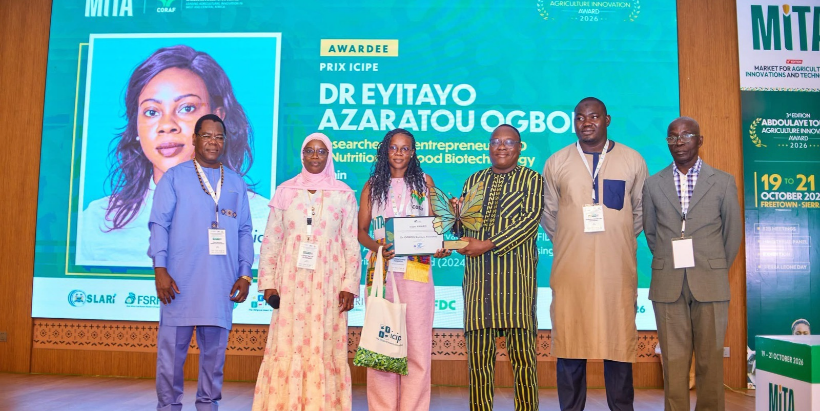
The award presentation ceremony in Sierra leone.

Dr Ogbon’s recognized work explores the application of this approach to rabbit nutrition. By investigating the use of black soldier fly larvae in rabbit feed, the research contributes to wider efforts to identify alternative protein sources for livestock and reduce reliance on conventional feed ingredients. The approach also raises an important question for African agriculture: how can materials that might otherwise be discarded be transformed into useful agricultural inputs?

Connecting waste management with livestock production

The potential value of black soldier fly technology extends beyond animal nutrition. It is also associated with the principles of circular agriculture, which seek to keep resources in productive use for as long as possible.

Suitable organic by-products can serve as substrates for insect larvae production. The resulting insect biomass can then be processed for potential use in animal feed, creating an opportunity to connect organic resource management with livestock production.

This approach offers opportunities to develop new value chains around organic by-products, insect production, and alternative feed ingredients. Its practical benefits, however, depend on several factors, including the availability and safety of suitable substrates, production costs, processing standards, nutritional consistency, and regulatory requirements.

The use of insect-based feed is therefore not simply a matter of replacing one ingredient with another. It requires research and quality control to establish appropriate feeding levels, animal performance, safety, and economic viability under local production conditions.
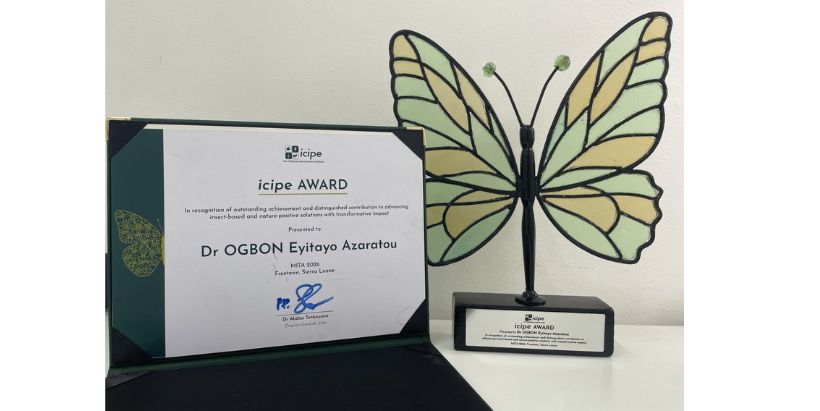
The ICIPE special prize won by Dr Eyitayo Azaratou Ogbon.

For rabbit producers, particularly smallholder farmers operating under tight financial constraints, more affordable feed ingredients could improve production economics. If the approach can be produced safely and competitively at scale, insect-based feed ingredients could help reduce dependence on more expensive protein sources. The technology could also create opportunities for entrepreneurs involved in insect farming, organic by-product collection, feed processing, and livestock services.

However, the extent of these benefits will depend on the research findings, the costs of production and processing, and the ability to establish reliable supply chains. Demonstrating that an alternative ingredient is nutritious is important, but showing that it is safe, affordable and practical for farmers is equally essential. These considerations make applied research particularly valuable: it can help bridge the gap between research innovation and solutions that farmers can use in their operations.

The inaugural ICIPE Special Prize 2026 provides a platform for recognizing research directed at practical agricultural challenges. Dr Ogbon’s award also highlights the role of collaboration in developing innovations that integrate insect science, animal nutrition, resource recovery, and sustainable food production. She describes the achievement as one shared with IITA Benin and the collaborators who contributed to the work, while reaffirming her commitment to developing and promoting insect-based feed innovations that support farmers, protect the environment and strengthen food-system resilience.

Dr Ogbon’s recognition highlights an area of agricultural innovation with potential implications for livestock production and resource management. By exploring how organic by-products can be converted into useful feed ingredients, her work contributes to the search for alternatives that make better use of available resources.

The broader lesson is that solutions to Africa’s agricultural challenges may come not only from producing more, but also from finding smarter ways to use what is already available. As research into insect-based feed continues, its long-term significance will depend on the evidence generated, the partnerships established, and the extent to which the technology can be adapted to farmers’ needs. For now, the inaugural ICIPE Special Prize shines a spotlight on Dr Ogbon’s work and the broader possibilities of science-driven innovation for building more sustainable and resilient African food systems.


Contribué par

Timilehin Osunde

Retour en haut
Olaosebikan, Olamide

Olamide Deborah Nwanze est une chercheuse principale spécialisée dans la recherche sur l'approche "genre" afin d'éclairer les politiques de sélection participative et inclusive, de développement de variétés et de systèmes semenciers concernant les cultures de racines, tubercules et bananes (RTB) au siège de l'Institut International d'Agriculture Tropicale, à Ibadan, au Nigeria. Elle est candidate au doctorat à l'Université d'Ibadan et titulaire d'un master et d'un diplôme d'ingénieur agronome en vulgarisation agricole et développement rural. Olamide est membre du programme African Women in Agricultural Research and Development – Gender Responsive Agricultural Systems Policy (SAISIE DE RÉCOMPENSEet les Chercheuses Sensibles au Genre Équipées pour la Transformation Agricole (SUPER. Elle cherche à appliquer ses apprentissages en matière d’approche genre, recherche sensible au genre, et expertise en développement et examen de politiques pour faciliter l’accès et l’adoption par les femmes, les jeunes, les enfants et les groupes sociaux vulnérables aux innovations agricoles qui garantissent la sécurité alimentaire, nutritionnelle, des revenus et des moyens de subsistance en Afrique. Ses rôles actuels comprennent le mentorat de chercheurs stagiaires, le développement de guides et manuels de formation, la mise en œuvre et l'adaptation de cadres et d'outils genre, l'engagement des acteurs de la chaîne de valeur en tant que partenaires de la science citoyenne, l'examen et la refonte des politiques, la gestion et l'analyse des données. Ses recherches actuelles portent sur les méthodes mixtes ainsi que sur les approches participatives et interdisciplinaires pour saisir et mettre en évidence les dynamiques de genre, les besoins, les préférences et les défis rencontrés par les parties prenantes au sein de la chaîne de valeur des moyens de subsistance agricoles afin de prioriser des stratégies axées sur le genre dans les programmes de sélection, la conception et la mise en œuvre des politiques.

À l'IITA, elle contribue à la mise en œuvre du CGIAR Initiative d'Élevage Accéléré et Innovation génétique Programmes ; recherche participative et genre au sein des Prochaine Génération Manioc, HarvestPlus, RTBAliments, et Tricot-ClimMob 1000Fermes Projets ; et la communication des connaissances sur le genre via le Série de webinaires G-LENS, vidéo documentaire, notes de politique, publications, et blogs.


Publications récentes

de Sousa, K., van Etten, J., Manners, R. Bello, A., Teeken, B., Olaosebikan, O., et al. 2024. L'approche tricot : un cadre agile pour les essais décentralisés à la ferme soutenus par la science citoyenne. Une rétrospective. Agron. Sustain. Dev. 44, 8. https://doi.org/10.1007/s13593-023-00937-1

Madu, T., Onwuka, S., Nwafor, S., Onyemauwa, N., Ejechi, M., Ofoeze, M., Ukeje, B., Eluagu, C., Olaosebikan, O., Okoye, B., 2024. Les études sur les consommateurs inclusifs en matière de genre améliorent l'amélioration du manioc au Nigeria dans : Frontiers in Sociology, volume 9, numéro : 1224504, doi : 10.3389/fsoc.2024.1224504

Olaosebikan, O. ; Bello, A. ; Utoblo, O. ; Okoye, B. ; Olutegbe, N. ; Garner, E. ; Teeken, B. ; Bryan, E. ; Forsythe, L. ; Cole, S. ; Madu, T. 2023. Facteurs de stress et résilience au sein de la chaîne de valeur du manioc au Nigeria : Caractéristiques préférées des variétés de manioc et stratégies de réponse des hommes et des femmes pour informer l'amélioration variétale. Sustainability 15, 7837. https://doi.org/10.3390/su15107837

Okoye, B., Ofoeze, M., Ejechi, M., Onwuka, S., Nwafor, S., Onyemauwa, N., Ukeje, B., Eluagu, C., Obidiegwu, J.*, Olaosebikan, O., Madu, T.* 2023. Priorisation des traits préférés dans la chaîne de valeur de l'igname au Nigeria : une analyse de la situation en matière de genre in: Frontiers in Sociology, volume 8, numéro : 1232626, pages 1 – 9, ISSN 2297-7775, 2023. https://www.frontiersin.org/articles/10.3389/fsoc.2023.1232626/full

Olaosebikan, O., Bello, A. A., de Sousa, K., Ndjouenkeu, R., Adesokan, M., Alamu, E. O., Agbona, A., van Etten, J., Kegah, F. N.*, Dufour, D., Bouniol, A., Teeken, B. 2023. Acceptabilité par les consommateurs des produits alimentaires à base de gari-eba de manioc dans des contextes culturels et environnementaux variés en utilisant l'approche triade de comparaison des technologies (tricot) dans : Journal of the Science of Food and Agriculture,

Teeken, B., Olaosebikan, O., Bello, A. A., Madu, T.*, Cole, S. M. 2023. Évaluation qualitative de la positionnalité et des préférences des dyades en relation avec les activités liées au manioc : travailler avec des scientifiques citoyens du procès tricot https://hdl.handle.net/10568/138326 Type : Manuel

Bouniol, A., Ceballos, H., Bello, A. A., Teeken, B., Olaosebikan, O., Owoade, D., Agbona, A., Fotso Kuate, A., Madu, T.*, Okoye, B.*, Ofoeze, M.*, Nwafor, S.*, Onyemauwa, N.*, Adinsi, L.*, Forsythe, L., Dufour, D. 2023. Impact variétal sur le travail des femmes, la charge de travail et la pénibilité associée dans le traitement des plantes à racines, tubercules et bananes : focus sur le manioc en Afrique subsaharienne dans : Journal of the Science of Food and Agriculture, pages 1 – 25, ISSN 0022-5142,

Bello, A. A., Agbona, A., Olaosebikan, O., Edughaen, G., Dufour, D., Bouniol, A., Iluebbey, P., Ndjouenkeu, R.*, Rabbi, I. Y., Teeken, B. 2023. Effets génétiques et environnementaux sur la productivité de la transformation et le rendement des produits alimentaires : la pénibilité du travail des femmes dans : Journal of the Science of Food and Agriculture, pages 1 – 32, ISSN 0022-5142, 5

Cavicchioli, M., Zimbiti, T., Teeken, B., Nwanze, D.O., Liani, M., Parkes, E. & Bello, A. 2023. Rapport sur la formation en sélection génétique sensible au genre à l'IITA. Genetic Resources Center, IITA-HQ, Ibadan, 21-23 septembre 2022. Ibadan, Nigéria : IITA, (34 p.).https://hdl.handle.net/10568/131368

Agbona, A. Peteti P., Teeken B., Olaosebikan O. Bello, A. A., Parkes, E., Rabbi, I. Y., Mueller, L., Egesi, C., Kulakow, P. 2022. Gestion des données dans les programmes d'amélioration des cultures RTB africaines multidisciplinaires. In : Williamson, H.F., Leonelli, S. (eds) Towards Responsible Plant Data Linkage: Data Challenges for Agricultural Research and Development. Springer, Cham. https://doi.org/10.1007/978-3-031-13276-6_5

Lora Forsythe, Pricilla Marimo, Sarah Mayanja, Olamide D. Olaosebikan, Esme Stuart, Bela Teeken, Benjamin Okoye, Tessy Madu, (2021). Analyse transversale du genre dans RTBfoods Étape 2 Cartographie des genres sur les produits RTB. Comprendre les moteurs des préférences en matière de traits et le développement de profils de produits RTB multi-utilisateurs, WP1. Londres, Royaume-Uni : Rapport scientifique de terrain RTBfoods, 30 p.

Teeken, B., Garner, E., Agbona, A., Balogun, I., Olaosebikan, O., Bello, A., Madu, T., Okoye, B., Egesi, C., Kulakow, P. et Tufan, H.A. 2021. Au-delà des “ traits des femmes ” : explorer comment le genre, les différences sociales et les caractéristiques des ménages influencent les préférences pour les traits. Frontiers Systèmes alimentaires durables 5:740926. https://doi.org/10.3389/fsufs.2021.740926

Teeken, B., Agbona, A., Bello, A., Olaosebikan, O., Alamu, E., Adesokan, M., Awoyale, W., Madu, T., Okoye, B., Chijioke, U., Owoade, D., Okoro, M., Bouniol, A., Dufour, D., Hershey, C., Rabbi, I., Maziya‐Dixon, B., Egesi, C., Tufan, H. et Kulakow, P. (020. Comprendre les préférences variétales du manioc par le classement par paires du gari-eba et du fufu préparés par des agriculteurs-transformateurs locaux. Int J Food Sci Technol. https://doi.org/10.1111/ijfs.14862

Bela Teeken, Olamide Olaosebikan, Ireti Balogun, Benjamin Okoye, Tessy Madu, Steven Cole, Abolore Bello, Elizabeth Parkes. (2020). Pilotage des outils de profil client et produit G+ pour l'amélioration sensible au genre du manioc au Nigeria. Nigeria : Institut international d'agriculture tropicale (IIAT). https://hdl.handle.net/20.500.11766/13000