
As the world’s foremost experts unite in their efforts to combat food insecurity and malnutrition, both exacerbated by climate change and responsible for stunting over 30% of children under the age of five, a group of new scientists emerged in October, equipped to enhance crop production through the art of gene editing.
The ten doctoral-level scientists from six different African nations, including Ethiopia, Ghana, Kenya, Malawi, Morocco, and Nigeria, have undergone an intensive six-week training program hosted by the African Plant Breeding Academy (APBA) to refine their skills in advanced crop breeding. The training focused on Clustered Regularly Interspaced Short Palindromic Repeats (CRISPR), which enables precise, targeted alterations to DNA sequences in living organisms, particularly crops.
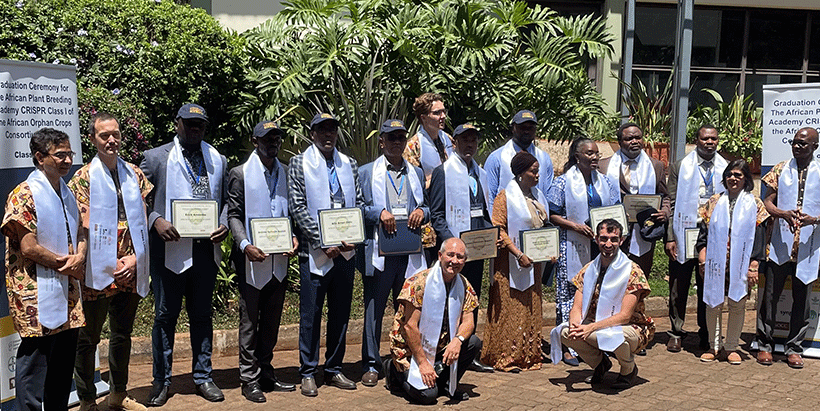
Strengthening the expertise of agricultural scientists within the National Agricultural Research Systems (NARS) across Africa with the latest technological advancements will help improve crop varieties. This will address various agricultural challenges, such as resistance to diseases, resilience against extreme weather conditions, and increased yields. Ultimately, this would lead to the transformation of African agriculture, improving the productivity and livelihoods of local farmers.
Regarding the impact of the training, Leena Tripathi, one of the primary instructors and Director of the Eastern Africa Hub of IITA–CGIAR, expressed confidence in the scientists’ newly acquired skills. According to her, the trained scientists are now equipped and empowered to conduct gene editing at their home institutions. This newfound capability places significant responsibilities on their shoulders—they are tasked with applying gene editing techniques to enhance crucial traits in priority crops. Moreover, they are expected to engage with regulators to ensure the successful deployment of gene-edited crops, ultimately reaching smallholder farmers in their respective countries. The training has thus empowered these scientists to play a pivotal role in the practical application of advanced agricultural technologies, fostering positive transformations in local farming communities.
Reflecting on the significance of the training program, Kingdom Kwapata, a molecular geneticist from Lilongwe University of Agriculture and Natural Resources in Malawi, expressed his appreciation during the graduation ceremony at the Center for International Forestry Research and World Agroforestry (CIFOR-ICRAF) in Nairobi. He said, “It is good to give a man fish, but it is better to teach him how to fish. Thank you for teaching me how to fish with the CRISPR technology.”
During the graduation ceremony, 2020 Nobel Laureate in Chemistry Jennifer Doudna, a key partner in the program through the African Orphan Crops Consortium (AOCC), challenged the graduates to boldly innovate to support nutritional security across the African continent.
The six-week program was divided into three two-week sessions at IITA on the International Livestock Research Institute (ILRI) and World Agroforestry (CIFOR-ICRAF) campus in Nairobi, Kenya. While bananas were used as the model crop throughout the course, the graduates are actively working on developing gene editing programs for other crops and traits aligned with their respective national priorities.
Following their graduation, the new experts are guaranteed post-course mentorship and ongoing support to maintain their laboratory productivity beyond the completion of the program. They are also encouraged to establish transnational partnerships for commercialization and value chain development.
This program marked a significant milestone as the first hands-on training course on CRISPR for national program scientists in Africa. The program is set to run for five years, empowering 80-100 scientists to harness the power of CRISPR technology for crop improvement.
The program is a collaborative effort involving IITA, the University of California, Davis (UC Davis), the Innovative Genomics Institute (IGI) at UC Berkeley, and other members of the African Orphan Crops Consortium (AOCC).
Generous support from Bayer, Syngenta, UM6P Ventures affiliated with Mohammed VI Polytechnic University in Morocco, and the US-based Foundation for Food and Agriculture Research (FFAR), alongside other donors, enabled the graduates to complete the course on full scholarships. Importantly, the program received full endorsement from the African Union Development Agency – New Partnership for African Development (AUDA-NEPAD).
Contribué par Gloriana Ndibalema
Contribué par
Histoires récentes