
The densely populated city of Bukavu faces increasing environmental decay, while the surrounding rural areas are experiencing an increasing soil fertility depletion. Projects to improve waste management in the town, although insufficient, are underway. However, they are being implemented in a scattered and uncoordinated way with overlapping efforts and weakened impact.
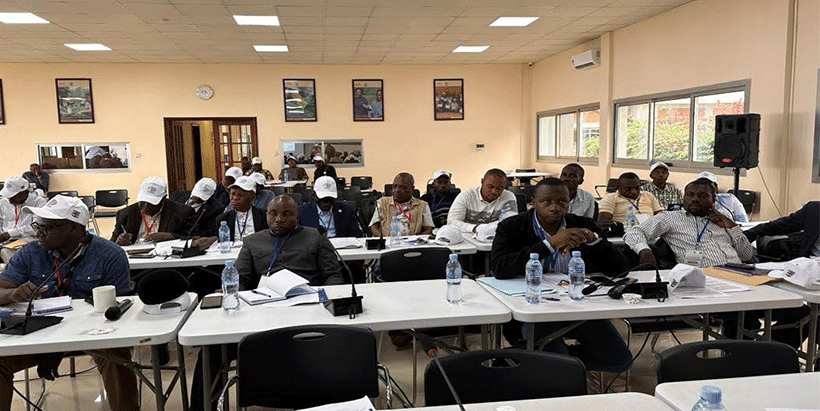
IITA–CGIAR and the Municipality of Bukavu Town, under the RUNRES project—funded by the Swiss Cooperation Agency—organized a workshop to share experiences and set up joint actions and ways to improve the management and recycling of organic waste for more productive and resilient agriculture in the Bukavu rural areas.
The workshop took place at the Olusegun Obasanjo Campus, IITA-Kalambo, on 27 and 28 September 2023. The South Kivu provincial minister of agriculture, provincial minister of environment, officials from Bukavu municipality, local and traditional authorities such as the king of Kabare territory (Mwami), the administrator of Kabare territory, representatives of public research and developments services (INERA, SNV, etc.), civil society, representatives of the Federation of DR Congo’s enterprises (FEC), stakeholders who are involved in garbage collection and recycling, farmers, media, academia, researchers and delegates from international organizations attended the event.
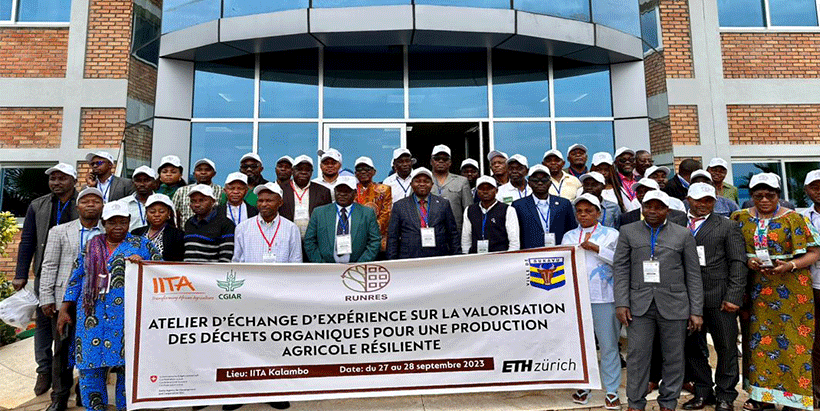
About 70 people attended the two-day event, with presentations on past and ongoing waste recycling-related initiatives being implemented by research-oriented institutions and private organizations in Bukavu. RUNRES experiences in other countries (such as Rwanda) were shared with the participants, and one of the three waste processing sites set up by RUNRES in DRC was visited. There were group works during which participants set up roles and responsibilities of different actors, including the government, to strengthen waste nutrient recycling from organic waste in Bukavu and its rural areas.
Insightful debates and discussions followed presentations, field visits, and group work. The participants welcomed the collective and concerted initiative, which began in waste collection and recycling, and strongly expressed the wish to see the initiative carried on under the guidance and leadership of the provincial political and administrative local bodies.
Representatives of the local authorities made concrete pledges to support the initiatives, such as His Majesty the Mwami (Chief) of Kabare pledging to locate a waste processing site in the Kabare district. The Université Evangelique en Afrique (UEA), through Professor Katcho Karume, pledged to carry out the environmental study of the site that the chiefdom will allocate.
Participants urged donors, international institutions, the government, and all other actors to leverage and support the dynamics of multi-actor consultation and co-design to increase and sustain nutrient recycling from organic waste to establish a bio-circular economy in Bukavu City and its surrounding areas.
An adhoc committee was set up to monitor compliance with the resolutions and guidance from this workshop.
Contributed by Kokou Kintche
Contribué par
Histoires récentes