Innovative solutions for fragile communities: WFP accelerator team visits IITA Yola
décembre 12, 2024
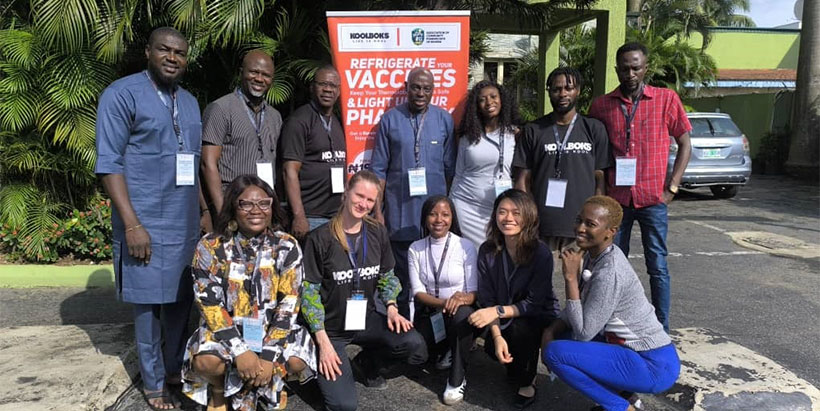
Members of the IITA team, the International Water Management Institute (IWMI), the World Food Programme (WFP) and Koolboks Limited at the workshop in Lagos.
Le IITA Yola office recently hosted a delegation from the World Food Programme (WFP) Innovation Accelerator for a field visit under the Fragility, Conflict, and Migration Innovation (FCMI) Accelerator program. The visit, from 18 to 22 November 2024, marked the second engagement of the WFP team in Nigeria. The first interaction occurred during a Boot Camp held in July 2024 to orient partners and stakeholders on the program’s objectives and prepare beneficiaries for the journey ahead.
The FCMI Accelerator collaborates with the WFP Innovation Accelerator and CGIAR centers, including IITA and the International Water Management Institute (IWMI). This program leverages expertise and resources to promote innovative solutions in fragile and conflict-affected (FCA) settings, with the overarching goal of achieving Sustainable Development Goal (SDG) 2: Zero Hunger. The initiative also supports SDG1 (No Poverty), SDG5 (Gender Equality), SDG13 (Climate Action), and SDG17 (Partnerships for the Goals).
During the field visit, the team assessed the deployment and impact of Koolboks’ solar-powered refrigeration systems in Northeast Nigeria. This innovative technology, piloted in Adamawa and Borno states for the Northeast market, aims to improve food preservation and storage capacities in vulnerable communities. Targeting critical locations such as public abattoirs, markets, and restaurants in Jimeta and Yola, the intervention addresses longstanding challenges posed by unreliable electricity, economic constraints, and frequent power outages.
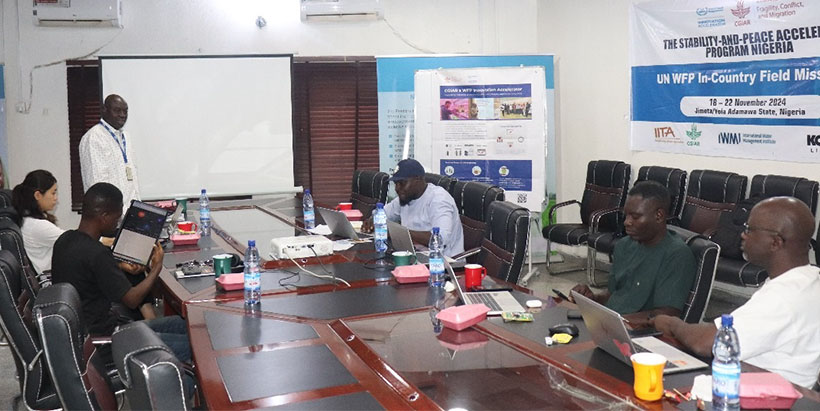
Mr Quadri Shakiru (standing) during his presentation at the session at the IITA Yola office.
The delegation included Zehui Qiu from the WFP and Babatunde Ogunseye from Koolboks Limited, the innovators behind the solar refrigeration solution. Representing IITA were Quadri Shakiru, FCMI Focal Point Coordinator; Isaac Twalbwam Philip, Monitoring and Evaluation Officer; and Sini Ndazhea Luwa of the FCMI program. The visit culminated in a comprehensive evaluation of the market readiness and acceptance of the Koolboks technology, designed to address the critical challenge of food preservation in fragile and conflict-affected regions.
Solar-powered refrigeration systems is coming at a crucial time for Northeast Nigeria, a region grappling with frequent power outages, rising electricity tariffs, increased fuel costs, and heightened vulnerability during the dry season when food preservation needs are at the peak.
By ensuring reliable cold storage, the systems provide a sustainable and cost-effective solution that reduces post-harvest losses, enhances food security, and supports local economic activities, particularly among small and medium enterprises. The IITA Yola team and its partners highlighted the potential of these systems in improving the livelihoods of vulnerable populations. Extensive field evaluations in Jimeta and Yola received overwhelmingly positive feedback from end-users and stakeholders, underscoring the impact of the intervention.
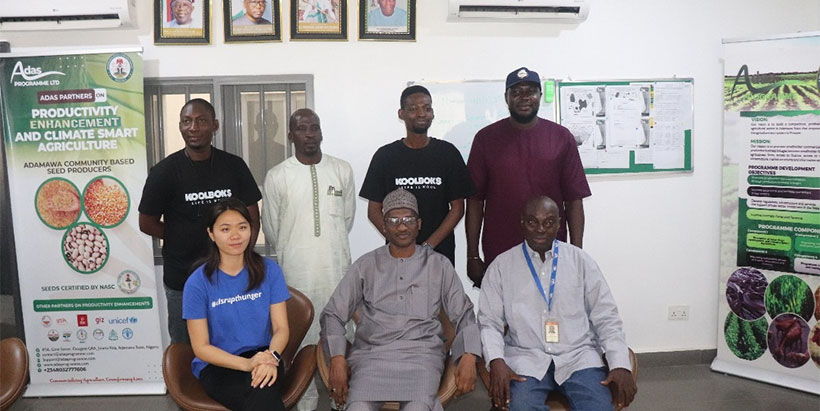
(front row, from left to right) Zehui Qiu, representing the WFP, Alhaji Yunusa Ibrahim Gafai, Lead Consultant and Chief Operating Officer of ADAS-P, Quadri Shakiru, Focal Person The Fragility, Conflict, and Migration Innovation (FCMI) Accelerator team on a visit to the the ADAS-P office in Yola.
The team reviewed findings following the field visit and strategized the next steps. Koolboks Limited was tasked with developing a strategy to meet the anticipated surge in demand for its refrigeration systems while ensuring consistent supply and deployment. Plans were also outlined to enhance community awareness and engagement, maximizing the adoption of the technology.
Additionally, discussions emphasized the need for a long-term sustainability framework to support the scaling of the intervention across other fragile and conflict-affected regions.
Introducing solar-powered refrigeration in Northeast Nigeria also offers broader implications beyond the region. As a scalable solution, it serves as a model for addressing similar challenges in other global FCA settings. Recommendations from the visit include:
Expanding the deployment of refrigeration systems to additional locations,
Encouraging community-led models through cooperatives and networks and
Strengthening monitoring and evaluation frameworks to track impact and identify areas for improvement.
Capacity-building efforts, such as end-user training sessions, will further ensure the systems’ efficiency and longevity.
The WFP team’s second visit to Nigeria emphasizes the progress and potential of the FCMI Accelerator program in driving impactful innovation for sustainable development. The engagement at the IITA Yola office also demonstrated the significant strides made in addressing food preservation challenges in Northeast Nigeria. It reveals immense opportunities for scaling the initiative to achieve broader impacts.
IITA remains at the forefront of fostering resilient and sustainable food systems, leveraging its expertise and partnerships to address pressing global challenges. Through initiatives like the FCMI Accelerator program, IITA reaffirms its commitment to advancing innovative solutions for the most vulnerable communities, ensuring no one is left behind in pursuing sustainable development.
Contributed by Olorunfemi Adedeji
Olamide Deborah Nwanze est une chercheuse principale spécialisée dans la recherche sur l'approche "genre" afin d'éclairer les politiques de sélection participative et inclusive, de développement de variétés et de systèmes semenciers concernant les cultures de racines, tubercules et bananes (RTB) au siège de l'Institut International d'Agriculture Tropicale, à Ibadan, au Nigeria. Elle est candidate au doctorat à l'Université d'Ibadan et titulaire d'un master et d'un diplôme d'ingénieur agronome en vulgarisation agricole et développement rural. Olamide est membre du programme African Women in Agricultural Research and Development – Gender Responsive Agricultural Systems Policy (SAISIE DE RÉCOMPENSEet les Chercheuses Sensibles au Genre Équipées pour la Transformation Agricole (SUPER. Elle cherche à appliquer ses apprentissages en matière d’approche genre, recherche sensible au genre, et expertise en développement et examen de politiques pour faciliter l’accès et l’adoption par les femmes, les jeunes, les enfants et les groupes sociaux vulnérables aux innovations agricoles qui garantissent la sécurité alimentaire, nutritionnelle, des revenus et des moyens de subsistance en Afrique. Ses rôles actuels comprennent le mentorat de chercheurs stagiaires, le développement de guides et manuels de formation, la mise en œuvre et l'adaptation de cadres et d'outils genre, l'engagement des acteurs de la chaîne de valeur en tant que partenaires de la science citoyenne, l'examen et la refonte des politiques, la gestion et l'analyse des données. Ses recherches actuelles portent sur les méthodes mixtes ainsi que sur les approches participatives et interdisciplinaires pour saisir et mettre en évidence les dynamiques de genre, les besoins, les préférences et les défis rencontrés par les parties prenantes au sein de la chaîne de valeur des moyens de subsistance agricoles afin de prioriser des stratégies axées sur le genre dans les programmes de sélection, la conception et la mise en œuvre des politiques.
de Sousa, K., van Etten, J., Manners, R. Bello, A., Teeken, B., Olaosebikan, O., et al. 2024. L'approche tricot : un cadre agile pour les essais décentralisés à la ferme soutenus par la science citoyenne. Une rétrospective. Agron. Sustain. Dev. 44, 8. https://doi.org/10.1007/s13593-023-00937-1
Madu, T., Onwuka, S., Nwafor, S., Onyemauwa, N., Ejechi, M., Ofoeze, M., Ukeje, B., Eluagu, C., Olaosebikan, O., Okoye, B., 2024. Les études sur les consommateurs inclusifs en matière de genre améliorent l'amélioration du manioc au Nigeria dans : Frontiers in Sociology, volume 9, numéro : 1224504, doi : 10.3389/fsoc.2024.1224504
Olaosebikan, O. ; Bello, A. ; Utoblo, O. ; Okoye, B. ; Olutegbe, N. ; Garner, E. ; Teeken, B. ; Bryan, E. ; Forsythe, L. ; Cole, S. ; Madu, T. 2023. Facteurs de stress et résilience au sein de la chaîne de valeur du manioc au Nigeria : Caractéristiques préférées des variétés de manioc et stratégies de réponse des hommes et des femmes pour informer l'amélioration variétale. Sustainability 15, 7837. https://doi.org/10.3390/su15107837
Okoye, B., Ofoeze, M., Ejechi, M., Onwuka, S., Nwafor, S., Onyemauwa, N., Ukeje, B., Eluagu, C., Obidiegwu, J.*, Olaosebikan, O., Madu, T.* 2023. Priorisation des traits préférés dans la chaîne de valeur de l'igname au Nigeria : une analyse de la situation en matière de genre in: Frontiers in Sociology, volume 8, numéro : 1232626, pages 1 – 9, ISSN 2297-7775, 2023. https://www.frontiersin.org/articles/10.3389/fsoc.2023.1232626/full
Olaosebikan, O., Bello, A. A., de Sousa, K., Ndjouenkeu, R., Adesokan, M., Alamu, E. O., Agbona, A., van Etten, J., Kegah, F. N.*, Dufour, D., Bouniol, A., Teeken, B. 2023. Acceptabilité par les consommateurs des produits alimentaires à base de gari-eba de manioc dans des contextes culturels et environnementaux variés en utilisant l'approche triade de comparaison des technologies (tricot) dans : Journal of the Science of Food and Agriculture,
Teeken, B., Olaosebikan, O., Bello, A. A., Madu, T.*, Cole, S. M. 2023. Évaluation qualitative de la positionnalité et des préférences des dyades en relation avec les activités liées au manioc : travailler avec des scientifiques citoyens du procès tricot https://hdl.handle.net/10568/138326 Type : Manuel
Bouniol, A., Ceballos, H., Bello, A. A., Teeken, B., Olaosebikan, O., Owoade, D., Agbona, A., Fotso Kuate, A., Madu, T.*, Okoye, B.*, Ofoeze, M.*, Nwafor, S.*, Onyemauwa, N.*, Adinsi, L.*, Forsythe, L., Dufour, D. 2023. Impact variétal sur le travail des femmes, la charge de travail et la pénibilité associée dans le traitement des plantes à racines, tubercules et bananes : focus sur le manioc en Afrique subsaharienne dans : Journal of the Science of Food and Agriculture, pages 1 – 25, ISSN 0022-5142,
Bello, A. A., Agbona, A., Olaosebikan, O., Edughaen, G., Dufour, D., Bouniol, A., Iluebbey, P., Ndjouenkeu, R.*, Rabbi, I. Y., Teeken, B. 2023. Effets génétiques et environnementaux sur la productivité de la transformation et le rendement des produits alimentaires : la pénibilité du travail des femmes dans : Journal of the Science of Food and Agriculture, pages 1 – 32, ISSN 0022-5142, 5
Cavicchioli, M., Zimbiti, T., Teeken, B., Nwanze, D.O., Liani, M., Parkes, E. & Bello, A. 2023. Rapport sur la formation en sélection génétique sensible au genre à l'IITA. Genetic Resources Center, IITA-HQ, Ibadan, 21-23 septembre 2022. Ibadan, Nigéria : IITA, (34 p.).https://hdl.handle.net/10568/131368
Agbona, A. Peteti P., Teeken B., Olaosebikan O. Bello, A. A., Parkes, E., Rabbi, I. Y., Mueller, L., Egesi, C., Kulakow, P. 2022. Gestion des données dans les programmes d'amélioration des cultures RTB africaines multidisciplinaires. In : Williamson, H.F., Leonelli, S. (eds) Towards Responsible Plant Data Linkage: Data Challenges for Agricultural Research and Development. Springer, Cham. https://doi.org/10.1007/978-3-031-13276-6_5
Lora Forsythe, Pricilla Marimo, Sarah Mayanja, Olamide D. Olaosebikan, Esme Stuart, Bela Teeken, Benjamin Okoye, Tessy Madu, (2021). Analyse transversale du genre dans RTBfoods Étape 2 Cartographie des genres sur les produits RTB. Comprendre les moteurs des préférences en matière de traits et le développement de profils de produits RTB multi-utilisateurs, WP1. Londres, Royaume-Uni : Rapport scientifique de terrain RTBfoods, 30 p.
Teeken, B., Garner, E., Agbona, A., Balogun, I., Olaosebikan, O., Bello, A., Madu, T., Okoye, B., Egesi, C., Kulakow, P. et Tufan, H.A. 2021. Au-delà des “ traits des femmes ” : explorer comment le genre, les différences sociales et les caractéristiques des ménages influencent les préférences pour les traits. Frontiers Systèmes alimentaires durables 5:740926. https://doi.org/10.3389/fsufs.2021.740926
Teeken, B., Agbona, A., Bello, A., Olaosebikan, O., Alamu, E., Adesokan, M., Awoyale, W., Madu, T., Okoye, B., Chijioke, U., Owoade, D., Okoro, M., Bouniol, A., Dufour, D., Hershey, C., Rabbi, I., Maziya‐Dixon, B., Egesi, C., Tufan, H. et Kulakow, P. (020. Comprendre les préférences variétales du manioc par le classement par paires du gari-eba et du fufu préparés par des agriculteurs-transformateurs locaux. Int J Food Sci Technol.https://doi.org/10.1111/ijfs.14862
Bela Teeken, Olamide Olaosebikan, Ireti Balogun, Benjamin Okoye, Tessy Madu, Steven Cole, Abolore Bello, Elizabeth Parkes. (2020). Pilotage des outils de profil client et produit G+ pour l'amélioration sensible au genre du manioc au Nigeria. Nigeria : Institut international d'agriculture tropicale (IIAT). https://hdl.handle.net/20.500.11766/13000