Innovative solutions for fragile communities: WFP accelerator team visits IITA Yola
December 12, 2024
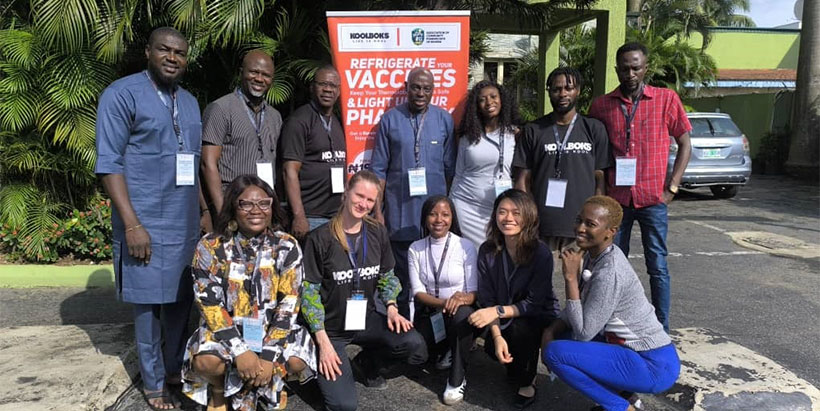
Members of the IITA team, the International Water Management Institute (IWMI), the World Food Programme (WFP) and Koolboks Limited at the workshop in Lagos.
The IITA Yola office recently hosted a delegation from the World Food Programme (WFP) Innovation Accelerator for a field visit under the Fragility, Conflict, and Migration Innovation (FCMI) Accelerator program. The visit, from 18 to 22 November 2024, marked the second engagement of the WFP team in Nigeria. The first interaction occurred during a Boot Camp held in July 2024 to orient partners and stakeholders on the program’s objectives and prepare beneficiaries for the journey ahead.
The FCMI Accelerator collaborates with the WFP Innovation Accelerator and CGIAR centers, including IITA and the International Water Management Institute (IWMI). This program leverages expertise and resources to promote innovative solutions in fragile and conflict-affected (FCA) settings, with the overarching goal of achieving Sustainable Development Goal (SDG) 2: Zero Hunger. The initiative also supports SDG1 (No Poverty), SDG5 (Gender Equality), SDG13 (Climate Action), and SDG17 (Partnerships for the Goals).
During the field visit, the team assessed the deployment and impact of Koolboks’ solar-powered refrigeration systems in Northeast Nigeria. This innovative technology, piloted in Adamawa and Borno states for the Northeast market, aims to improve food preservation and storage capacities in vulnerable communities. Targeting critical locations such as public abattoirs, markets, and restaurants in Jimeta and Yola, the intervention addresses longstanding challenges posed by unreliable electricity, economic constraints, and frequent power outages.
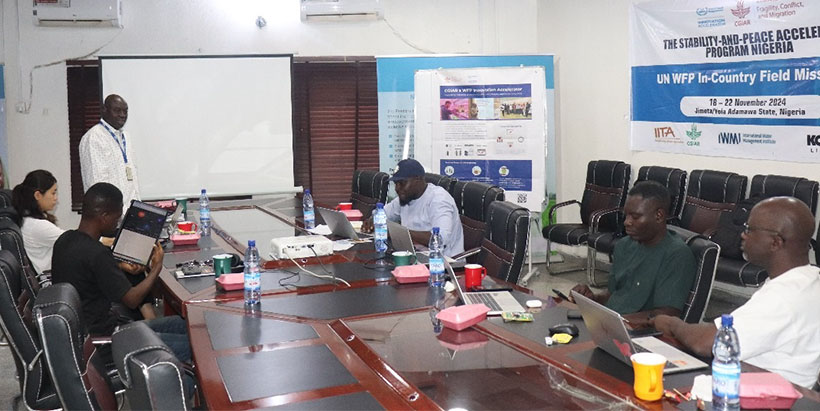
Mr Quadri Shakiru (standing) during his presentation at the session at the IITA Yola office.
The delegation included Zehui Qiu from the WFP and Babatunde Ogunseye from Koolboks Limited, the innovators behind the solar refrigeration solution. Representing IITA were Quadri Shakiru, FCMI Focal Point Coordinator; Isaac Twalbwam Philip, Monitoring and Evaluation Officer; and Sini Ndazhea Luwa of the FCMI program. The visit culminated in a comprehensive evaluation of the market readiness and acceptance of the Koolboks technology, designed to address the critical challenge of food preservation in fragile and conflict-affected regions.
Solar-powered refrigeration systems is coming at a crucial time for Northeast Nigeria, a region grappling with frequent power outages, rising electricity tariffs, increased fuel costs, and heightened vulnerability during the dry season when food preservation needs are at the peak.
By ensuring reliable cold storage, the systems provide a sustainable and cost-effective solution that reduces post-harvest losses, enhances food security, and supports local economic activities, particularly among small and medium enterprises. The IITA Yola team and its partners highlighted the potential of these systems in improving the livelihoods of vulnerable populations. Extensive field evaluations in Jimeta and Yola received overwhelmingly positive feedback from end-users and stakeholders, underscoring the impact of the intervention.
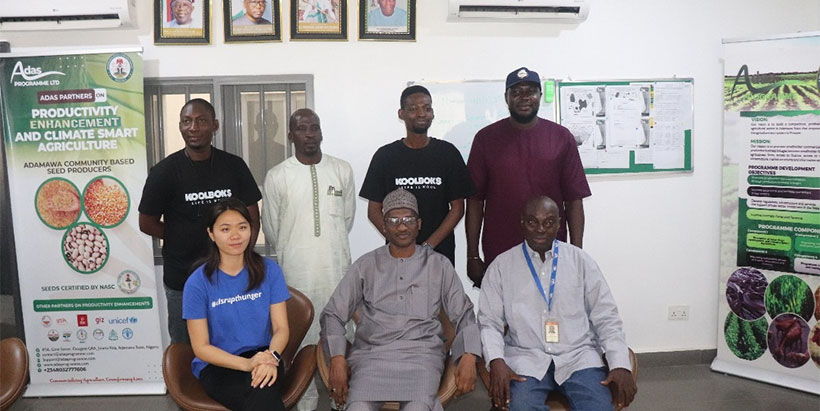
(front row, from left to right) Zehui Qiu, representing the WFP, Alhaji Yunusa Ibrahim Gafai, Lead Consultant and Chief Operating Officer of ADAS-P, Quadri Shakiru, Focal Person The Fragility, Conflict, and Migration Innovation (FCMI) Accelerator team on a visit to the the ADAS-P office in Yola.
The team reviewed findings following the field visit and strategized the next steps. Koolboks Limited was tasked with developing a strategy to meet the anticipated surge in demand for its refrigeration systems while ensuring consistent supply and deployment. Plans were also outlined to enhance community awareness and engagement, maximizing the adoption of the technology.
Additionally, discussions emphasized the need for a long-term sustainability framework to support the scaling of the intervention across other fragile and conflict-affected regions.
Introducing solar-powered refrigeration in Northeast Nigeria also offers broader implications beyond the region. As a scalable solution, it serves as a model for addressing similar challenges in other global FCA settings. Recommendations from the visit include:
Expanding the deployment of refrigeration systems to additional locations,
Encouraging community-led models through cooperatives and networks and
Strengthening monitoring and evaluation frameworks to track impact and identify areas for improvement.
Capacity-building efforts, such as end-user training sessions, will further ensure the systems’ efficiency and longevity.
The WFP team’s second visit to Nigeria emphasizes the progress and potential of the FCMI Accelerator program in driving impactful innovation for sustainable development. The engagement at the IITA Yola office also demonstrated the significant strides made in addressing food preservation challenges in Northeast Nigeria. It reveals immense opportunities for scaling the initiative to achieve broader impacts.
IITA remains at the forefront of fostering resilient and sustainable food systems, leveraging its expertise and partnerships to address pressing global challenges. Through initiatives like the FCMI Accelerator program, IITA reaffirms its commitment to advancing innovative solutions for the most vulnerable communities, ensuring no one is left behind in pursuing sustainable development.
Contributed by Olorunfemi Adedeji
Olamide Deborah Nwanze is a Senior Research Associate specializing in gender mainstreaming research to inform participatory and inclusive breeding, variety development, and seed systems policies regarding root, tuber, and banana (RTB) crops in the International Institute of Tropical Agriculture Headquarters, Ibadan, Nigeria. She is a PhD candidate at the University of Ibadan and holds an MSc and B. Agric in Agricultural Extension and Rural Development. Olamide is a fellow of the African Women in Agricultural Research and Development – Gender Responsive Agricultural Systems Policy (AWARD-GRASP) and the Gender Responsive Researchers Equipped for Agricultural Transformation (GREAT). She seeks to apply her gender-mainstreaming learnings, gender-responsive research, and policy development, and review expertise to facilitate women, youth, children, and vulnerable social group’s access to and adoption of agricultural Innovations that guarantee food, nutrition, income, and livelihood security in Africa. Her current roles include mentoring research fellows, development of guides and training manuals, implementation and adaptation of gender frameworks and tools, value chain actors’ engagement as citizen science partners, policy review and redesign, data management, and analysis. Her current research explores mixed methods and participatory and interdisciplinary approaches to capture and highlight gender dynamics, needs, preferences, and challenges stakeholders face within the agricultural livelihood value chain to prioritize gender-inclusive strategies in breeding programs, policy design, and implementation.
de Sousa, K., van Etten, J., Manners, R. Bello, A., Teeken, B., Olaosebikan, O., et al. 2024. The tricot approach: an agile framework for decentralized on-farm testing supported by citizen science. A retrospective. Agron. Sustain. Dev. 44, 8. https://doi.org/10.1007/s13593-023-00937-1
Madu, T., Onwuka, S., Nwafor, S., Onyemauwa, N., Ejechi, M., Ofoeze, M., Ukeje, B., Eluagu, C., Olaosebikan, O., Okoye, B., 2024. Gender-Inclusive Consumer Studies Improve Cassava Breeding in Nigeria in: Frontiers in Sociology, volume 9, number: 1224504, doi: 10.3389/fsoc.2024.1224504
Olaosebikan, O.; Bello, A.; Utoblo, O.; Okoye, B.; Olutegbe, N.; Garner, E.; Teeken, B.; Bryan, E.; Forsythe, L.; Cole, S.; Madu, T. 2023. Stressors and Resilience within the Cassava Value Chain in Nigeria: Preferred Cassava Variety Traits and Response Strategies of Men and Women to Inform Breeding. Sustainability 15, 7837. https://doi.org/10.3390/su15107837
Okoye, B., Ofoeze, M., Ejechi, M., Onwuka, S., Nwafor, S., Onyemauwa, N., Ukeje, B., Eluagu, C., Obidiegwu, J.*, Olaosebikan, O., Madu, T.* 2023. Prioritizing preferred traits in the yam value chain in Nigeria: a gender situation analysis in: Frontiers in Sociology, volume 8, number: 1232626, pages 1 – 9, ISSN 2297-7775, 2023. https://www.frontiersin.org/articles/10.3389/fsoc.2023.1232626/full
Olaosebikan, O., Bello, A. A., de Sousa, K., Ndjouenkeu, R., Adesokan, M., Alamu, E. O., Agbona, A., van Etten, J., Kegah, F. N.*, Dufour, D., Bouniol, A., Teeken, B. 2023. Consumer acceptability of cassava gari-eba food products across cultural and environmental settings using the triadic comparison of technologies approach (tricot) in: Journal of the Science of Food and Agriculture,
Teeken, B., Olaosebikan, O., Bello, A. A., Madu, T.*, Cole, S. M. 2023. Qualitative assessment on the positionality and preferences of dyads in relation to cassava-related activities: working with tricot trial citizen scientists https://hdl.handle.net/10568/138326 Type: Manual
Bouniol, A., Ceballos, H., Bello, A. A., Teeken, B., Olaosebikan, O., Owoade, D., Agbona, A., Fotso Kuate, A., Madu, T.*, Okoye, B.*, Ofoeze, M.*, Nwafor, S.*, Onyemauwa, N.*, Adinsi, L.*, Forsythe, L., Dufour, D. 2023. Varietal impact on women’s labour, workload and related drudgery in processing root, tuber and banana crops: focus on cassava in sub-Saharan Africa in: Journal of the Science of Food and Agriculture, pages 1 – 25, ISSN 0022-5142,
Bello, A. A., Agbona, A., Olaosebikan, O., Edughaen, G., Dufour, D., Bouniol, A., Iluebbey, P., Ndjouenkeu, R.*, Rabbi, I. Y., Teeken, B. 2023. Genetic and environmental effects on processing productivity and food product yield: drudgery of women’s work in: Journal of the Science of Food and Agriculture, pages 1 – 32, ISSN 0022-5142, 5
Cavicchioli, M., Zimbiti, T., Teeken, B., Nwanze, D.O., Liani, M., Parkes, E. & Bello, A. 2023. IITA-Gender Responsive Breeding Training Report. Genetic Resources Center, IITA-HQ, Ibadan, 21-23 September, 2022. Ibadan, Nigeria: IITA, (34 p.).https://hdl.handle.net/10568/131368
Agbona, A. Peteti P., Teeken B., Olaosebikan O. Bello, A. A., Parkes, E., Rabbi, I. Y., Mueller, L., Egesi, C., Kulakow, P. 2022. Data Management in Multi-disciplinary African RTB Crop Breeding Programs. In: Williamson, H.F., Leonelli, S. (eds) Towards Responsible Plant Data Linkage: Data Challenges for Agricultural Research and Development. Springer, Cham. https://doi.org/10.1007/978-3-031-13276-6_5
Lora Forsythe, Pricilla Marimo, Sarah Mayanja, Olamide D. Olaosebikan, Esme Stuart, Bela Teeken, Benjamin Okoye, Tessy Madu, (2021). Cross-product Gender Analysis of RTBfoods Step 2 Gendered Food Mapping on RTB Products. Understanding the Drivers of Trait Preferences and the Development of Multi-user RTB Product Profiles, WP1. London, UK: RTBfoods Field Scientific Report, 30 p.
Teeken, B., Garner, E., Agbona, A., Balogun, I., Olaosebikan, O., Bello, A., Madu, T., Okoye, B., Egesi, C., Kulakow, P. and Tufan, H.A. 2021. Beyond “Women’s Traits”: Exploring How Gender, Social Difference, and Household Characteristics Influence Trait Preferences. Frontiers Sustainable Food Systems 5:740926. https://doi.org/10.3389/fsufs.2021.740926
Teeken, B., Agbona, A., Bello, A., Olaosebikan, O., Alamu, E., Adesokan, M., Awoyale, W., Madu, T., Okoye, B., Chijioke, U., Owoade, D., Okoro, M., Bouniol, A., Dufour, D., Hershey, C., Rabbi, I., Maziya‐Dixon, B., Egesi, C., Tufan, H. and Kulakow, P. (020. Understanding cassava varietal preferences through pairwise ranking of gari‐eba and fufu prepared by local farmer–processors. Int J Food Sci Technol.https://doi.org/10.1111/ijfs.14862
Bela Teeken, Olamide Olaosebikan, Ireti Balogun, Benjamin Okoye, Tessy Madu, Steven Cole, Abolore Bello, Elizabeth Parkes. (2020). Piloting the G+ customer and product profile tools for gender-responsive cassava breeding in Nigeria. Nigeria: International Institute of Tropical Agriculture (IITA). https://hdl.handle.net/20.500.11766/13000