
NOUVELLES DE L'IITA

Netherlands’ delegation visits the YAS hub and applauds the project’s impact
juillet 25, 2025

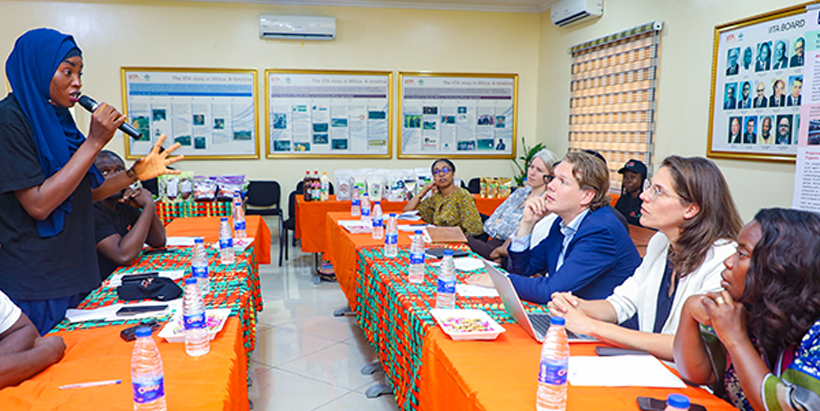
One of YAS Project's participants, Azeezat Lawal, addressing the delegation.
One of YAS Project’s participants, Azeezat Lawal, addressing the delegation.

A top-level delegation from the Kingdom of the Netherlands and its Embassy in Nigeria recently visited the Abuja Hub of the ‘Youth in Agribusiness: Enabling scaling of innovative technologies for sustainable food solutions’, also known as the YAS project. The visit enabled the delegation to witness the project implementation outcomes first-hand and examine the critical sustainability areas.

While welcoming the guests, YAS team lead and Chief Executive Officer, IITA Youth Agripreneurs (IYA), Aline Mugisho, applauded the Embassy for the support, saying that through its capacity development and post-training support, YAS had helped many youths to start thriving agribusinesses. In contrast, many existing agribusinesses had been able to scale up, translating to improved livelihood and job creation for other youths.

She added, “YAS is our baby, and we can all see the growth that has happened to businesses in exponential dimensions that even the participants could not have imagined. We are pleased with what we have achieved, and our satisfaction lies in the many agribusinesses thriving because YAS stepped in.”
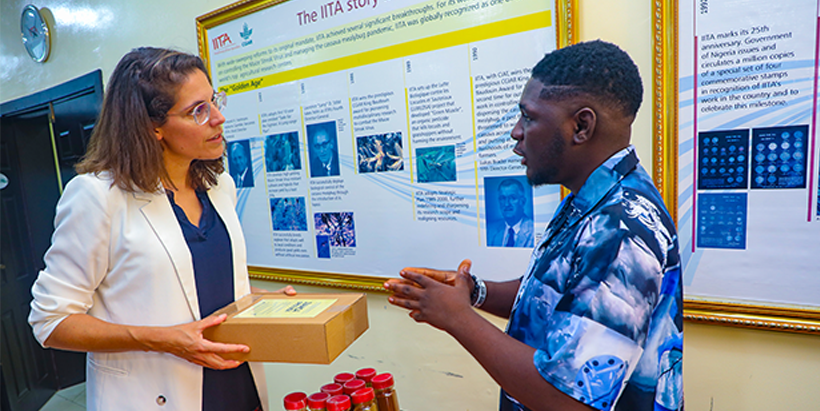
A participant showcasing his products to a member of the delegation.

After a robust round-table discussion with some participants to assess the project’s impact on their businesses, the delegation proceeded to the exhibition stand to see the various products produced and packaged by the participants. This was followed by a visit to the aquaculture, horticulture, and poultry agribusiness hubs, where they witnessed ongoing activities and interacted with the participants running the hubs.

Speaking on the delegation’s assessment of the project’s outcomes, the Netherlands Youth Ambassador, Jurriaan Middelhoff, applauded the devotion and passion of the participants, saying the initiative had further shown that agriculture could help to reduce youth unemployment, especially if approached as a business and not a vocation.

He added, “To thrive in agriculture requires creativity, entrepreneurial skills, and perseverance, and you are showing all of these. Thanks to the YAS project, we try to demonstrate that you can achieve job numbers if you approach it from the agribusiness mindset, which is so exciting.
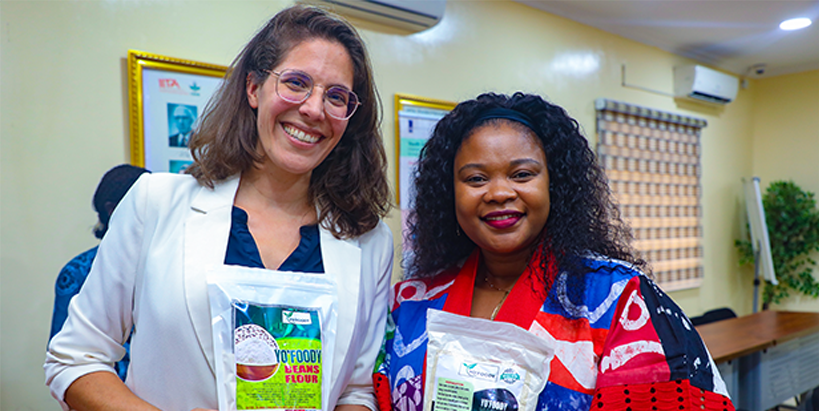
 A member of the delegation, Ms. Stephanie Wellink (left); and YAS Team Lead, Ms Aline Mugisho, at the Exhibition (right).
A member of the delegation, Ms. Stephanie Wellink (left); and YAS Team Lead, Ms Aline Mugisho, at the Exhibition (right).

“Looking at the amazing products during the exhibition and knowing that the people behind those products are our partners who put their heart and passion into it, simply explains how they came up with new or better versions of existing products.

“You have a unique selling point: passion, and I have seen that with everyone. I also love how connections have been made across commodities. In that sense, you are not competitors but partners, which is commendable and a unique selling point for the project. I believe that participating in YAS is one of the best decisions you have made in your agribusiness. We also encourage you to spread the word in your communities.”

Senior Policy Officer, Youth, Employment and Work, Stephanie Wellink, expressed delight with the participants’ performance, noting, “I was excited seeing what you all have been able to achieve and how you are going about it. It is incredible.”

“I cannot stress enough that the innovation you are making, the little twist in how you produce your products to make them better, and what you are doing to get the authorities’ approval are inspiring, and that is what innovation is. It’s amazing and difficult to find, so synergize and make greater success out of your enterprises. It has been so inspiring seeing what you have been doing.”

In her remarks, Senior Policy Officer, Human Capital Development, Embassy of the Netherlands, Temitayo Akinbiyi, stressed that youth engagement remained central to the Netherlands’ bilateral relations with Nigeria and that the purpose of the visit was to measure the impact of the project and be sure it was demand-driven. “The visit is for us to see if we are only changing the lives of urban youth or we are also impacting the semi-urban or rural youths, and we have seen that with YAS, we have been able to affect both segments of the society.”

Other members of the delegation included Foluso Adejoro, the Senior Policy Officer for Food Security and Climate; Nienke Raap, the Policy Officer for West Africa, Department of African Affairs; Sonia Odije, the Policy Officer for Youth and Health, Consulate General of the Netherlands; and Jessica Odudu, the Projects and Communication Officer, Embassy of the Netherlands.

The participants appreciated the Kingdom of the Netherlands’ support, noting that the project had an invaluable impact on their businesses.

One of them, Precious Zamdayu, said he was involved in fish farming and spice production before the training, but that he incurred huge losses on the fish farm while the spice production operated on a low scale. However, he said his participation in the YAS training marked a turning point for the business.

He stated, “I was one of the aquaculture trainees. The experience from YAS helped me a lot on my farm, as I have increased my output. We used to battle a high mortality rate, and many fish didn’t make it to table size.

I started the business out of passion. I had no knowledge of it, and I fed the fish how I liked. But when I came to YAS, I learned so much, and they gave us a feeding chart. That helped the fish grow well, and I also reduced my costs and increased my profit.

Also, there was a gap in business intelligence in my spice production before YAS. Meanwhile, a section of the training focused on business intelligence, and after the training, I was able to start a new product called the ‘Spice Box’. Before, we sold single spices, but this time round, we produced nine different spices that most Nigerian homes use regularly. We packaged them in a box and called it the Jiamca Spice Subscription Box. People sign up for the box, and we deliver to their destination monthly or quarterly, depending on their preference. And all our products are 100 per cent organic, so they are very safe.”

Contributed by Babatunde Ajaja


Contribué par

Nouvelles connexes

Aucun article trouvé

Laisser un commentaire

Votre adresse e-mail ne sera pas publiée. Les champs obligatoires sont indiqués avec *

Retour en haut
Olaosebikan, Olamide

Olamide Deborah Nwanze est une chercheuse principale spécialisée dans la recherche sur l'approche "genre" afin d'éclairer les politiques de sélection participative et inclusive, de développement de variétés et de systèmes semenciers concernant les cultures de racines, tubercules et bananes (RTB) au siège de l'Institut International d'Agriculture Tropicale, à Ibadan, au Nigeria. Elle est candidate au doctorat à l'Université d'Ibadan et titulaire d'un master et d'un diplôme d'ingénieur agronome en vulgarisation agricole et développement rural. Olamide est membre du programme African Women in Agricultural Research and Development – Gender Responsive Agricultural Systems Policy (SAISIE DE RÉCOMPENSEet les Chercheuses Sensibles au Genre Équipées pour la Transformation Agricole (SUPER. Elle cherche à appliquer ses apprentissages en matière d’approche genre, recherche sensible au genre, et expertise en développement et examen de politiques pour faciliter l’accès et l’adoption par les femmes, les jeunes, les enfants et les groupes sociaux vulnérables aux innovations agricoles qui garantissent la sécurité alimentaire, nutritionnelle, des revenus et des moyens de subsistance en Afrique. Ses rôles actuels comprennent le mentorat de chercheurs stagiaires, le développement de guides et manuels de formation, la mise en œuvre et l'adaptation de cadres et d'outils genre, l'engagement des acteurs de la chaîne de valeur en tant que partenaires de la science citoyenne, l'examen et la refonte des politiques, la gestion et l'analyse des données. Ses recherches actuelles portent sur les méthodes mixtes ainsi que sur les approches participatives et interdisciplinaires pour saisir et mettre en évidence les dynamiques de genre, les besoins, les préférences et les défis rencontrés par les parties prenantes au sein de la chaîne de valeur des moyens de subsistance agricoles afin de prioriser des stratégies axées sur le genre dans les programmes de sélection, la conception et la mise en œuvre des politiques.

À l'IITA, elle contribue à la mise en œuvre du CGIAR Initiative d'Élevage Accéléré et Innovation génétique Programmes ; recherche participative et genre au sein des Prochaine Génération ManiocHarvestPlusRTBAliments, et Tricot-ClimMob 1000Fermes Projets ; et la communication des connaissances sur le genre via le Série de webinaires G-LENS, vidéo documentaire, notes de politiquepublications, et blogs.


Publications récentes

de Sousa, K., van Etten, J., Manners, R. Bello, A., Teeken, B., Olaosebikan, O., et al. 2024. L'approche tricot : un cadre agile pour les essais décentralisés à la ferme soutenus par la science citoyenne. Une rétrospective. Agron. Sustain. Dev. 44, 8. https://doi.org/10.1007/s13593-023-00937-1

Madu, T., Onwuka, S., Nwafor, S., Onyemauwa, N., Ejechi, M., Ofoeze, M., Ukeje, B., Eluagu, C., Olaosebikan, O., Okoye, B., 2024. Les études sur les consommateurs inclusifs en matière de genre améliorent l'amélioration du manioc au Nigeria dans : Frontiers in Sociology, volume 9, numéro : 1224504, doi : 10.3389/fsoc.2024.1224504

Olaosebikan, O. ; Bello, A. ; Utoblo, O. ; Okoye, B. ; Olutegbe, N. ; Garner, E. ; Teeken, B. ; Bryan, E. ; Forsythe, L. ; Cole, S. ; Madu, T. 2023. Facteurs de stress et résilience au sein de la chaîne de valeur du manioc au Nigeria : Caractéristiques préférées des variétés de manioc et stratégies de réponse des hommes et des femmes pour informer l'amélioration variétale. Sustainability 15, 7837. https://doi.org/10.3390/su15107837

Okoye, B., Ofoeze, M., Ejechi, M., Onwuka, S., Nwafor, S., Onyemauwa, N., Ukeje, B., Eluagu, C., Obidiegwu, J.*, Olaosebikan, O., Madu, T.* 2023. Priorisation des traits préférés dans la chaîne de valeur de l'igname au Nigeria : une analyse de la situation en matière de genre in: Frontiers in Sociology, volume 8, numéro : 1232626, pages 1 – 9, ISSN 2297-7775, 2023. https://www.frontiersin.org/articles/10.3389/fsoc.2023.1232626/full

Olaosebikan, O., Bello, A. A., de Sousa, K., Ndjouenkeu, R., Adesokan, M., Alamu, E. O., Agbona, A., van Etten, J., Kegah, F. N.*, Dufour, D., Bouniol, A., Teeken, B. 2023. Acceptabilité par les consommateurs des produits alimentaires à base de gari-eba de manioc dans des contextes culturels et environnementaux variés en utilisant l'approche triade de comparaison des technologies (tricot) dans : Journal of the Science of Food and Agriculture,

Teeken, B., Olaosebikan, O., Bello, A. A., Madu, T.*, Cole, S. M. 2023. Évaluation qualitative de la positionnalité et des préférences des dyades en relation avec les activités liées au manioc : travailler avec des scientifiques citoyens du procès tricot https://hdl.handle.net/10568/138326 Type : Manuel

Bouniol, A., Ceballos, H., Bello, A. A., Teeken, B., Olaosebikan, O., Owoade, D., Agbona, A., Fotso Kuate, A., Madu, T.*, Okoye, B.*, Ofoeze, M.*, Nwafor, S.*, Onyemauwa, N.*, Adinsi, L.*, Forsythe, L., Dufour, D. 2023. Impact variétal sur le travail des femmes, la charge de travail et la pénibilité associée dans le traitement des plantes à racines, tubercules et bananes : focus sur le manioc en Afrique subsaharienne dans : Journal of the Science of Food and Agriculture, pages 1 – 25, ISSN 0022-5142,

Bello, A. A., Agbona, A., Olaosebikan, O., Edughaen, G., Dufour, D., Bouniol, A., Iluebbey, P., Ndjouenkeu, R.*, Rabbi, I. Y., Teeken, B. 2023. Effets génétiques et environnementaux sur la productivité de la transformation et le rendement des produits alimentaires : la pénibilité du travail des femmes dans : Journal of the Science of Food and Agriculture, pages 1 – 32, ISSN 0022-5142, 5

Cavicchioli, M., Zimbiti, T., Teeken, B., Nwanze, D.O., Liani, M., Parkes, E. & Bello, A. 2023. Rapport sur la formation en sélection génétique sensible au genre à l'IITA. Genetic Resources Center, IITA-HQ, Ibadan, 21-23 septembre 2022. Ibadan, Nigéria : IITA, (34 p.).https://hdl.handle.net/10568/131368

Agbona, A. Peteti P., Teeken B., Olaosebikan O. Bello, A. A., Parkes, E., Rabbi, I. Y., Mueller, L., Egesi, C., Kulakow, P. 2022. Gestion des données dans les programmes d'amélioration des cultures RTB africaines multidisciplinaires. In : Williamson, H.F., Leonelli, S. (eds) Towards Responsible Plant Data Linkage: Data Challenges for Agricultural Research and Development. Springer, Cham. https://doi.org/10.1007/978-3-031-13276-6_5

Lora Forsythe, Pricilla Marimo, Sarah Mayanja, Olamide D. Olaosebikan, Esme Stuart, Bela Teeken, Benjamin Okoye, Tessy Madu, (2021). Analyse transversale du genre dans RTBfoods Étape 2 Cartographie des genres sur les produits RTB. Comprendre les moteurs des préférences en matière de traits et le développement de profils de produits RTB multi-utilisateurs, WP1. Londres, Royaume-Uni : Rapport scientifique de terrain RTBfoods, 30 p.

Teeken, B., Garner, E., Agbona, A., Balogun, I., Olaosebikan, O., Bello, A., Madu, T., Okoye, B., Egesi, C., Kulakow, P. et Tufan, H.A. 2021. Au-delà des “ traits des femmes ” : explorer comment le genre, les différences sociales et les caractéristiques des ménages influencent les préférences pour les traits. Frontiers Systèmes alimentaires durables 5:740926. https://doi.org/10.3389/fsufs.2021.740926

Teeken, B., Agbona, A., Bello, A., Olaosebikan, O., Alamu, E., Adesokan, M., Awoyale, W., Madu, T., Okoye, B., Chijioke, U., Owoade, D., Okoro, M., Bouniol, A., Dufour, D., Hershey, C., Rabbi, I., Maziya‐Dixon, B., Egesi, C., Tufan, H. et Kulakow, P. (020. Comprendre les préférences variétales du manioc par le classement par paires du gari-eba et du fufu préparés par des agriculteurs-transformateurs locaux. Int J Food Sci Technol. https://doi.org/10.1111/ijfs.14862

Bela Teeken, Olamide Olaosebikan, Ireti Balogun, Benjamin Okoye, Tessy Madu, Steven Cole, Abolore Bello, Elizabeth Parkes. (2020). Pilotage des outils de profil client et produit G+ pour l'amélioration sensible au genre du manioc au Nigeria. Nigeria : Institut international d'agriculture tropicale (IIAT). https://hdl.handle.net/20.500.11766/13000