Le réseau progresse dans le renforcement de la recherche sur le genre à l'IITA
4 septembre 2020
Le réseau de science du genre de l'IITA a fait des progrès significatifs dans ses efforts pour améliorer la recherche sur le genre au sein de l'institut. Le réseau, qui est composé de spécialistes des sciences sociales et biophysiques de l'IITA, d'experts techniques du Programme Jeunesse et de personnel d'autres unités, a finalisé sa stratégie de travail qui articule la manière dont le réseau fonctionnera en 2020 et au-delà pour aider à renforcer la recherche sur le genre à l'IITA.
L'équipe Genre envisage de disposer d'un réseau de scientifiques innovant et diversifié à l'IITA pour renforcer la qualité et la visibilité de la recherche sur le genre à l'IITA par le dialogue, la coopération et l'influence sur le programme de mise en œuvre de l'institut. Son objectif est d'être une communauté de pratique dynamique pour le plaidoyer en faveur du genre et l'amélioration de la recherche sur le genre, de sa communication et de son impact.
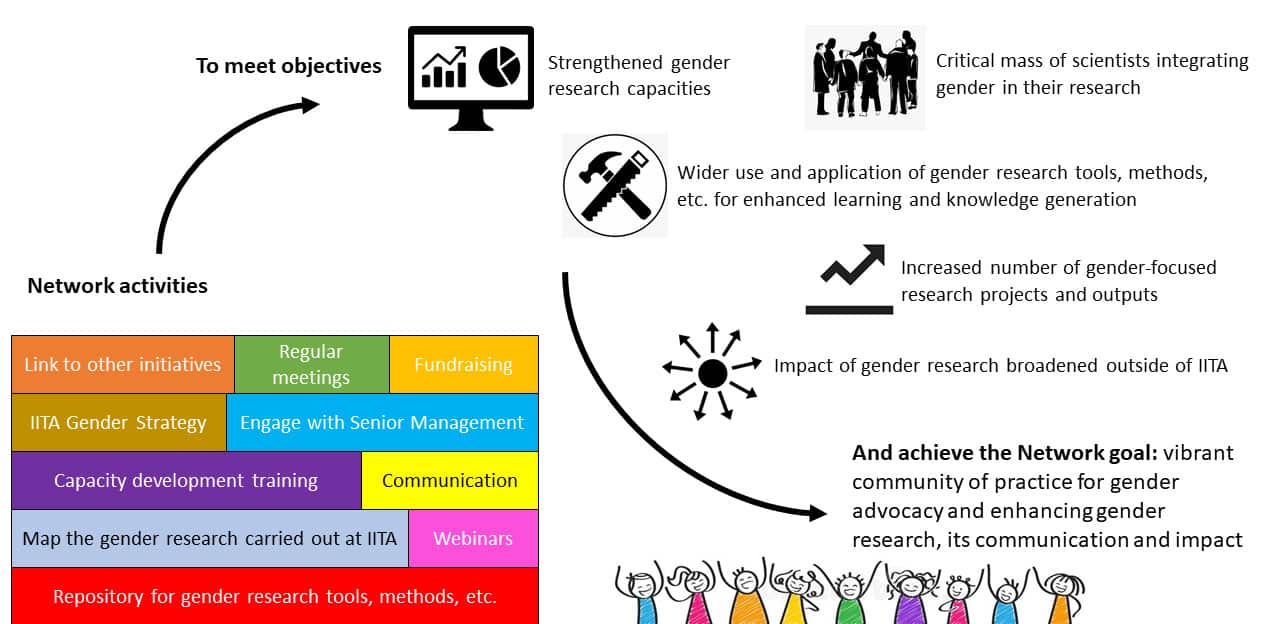
La théorie du changement de la stratégie montrant les différents composants
Le réseau poursuit cinq objectifs principaux, notamment : (1) renforcer les capacités des membres du réseau en matière de recherche sur le genre ; (2) développer et partager des outils, des méthodes et des analyses de recherche sur le genre afin de les appliquer à plus grande échelle dans le cadre de projets et de programmes de recherche plus vastes, et d’améliorer l’apprentissage des membres du réseau ; (3) mobiliser un nombre plus important et plus diversifié de membres au sein de l’IITA afin de créer une masse critique de scientifiques intégrant la dimension de genre dans leurs recherches ; (4) augmenter le nombre de projets de recherche axés sur le genre au sein de l’IITA ainsi que les résultats produits par celui-ci ; et (5) nouer des partenariats en dehors du réseau afin d’élargir l’impact de la recherche sur le genre, notamment avec des partenaires nationaux.
En lien avec ces objectifs, le réseau a identifié 10 activités qui débuteront cette année. Il s’agit notamment d’organiser des réunions trimestrielles en ligne et une réunion en présentiel pour le partage des connaissances et l’apprentissage ; de développer une base de données permettant de partager une grande variété d’outils de recherche sur le genre, de stratégies d’analyse, de lectures essentielles et de publications, de webinaires, etc. ; de promouvoir la prise en compte et l’intégration de la dimension de genre dans la recherche ; de sensibiliser et de favoriser la compréhension de la recherche sur le genre ; et de mener des activités de renforcement des capacités en matière de recherche sur le genre.
Ce renforcement de la recherche sur le genre à l’IITA devrait contribuer à la vision de l’Institut visant à transformer l’agriculture africaine.
“ La question du genre revêt une grande importance à l’IITA, car nous traitons de questions liées à l’amélioration des moyens de subsistance de la société. Nous ne pouvons pas atteindre cet objectif tant qu’il existe des inégalités et que des groupes sont marginalisés et vulnérables. Des approches transformatrices en matière de genre sont nécessaires pour évoluer vers une société égalitaire. Le réseau sur le genre est ce moteur que l’IITA a mis en place pour guider l’institut et ses membres dans cette direction. Au cours des derniers trimestres, le réseau a réalisé d’énormes progrès en suscitant l’intérêt de la communauté de l’IITA, comme en témoigne la forte participation de membres du personnel issus de différentes disciplines et horizons. La nouvelle experte en questions de genre est la pièce maîtresse qui contribue à ces progrès ”, a expliqué Victor Manyong, directeur de l’IITA pour le pôle Afrique de l’Est.
“ Notre approche participative lors de la conception du réseau scientifique sur le genre, en collaboration avec des membres du personnel de l’IITA issus de différents horizons techniques, contribuera à garantir que le réseau apporte une contribution importante au sein de l’IITA et renforce la recherche globale sur le genre au sein de l’institut ”, a déclaré Steven Cole, coordinateur des questions de genre à l’IITA.
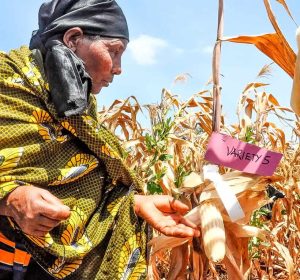
Une agricultrice participant à une évaluation participative des variétés dans le cadre du projet Africa RISING
“ Faire partie du réseau sur le genre améliorera notre champ d'action. Le bureau ” La jeunesse dans l'agroentreprise “ souligne l'importance d'une participation et de chances égales pour tous, en particulier pour les femmes. Les composantes liées au genre doivent faire partie intégrante de tout projet de développement et cette plateforme nous aidera à affiner notre stratégie en matière de genre et à plaider pour une participation active de toutes les parties prenantes ”, a expliqué Evelyne Ohanwusi, coordinatrice du projet Young Africa Works et du bureau “ La jeunesse dans l'agroentreprise ” de l'IITA.
Selon Béla Teeken, chercheur associé en sciences sociales et de genre à l'IITA, « Le réseau sur le genre est essentiel pour intégrer concrètement le genre dans les sciences biophysiques et socio-économiques de l'IITA, car les aspects liés au genre sont cruciaux pour concevoir et fournir des technologies et des innovations institutionnelles d'une manière socialement inclusive. Une grande partie du groupe cible de l'IITA comprend des petits producteurs, transformateurs et négociants de cultures et, en particulier en Afrique, une grande partie du travail lié aux cultures est organisée selon les rôles de genre. »
Il ajoute : « Nous venons de lancer le réseau et l'intérêt manifesté par des personnes travaillant dans diverses disciplines est très encourageant. Le réseau sur le genre est un pôle important pour une approche interdisciplinaire axée sur les problèmes, visant un résultat et un impact socialement inclusifs afin d'améliorer les conditions de vie des populations et de réduire la pauvreté. »
Le réseau actuel s'appuie sur les efforts passés visant à rassembler les scientifiques de l'IITA en tant que communauté de pratique pour l'apprentissage et le partage des connaissances. En novembre 2019, les membres se sont réunis pour déterminer comment le réseau pouvait s'ouvrir pour inclure d'autres membres du personnel de l'IITA. Une analyse SWOT (forces, faiblesses, opportunités et menaces) a été réalisée pour aider à orienter la nouvelle direction du réseau. Le personnel de l'IITA a ensuite été invité à assister à une réunion sur le réseau pour contribuer à définir sa vision, son but, ses objectifs et ses principales activités. Par la suite, la stratégie du réseau a été élaborée au début de 2020, laquelle guide les efforts de mise en œuvre.
Olamide Deborah Nwanze est une chercheuse principale spécialisée dans la recherche sur l'approche "genre" afin d'éclairer les politiques de sélection participative et inclusive, de développement de variétés et de systèmes semenciers concernant les cultures de racines, tubercules et bananes (RTB) au siège de l'Institut International d'Agriculture Tropicale, à Ibadan, au Nigeria. Elle est candidate au doctorat à l'Université d'Ibadan et titulaire d'un master et d'un diplôme d'ingénieur agronome en vulgarisation agricole et développement rural. Olamide est membre du programme African Women in Agricultural Research and Development – Gender Responsive Agricultural Systems Policy (SAISIE DE RÉCOMPENSEet les Chercheuses Sensibles au Genre Équipées pour la Transformation Agricole (SUPER. Elle cherche à appliquer ses apprentissages en matière d’approche genre, recherche sensible au genre, et expertise en développement et examen de politiques pour faciliter l’accès et l’adoption par les femmes, les jeunes, les enfants et les groupes sociaux vulnérables aux innovations agricoles qui garantissent la sécurité alimentaire, nutritionnelle, des revenus et des moyens de subsistance en Afrique. Ses rôles actuels comprennent le mentorat de chercheurs stagiaires, le développement de guides et manuels de formation, la mise en œuvre et l'adaptation de cadres et d'outils genre, l'engagement des acteurs de la chaîne de valeur en tant que partenaires de la science citoyenne, l'examen et la refonte des politiques, la gestion et l'analyse des données. Ses recherches actuelles portent sur les méthodes mixtes ainsi que sur les approches participatives et interdisciplinaires pour saisir et mettre en évidence les dynamiques de genre, les besoins, les préférences et les défis rencontrés par les parties prenantes au sein de la chaîne de valeur des moyens de subsistance agricoles afin de prioriser des stratégies axées sur le genre dans les programmes de sélection, la conception et la mise en œuvre des politiques.
de Sousa, K., van Etten, J., Manners, R. Bello, A., Teeken, B., Olaosebikan, O., et al. 2024. L'approche tricot : un cadre agile pour les essais décentralisés à la ferme soutenus par la science citoyenne. Une rétrospective. Agron. Sustain. Dev. 44, 8. https://doi.org/10.1007/s13593-023-00937-1
Madu, T., Onwuka, S., Nwafor, S., Onyemauwa, N., Ejechi, M., Ofoeze, M., Ukeje, B., Eluagu, C., Olaosebikan, O., Okoye, B., 2024. Les études sur les consommateurs inclusifs en matière de genre améliorent l'amélioration du manioc au Nigeria dans : Frontiers in Sociology, volume 9, numéro : 1224504, doi : 10.3389/fsoc.2024.1224504
Olaosebikan, O. ; Bello, A. ; Utoblo, O. ; Okoye, B. ; Olutegbe, N. ; Garner, E. ; Teeken, B. ; Bryan, E. ; Forsythe, L. ; Cole, S. ; Madu, T. 2023. Facteurs de stress et résilience au sein de la chaîne de valeur du manioc au Nigeria : Caractéristiques préférées des variétés de manioc et stratégies de réponse des hommes et des femmes pour informer l'amélioration variétale. Sustainability 15, 7837. https://doi.org/10.3390/su15107837
Okoye, B., Ofoeze, M., Ejechi, M., Onwuka, S., Nwafor, S., Onyemauwa, N., Ukeje, B., Eluagu, C., Obidiegwu, J.*, Olaosebikan, O., Madu, T.* 2023. Priorisation des traits préférés dans la chaîne de valeur de l'igname au Nigeria : une analyse de la situation en matière de genre in: Frontiers in Sociology, volume 8, numéro : 1232626, pages 1 – 9, ISSN 2297-7775, 2023. https://www.frontiersin.org/articles/10.3389/fsoc.2023.1232626/full
Olaosebikan, O., Bello, A. A., de Sousa, K., Ndjouenkeu, R., Adesokan, M., Alamu, E. O., Agbona, A., van Etten, J., Kegah, F. N.*, Dufour, D., Bouniol, A., Teeken, B. 2023. Acceptabilité par les consommateurs des produits alimentaires à base de gari-eba de manioc dans des contextes culturels et environnementaux variés en utilisant l'approche triade de comparaison des technologies (tricot) dans : Journal of the Science of Food and Agriculture,
Teeken, B., Olaosebikan, O., Bello, A. A., Madu, T.*, Cole, S. M. 2023. Évaluation qualitative de la positionnalité et des préférences des dyades en relation avec les activités liées au manioc : travailler avec des scientifiques citoyens du procès tricot https://hdl.handle.net/10568/138326 Type : Manuel
Bouniol, A., Ceballos, H., Bello, A. A., Teeken, B., Olaosebikan, O., Owoade, D., Agbona, A., Fotso Kuate, A., Madu, T.*, Okoye, B.*, Ofoeze, M.*, Nwafor, S.*, Onyemauwa, N.*, Adinsi, L.*, Forsythe, L., Dufour, D. 2023. Impact variétal sur le travail des femmes, la charge de travail et la pénibilité associée dans le traitement des plantes à racines, tubercules et bananes : focus sur le manioc en Afrique subsaharienne dans : Journal of the Science of Food and Agriculture, pages 1 – 25, ISSN 0022-5142,
Bello, A. A., Agbona, A., Olaosebikan, O., Edughaen, G., Dufour, D., Bouniol, A., Iluebbey, P., Ndjouenkeu, R.*, Rabbi, I. Y., Teeken, B. 2023. Effets génétiques et environnementaux sur la productivité de la transformation et le rendement des produits alimentaires : la pénibilité du travail des femmes dans : Journal of the Science of Food and Agriculture, pages 1 – 32, ISSN 0022-5142, 5
Cavicchioli, M., Zimbiti, T., Teeken, B., Nwanze, D.O., Liani, M., Parkes, E. & Bello, A. 2023. Rapport sur la formation en sélection génétique sensible au genre à l'IITA. Genetic Resources Center, IITA-HQ, Ibadan, 21-23 septembre 2022. Ibadan, Nigéria : IITA, (34 p.).https://hdl.handle.net/10568/131368
Agbona, A. Peteti P., Teeken B., Olaosebikan O. Bello, A. A., Parkes, E., Rabbi, I. Y., Mueller, L., Egesi, C., Kulakow, P. 2022. Gestion des données dans les programmes d'amélioration des cultures RTB africaines multidisciplinaires. In : Williamson, H.F., Leonelli, S. (eds) Towards Responsible Plant Data Linkage: Data Challenges for Agricultural Research and Development. Springer, Cham. https://doi.org/10.1007/978-3-031-13276-6_5
Lora Forsythe, Pricilla Marimo, Sarah Mayanja, Olamide D. Olaosebikan, Esme Stuart, Bela Teeken, Benjamin Okoye, Tessy Madu, (2021). Analyse transversale du genre dans RTBfoods Étape 2 Cartographie des genres sur les produits RTB. Comprendre les moteurs des préférences en matière de traits et le développement de profils de produits RTB multi-utilisateurs, WP1. Londres, Royaume-Uni : Rapport scientifique de terrain RTBfoods, 30 p.
Teeken, B., Garner, E., Agbona, A., Balogun, I., Olaosebikan, O., Bello, A., Madu, T., Okoye, B., Egesi, C., Kulakow, P. et Tufan, H.A. 2021. Au-delà des “ traits des femmes ” : explorer comment le genre, les différences sociales et les caractéristiques des ménages influencent les préférences pour les traits. Frontiers Systèmes alimentaires durables 5:740926. https://doi.org/10.3389/fsufs.2021.740926
Teeken, B., Agbona, A., Bello, A., Olaosebikan, O., Alamu, E., Adesokan, M., Awoyale, W., Madu, T., Okoye, B., Chijioke, U., Owoade, D., Okoro, M., Bouniol, A., Dufour, D., Hershey, C., Rabbi, I., Maziya‐Dixon, B., Egesi, C., Tufan, H. et Kulakow, P. (020. Comprendre les préférences variétales du manioc par le classement par paires du gari-eba et du fufu préparés par des agriculteurs-transformateurs locaux. Int J Food Sci Technol.https://doi.org/10.1111/ijfs.14862
Bela Teeken, Olamide Olaosebikan, Ireti Balogun, Benjamin Okoye, Tessy Madu, Steven Cole, Abolore Bello, Elizabeth Parkes. (2020). Pilotage des outils de profil client et produit G+ pour l'amélioration sensible au genre du manioc au Nigeria. Nigeria : Institut international d'agriculture tropicale (IIAT). https://hdl.handle.net/20.500.11766/13000