Network makes headway in strengthening gender research at IITA
September 4, 2020
The gender science network at IITA has made significant progress in its efforts to enhance gender research at the institute. The network, which is made up of IITA social and biophysical scientists, Youth Program technical experts, and staff from other units, has finalized its working strategy that articulates how the network will operate in 2020 and beyond to help strengthen gender research at IITA.
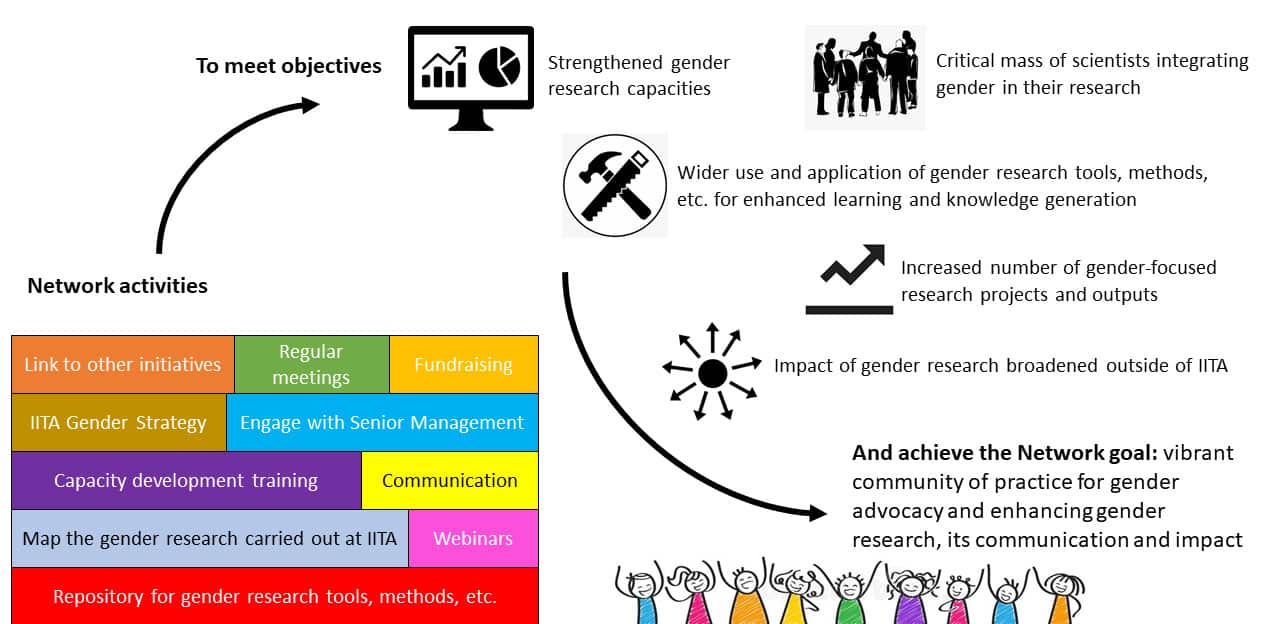
The Gender team envisions having an innovative and diverse network of scientists in IITA to strengthen the quality and visibility of gender research at IITA through dialogue, cooperation, and influencing the delivery agenda of the institute. Its goal is to be a vibrant community of practice for gender advocacy and enhancing gender research, its communication, and impact.
The strategy’s theory of change showing the different components
The network has five main objectives, including to: (1) strengthen gender research capacities of network members; (2) develop and share gender research tools, methods, and analyses for wider application in projects and larger research programs and for enhanced learning by network members; (3) mobilize a diverse and larger membership within IITA to create a critical mass of scientists integrating gender in their research, (4) increase the number of gender-focused research projects in and outputs produced by IITA, and, (5) engage outside the network to broaden the impact of gender research, including with national partners.
Linked to these objectives, the network has identified 10 activities starting this year. These include organizing quarterly online and one face-to-face meetings for knowledge sharing and learning; developing a repository to share a wide variety of gender research tools, analysis strategies, key reading material and publications, webinars, etc., promoting gender focus and integration in research, creating awareness and understanding of gender research, and conducting gender research capacity development activities.
This strengthened gender research at IITA is expected to contribute to the Institute’s vision of transforming Africa’s agriculture.
“Gender is very important at IITA because we deal with issues related to improving the livelihoods of the society. We cannot achieve this goal in the presence of inequality, marginalized, and vulnerable groups. Gender transformative approaches are needed to evolve towards an egalitarian society. The gender network is that engine that IITA has developed to guide the institute and its members in that direction. In the last quarters, the network has made a tremendous progress by attracting the interest of the IITA community, as shown by the large participation of staff from different disciplines and backgrounds. The new gender expert is the centerpiece contributing to that progress,” explained Victor Manyong, IITA Director for Eastern Africa hub.
“Our use of a participatory approach when designing the gender science network with IITA staff from different technical backgrounds will help ensure that the network is delivering an important service at IITA and enhancing the overall gender research at the institute,” said Steven Cole, IITA gender coordinator.
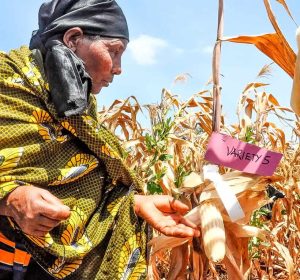
A female farmer taking part in a participatory variety evaluation as part the Africa RISING project
“Being a part of the gender network will improve our scope of work. The Youth in Agribusiness office emphasizes the importance of equal participation and opportunities for all, especially women. Gender-related components need to be part and parcel of every in development project and this platform will help us to fine-tune our gender strategy and advocate for active involvement of all stakeholders,” Expounded Evelyne Ohanwusi, Coordinator, Young Africa Works Project and IITA’s Youth In Agribusiness Office.
According to Béla Teeken, IITA Associate social and gender scientist, “The gender network is essential in concretely integrating gender into the biophysical and soci-economic sciences of IITA because gender aspects are crucial in designing and delivering technologies and institutional innovations in a socially inclusive way. A large part of IITA’s target group comprises of smallholder crop producers, processors, and marketers and, especially in Africa, many crop-related work is organized along gender roles.”
He adds, “We have just started the network and the interest from people working in various disciplines is very encouraging. The gender network is an important hub for a problem-focused interdisciplinary approach looking at a socially inclusive outcome and impact to improve the living conditions of people and reduce poverty.”
The current network builds on past efforts aimed at bringing IITA scientists together as a community of practice for learning and knowledge sharing. In November 2019, the members met to determine how the network could open up to include additional IITA staff members. A SWOT (strengths, weaknesses, opportunities, and threats) analysis was carried out to help inform the new direction of the network. IITA staff were then invited to attend a meeting about the network to help chart its vision, goal, objectives, and key activities. Thereafter, the network strategy was developed in early 2020, which guides implementation efforts.
Olamide Deborah Nwanze is a Senior Research Associate specializing in gender mainstreaming research to inform participatory and inclusive breeding, variety development, and seed systems policies regarding root, tuber, and banana (RTB) crops in the International Institute of Tropical Agriculture Headquarters, Ibadan, Nigeria. She is a PhD candidate at the University of Ibadan and holds an MSc and B. Agric in Agricultural Extension and Rural Development. Olamide is a fellow of the African Women in Agricultural Research and Development – Gender Responsive Agricultural Systems Policy (AWARD-GRASP) and the Gender Responsive Researchers Equipped for Agricultural Transformation (GREAT). She seeks to apply her gender-mainstreaming learnings, gender-responsive research, and policy development, and review expertise to facilitate women, youth, children, and vulnerable social group’s access to and adoption of agricultural Innovations that guarantee food, nutrition, income, and livelihood security in Africa. Her current roles include mentoring research fellows, development of guides and training manuals, implementation and adaptation of gender frameworks and tools, value chain actors’ engagement as citizen science partners, policy review and redesign, data management, and analysis. Her current research explores mixed methods and participatory and interdisciplinary approaches to capture and highlight gender dynamics, needs, preferences, and challenges stakeholders face within the agricultural livelihood value chain to prioritize gender-inclusive strategies in breeding programs, policy design, and implementation.
de Sousa, K., van Etten, J., Manners, R. Bello, A., Teeken, B., Olaosebikan, O., et al. 2024. The tricot approach: an agile framework for decentralized on-farm testing supported by citizen science. A retrospective. Agron. Sustain. Dev. 44, 8. https://doi.org/10.1007/s13593-023-00937-1
Madu, T., Onwuka, S., Nwafor, S., Onyemauwa, N., Ejechi, M., Ofoeze, M., Ukeje, B., Eluagu, C., Olaosebikan, O., Okoye, B., 2024. Gender-Inclusive Consumer Studies Improve Cassava Breeding in Nigeria in: Frontiers in Sociology, volume 9, number: 1224504, doi: 10.3389/fsoc.2024.1224504
Olaosebikan, O.; Bello, A.; Utoblo, O.; Okoye, B.; Olutegbe, N.; Garner, E.; Teeken, B.; Bryan, E.; Forsythe, L.; Cole, S.; Madu, T. 2023. Stressors and Resilience within the Cassava Value Chain in Nigeria: Preferred Cassava Variety Traits and Response Strategies of Men and Women to Inform Breeding. Sustainability 15, 7837. https://doi.org/10.3390/su15107837
Okoye, B., Ofoeze, M., Ejechi, M., Onwuka, S., Nwafor, S., Onyemauwa, N., Ukeje, B., Eluagu, C., Obidiegwu, J.*, Olaosebikan, O., Madu, T.* 2023. Prioritizing preferred traits in the yam value chain in Nigeria: a gender situation analysis in: Frontiers in Sociology, volume 8, number: 1232626, pages 1 – 9, ISSN 2297-7775, 2023. https://www.frontiersin.org/articles/10.3389/fsoc.2023.1232626/full
Olaosebikan, O., Bello, A. A., de Sousa, K., Ndjouenkeu, R., Adesokan, M., Alamu, E. O., Agbona, A., van Etten, J., Kegah, F. N.*, Dufour, D., Bouniol, A., Teeken, B. 2023. Consumer acceptability of cassava gari-eba food products across cultural and environmental settings using the triadic comparison of technologies approach (tricot) in: Journal of the Science of Food and Agriculture,
Teeken, B., Olaosebikan, O., Bello, A. A., Madu, T.*, Cole, S. M. 2023. Qualitative assessment on the positionality and preferences of dyads in relation to cassava-related activities: working with tricot trial citizen scientists https://hdl.handle.net/10568/138326 Type: Manual
Bouniol, A., Ceballos, H., Bello, A. A., Teeken, B., Olaosebikan, O., Owoade, D., Agbona, A., Fotso Kuate, A., Madu, T.*, Okoye, B.*, Ofoeze, M.*, Nwafor, S.*, Onyemauwa, N.*, Adinsi, L.*, Forsythe, L., Dufour, D. 2023. Varietal impact on women’s labour, workload and related drudgery in processing root, tuber and banana crops: focus on cassava in sub-Saharan Africa in: Journal of the Science of Food and Agriculture, pages 1 – 25, ISSN 0022-5142,
Bello, A. A., Agbona, A., Olaosebikan, O., Edughaen, G., Dufour, D., Bouniol, A., Iluebbey, P., Ndjouenkeu, R.*, Rabbi, I. Y., Teeken, B. 2023. Genetic and environmental effects on processing productivity and food product yield: drudgery of women’s work in: Journal of the Science of Food and Agriculture, pages 1 – 32, ISSN 0022-5142, 5
Cavicchioli, M., Zimbiti, T., Teeken, B., Nwanze, D.O., Liani, M., Parkes, E. & Bello, A. 2023. IITA-Gender Responsive Breeding Training Report. Genetic Resources Center, IITA-HQ, Ibadan, 21-23 September, 2022. Ibadan, Nigeria: IITA, (34 p.).https://hdl.handle.net/10568/131368
Agbona, A. Peteti P., Teeken B., Olaosebikan O. Bello, A. A., Parkes, E., Rabbi, I. Y., Mueller, L., Egesi, C., Kulakow, P. 2022. Data Management in Multi-disciplinary African RTB Crop Breeding Programs. In: Williamson, H.F., Leonelli, S. (eds) Towards Responsible Plant Data Linkage: Data Challenges for Agricultural Research and Development. Springer, Cham. https://doi.org/10.1007/978-3-031-13276-6_5
Lora Forsythe, Pricilla Marimo, Sarah Mayanja, Olamide D. Olaosebikan, Esme Stuart, Bela Teeken, Benjamin Okoye, Tessy Madu, (2021). Cross-product Gender Analysis of RTBfoods Step 2 Gendered Food Mapping on RTB Products. Understanding the Drivers of Trait Preferences and the Development of Multi-user RTB Product Profiles, WP1. London, UK: RTBfoods Field Scientific Report, 30 p.
Teeken, B., Garner, E., Agbona, A., Balogun, I., Olaosebikan, O., Bello, A., Madu, T., Okoye, B., Egesi, C., Kulakow, P. and Tufan, H.A. 2021. Beyond “Women’s Traits”: Exploring How Gender, Social Difference, and Household Characteristics Influence Trait Preferences. Frontiers Sustainable Food Systems 5:740926. https://doi.org/10.3389/fsufs.2021.740926
Teeken, B., Agbona, A., Bello, A., Olaosebikan, O., Alamu, E., Adesokan, M., Awoyale, W., Madu, T., Okoye, B., Chijioke, U., Owoade, D., Okoro, M., Bouniol, A., Dufour, D., Hershey, C., Rabbi, I., Maziya‐Dixon, B., Egesi, C., Tufan, H. and Kulakow, P. (020. Understanding cassava varietal preferences through pairwise ranking of gari‐eba and fufu prepared by local farmer–processors. Int J Food Sci Technol.https://doi.org/10.1111/ijfs.14862
Bela Teeken, Olamide Olaosebikan, Ireti Balogun, Benjamin Okoye, Tessy Madu, Steven Cole, Abolore Bello, Elizabeth Parkes. (2020). Piloting the G+ customer and product profile tools for gender-responsive cassava breeding in Nigeria. Nigeria: International Institute of Tropical Agriculture (IITA). https://hdl.handle.net/20.500.11766/13000