
NOUVELLES DE L'IITA

New app diagnoses crop diseases in the field and alerts rural farmers
septembre 28, 2017

The team behind a new mobile app that uses artificial intelligence to accurately diagnose crop diseases in the field has won a $US100,000 award to help exp and their project to help millions of small-scale farmers across Africa.
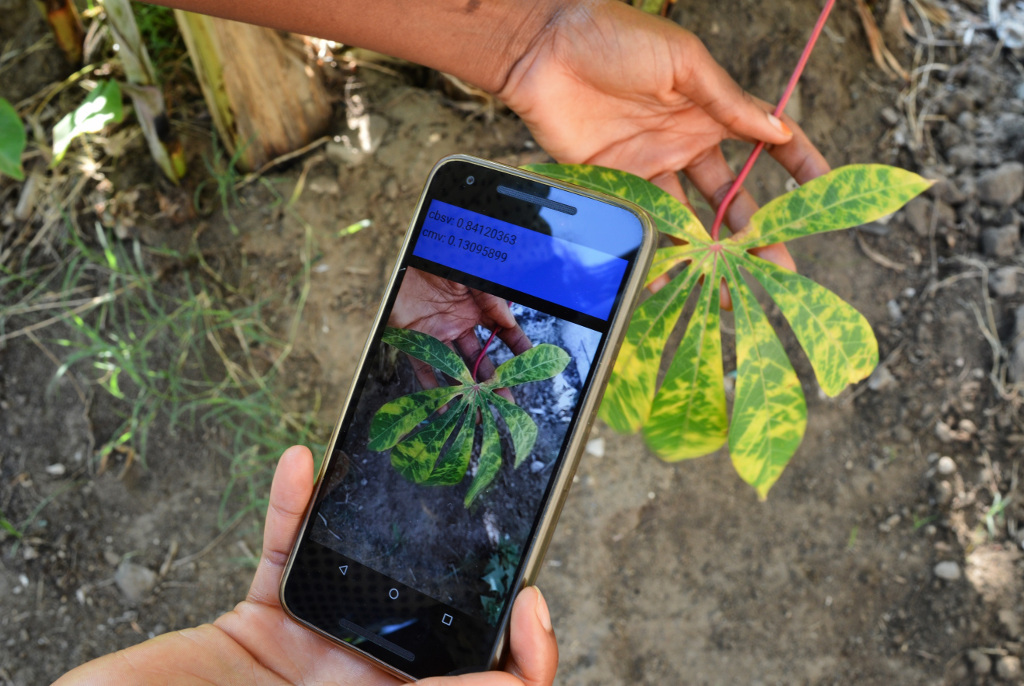
Picture of mobile phone being used in the field
The app is being field tested in Tanzania. Photo: IITA

Cassava brown streak disease is spreading westward across the African continent, and together with cassava mosaic disease, threatens the food and income security of over 30 million farmers in East and Central Africa. Likewise, banana is threatened by fungal and bacterial diseases including the devastating Banana bunchy top virus, while late blight still plagues potato farmers.

Farmers are often unable to properly identify these diseases, while researchers, plant health authorities and extension organizations lack the data to support them.

To stop the spread of these pests and diseases, a team under the CGIAR Research Program on Roots, Tubers and Bananas (RTB) has developed a revolutionary app to accurately diagnose diseases in the field, which will be combined with SMS services to send alerts to thous ands of rural farmers.

“Smartphones are becoming more and more common in rural Africa. Smallholders or extension officers with a basic smartphone with a camera will be able to download the app for free, fire it up, point it at a leaf with disease symptoms and get an instant diagnosis. That is truly revolutionary!” explained Dr. James Legg of the International Institute of Topical Agriculture (IITA), who leads the project together with Dr. David Hughes of Penn State.

The app will also provide the latest management advice for all major diseases and pests of root, tuber and banana crops, and pinpoint the location of the nearest agricultural extension support for farmers.

The team were winners of a $US100,000 grant as part of the CGIAR Platform for Big Data in Agriculture Inspire Challenges at the Big Data in Agriculture Convention 2017 in Cali, Colombia on 21 September.

Currently developed for cassava, the grant will allow researchers to exp and the app for other root, tuber and banana crops that are critical sources of food, nutrition and income security for millions.

“This prize is transformative. It allows us to exp and across multiple sites in Africa and multiple crops that are critical for food security on the continent. We can amplify by 100 times what we have achieved so far,” said Dr. David Hughes of Penn State.

Painstaking field work using cameras, spectrophotometers and drones at RTB cassava field sites in coastal Tanzania and on farms in western Kenya generated more than 200,000 images of diseased crops to train artificial intelligence (AI) algorithms.

Using many of these images, Hughes, Legg and collaborators developed an AI algorithm that can automatically classify five cassava diseases, and by collaborating with Google, the team were able to develop their smartphone app with TensorFlow. It is currently being field-tested in Tanzania.

Penn State has also developed a mobile spectrophotometer through a start-up called CROPTIX. Early results suggest it can accurately diagnose different viral diseases in the field, even if the plant looks healthy.

“The app employs AI in real time so the farmer can be an active participant in disease diagnosis and crop health management, leading to more yields for smallholder farmers. It is also revolutionary because our artificial intelligence is based on the world’s best human intelligence on African crops – the research scientists at CGIAR and RTB,” added Dr. Hughes.

The project team has developed linkages with the Vodafone agriculture SMS platform called DigiFarm, which will allow them to link digital diagnostics to large-scale rural text messaging services.

The team will deliver farmer tailored SMS alerts on crop diseases and pests to 350,000 Kenyan farmers by July 2018.

The project is being carried out by a global network of scientists from IITA, Penn State, the International Institute of Tropical Agriculture (CIAT), the International Potato Center (CIP) and Bioversity International, as part of the CGIAR Research Program on Roots, Tubers and Bananas (RTB).

# # # 

For interviews, photographs, and more information: 
Holly Holmes
h.holmes@cgiar.org 
Communication Specialist
CGIAR Research Program on Roots, Tubers and Bananas

About the CGIAR Research Program on Roots, Tubers and Bananas 

The CGIAR Research Program on Roots, Tubers and Bananas (RTB) is an alliance led by the International Potato Center implemented jointly with Bioversity International, the International Center for Tropical Agriculture (CIAT), the International Institute of Tropical Agriculture (IITA), and the Centre de Coopération Internationale en Recherche Agronomique pour le Développement (CIRAD), that includes a growing number of research and development partners. RTB brings together research on its m andate crops: bananas and plantains, cassava, potato, sweetpotato, yams, and minor roots and tubers, to improve nutrition and food security and foster greater gender equity especially among some of the world’s poorest and most vulnerable populations. www.rtb.cgiar.org 

About CGIAR  

CGIAR is a global research partnership for a food-secure future. Its science is carried out by 15 Research Centers in close collaboration with hundreds of partners across the globe. www.cgiar.org


Contribué par

Nouvelles connexes

Aucun article trouvé

Laisser un commentaire

Votre adresse e-mail ne sera pas publiée. Les champs obligatoires sont indiqués avec *

Retour en haut
Olaosebikan, Olamide

Olamide Deborah Nwanze est une chercheuse principale spécialisée dans la recherche sur l'approche "genre" afin d'éclairer les politiques de sélection participative et inclusive, de développement de variétés et de systèmes semenciers concernant les cultures de racines, tubercules et bananes (RTB) au siège de l'Institut International d'Agriculture Tropicale, à Ibadan, au Nigeria. Elle est candidate au doctorat à l'Université d'Ibadan et titulaire d'un master et d'un diplôme d'ingénieur agronome en vulgarisation agricole et développement rural. Olamide est membre du programme African Women in Agricultural Research and Development – Gender Responsive Agricultural Systems Policy (SAISIE DE RÉCOMPENSEet les Chercheuses Sensibles au Genre Équipées pour la Transformation Agricole (SUPER. Elle cherche à appliquer ses apprentissages en matière d’approche genre, recherche sensible au genre, et expertise en développement et examen de politiques pour faciliter l’accès et l’adoption par les femmes, les jeunes, les enfants et les groupes sociaux vulnérables aux innovations agricoles qui garantissent la sécurité alimentaire, nutritionnelle, des revenus et des moyens de subsistance en Afrique. Ses rôles actuels comprennent le mentorat de chercheurs stagiaires, le développement de guides et manuels de formation, la mise en œuvre et l'adaptation de cadres et d'outils genre, l'engagement des acteurs de la chaîne de valeur en tant que partenaires de la science citoyenne, l'examen et la refonte des politiques, la gestion et l'analyse des données. Ses recherches actuelles portent sur les méthodes mixtes ainsi que sur les approches participatives et interdisciplinaires pour saisir et mettre en évidence les dynamiques de genre, les besoins, les préférences et les défis rencontrés par les parties prenantes au sein de la chaîne de valeur des moyens de subsistance agricoles afin de prioriser des stratégies axées sur le genre dans les programmes de sélection, la conception et la mise en œuvre des politiques.

À l'IITA, elle contribue à la mise en œuvre du CGIAR Initiative d'Élevage Accéléré et Innovation génétique Programmes ; recherche participative et genre au sein des Prochaine Génération ManiocHarvestPlusRTBAliments, et Tricot-ClimMob 1000Fermes Projets ; et la communication des connaissances sur le genre via le Série de webinaires G-LENS, vidéo documentaire, notes de politiquepublications, et blogs.


Publications récentes

de Sousa, K., van Etten, J., Manners, R. Bello, A., Teeken, B., Olaosebikan, O., et al. 2024. L'approche tricot : un cadre agile pour les essais décentralisés à la ferme soutenus par la science citoyenne. Une rétrospective. Agron. Sustain. Dev. 44, 8. https://doi.org/10.1007/s13593-023-00937-1

Madu, T., Onwuka, S., Nwafor, S., Onyemauwa, N., Ejechi, M., Ofoeze, M., Ukeje, B., Eluagu, C., Olaosebikan, O., Okoye, B., 2024. Les études sur les consommateurs inclusifs en matière de genre améliorent l'amélioration du manioc au Nigeria dans : Frontiers in Sociology, volume 9, numéro : 1224504, doi : 10.3389/fsoc.2024.1224504

Olaosebikan, O. ; Bello, A. ; Utoblo, O. ; Okoye, B. ; Olutegbe, N. ; Garner, E. ; Teeken, B. ; Bryan, E. ; Forsythe, L. ; Cole, S. ; Madu, T. 2023. Facteurs de stress et résilience au sein de la chaîne de valeur du manioc au Nigeria : Caractéristiques préférées des variétés de manioc et stratégies de réponse des hommes et des femmes pour informer l'amélioration variétale. Sustainability 15, 7837. https://doi.org/10.3390/su15107837

Okoye, B., Ofoeze, M., Ejechi, M., Onwuka, S., Nwafor, S., Onyemauwa, N., Ukeje, B., Eluagu, C., Obidiegwu, J.*, Olaosebikan, O., Madu, T.* 2023. Priorisation des traits préférés dans la chaîne de valeur de l'igname au Nigeria : une analyse de la situation en matière de genre in: Frontiers in Sociology, volume 8, numéro : 1232626, pages 1 – 9, ISSN 2297-7775, 2023. https://www.frontiersin.org/articles/10.3389/fsoc.2023.1232626/full

Olaosebikan, O., Bello, A. A., de Sousa, K., Ndjouenkeu, R., Adesokan, M., Alamu, E. O., Agbona, A., van Etten, J., Kegah, F. N.*, Dufour, D., Bouniol, A., Teeken, B. 2023. Acceptabilité par les consommateurs des produits alimentaires à base de gari-eba de manioc dans des contextes culturels et environnementaux variés en utilisant l'approche triade de comparaison des technologies (tricot) dans : Journal of the Science of Food and Agriculture,

Teeken, B., Olaosebikan, O., Bello, A. A., Madu, T.*, Cole, S. M. 2023. Évaluation qualitative de la positionnalité et des préférences des dyades en relation avec les activités liées au manioc : travailler avec des scientifiques citoyens du procès tricot https://hdl.handle.net/10568/138326 Type : Manuel

Bouniol, A., Ceballos, H., Bello, A. A., Teeken, B., Olaosebikan, O., Owoade, D., Agbona, A., Fotso Kuate, A., Madu, T.*, Okoye, B.*, Ofoeze, M.*, Nwafor, S.*, Onyemauwa, N.*, Adinsi, L.*, Forsythe, L., Dufour, D. 2023. Impact variétal sur le travail des femmes, la charge de travail et la pénibilité associée dans le traitement des plantes à racines, tubercules et bananes : focus sur le manioc en Afrique subsaharienne dans : Journal of the Science of Food and Agriculture, pages 1 – 25, ISSN 0022-5142,

Bello, A. A., Agbona, A., Olaosebikan, O., Edughaen, G., Dufour, D., Bouniol, A., Iluebbey, P., Ndjouenkeu, R.*, Rabbi, I. Y., Teeken, B. 2023. Effets génétiques et environnementaux sur la productivité de la transformation et le rendement des produits alimentaires : la pénibilité du travail des femmes dans : Journal of the Science of Food and Agriculture, pages 1 – 32, ISSN 0022-5142, 5

Cavicchioli, M., Zimbiti, T., Teeken, B., Nwanze, D.O., Liani, M., Parkes, E. & Bello, A. 2023. Rapport sur la formation en sélection génétique sensible au genre à l'IITA. Genetic Resources Center, IITA-HQ, Ibadan, 21-23 septembre 2022. Ibadan, Nigéria : IITA, (34 p.).https://hdl.handle.net/10568/131368

Agbona, A. Peteti P., Teeken B., Olaosebikan O. Bello, A. A., Parkes, E., Rabbi, I. Y., Mueller, L., Egesi, C., Kulakow, P. 2022. Gestion des données dans les programmes d'amélioration des cultures RTB africaines multidisciplinaires. In : Williamson, H.F., Leonelli, S. (eds) Towards Responsible Plant Data Linkage: Data Challenges for Agricultural Research and Development. Springer, Cham. https://doi.org/10.1007/978-3-031-13276-6_5

Lora Forsythe, Pricilla Marimo, Sarah Mayanja, Olamide D. Olaosebikan, Esme Stuart, Bela Teeken, Benjamin Okoye, Tessy Madu, (2021). Analyse transversale du genre dans RTBfoods Étape 2 Cartographie des genres sur les produits RTB. Comprendre les moteurs des préférences en matière de traits et le développement de profils de produits RTB multi-utilisateurs, WP1. Londres, Royaume-Uni : Rapport scientifique de terrain RTBfoods, 30 p.

Teeken, B., Garner, E., Agbona, A., Balogun, I., Olaosebikan, O., Bello, A., Madu, T., Okoye, B., Egesi, C., Kulakow, P. et Tufan, H.A. 2021. Au-delà des “ traits des femmes ” : explorer comment le genre, les différences sociales et les caractéristiques des ménages influencent les préférences pour les traits. Frontiers Systèmes alimentaires durables 5:740926. https://doi.org/10.3389/fsufs.2021.740926

Teeken, B., Agbona, A., Bello, A., Olaosebikan, O., Alamu, E., Adesokan, M., Awoyale, W., Madu, T., Okoye, B., Chijioke, U., Owoade, D., Okoro, M., Bouniol, A., Dufour, D., Hershey, C., Rabbi, I., Maziya‐Dixon, B., Egesi, C., Tufan, H. et Kulakow, P. (020. Comprendre les préférences variétales du manioc par le classement par paires du gari-eba et du fufu préparés par des agriculteurs-transformateurs locaux. Int J Food Sci Technol. https://doi.org/10.1111/ijfs.14862

Bela Teeken, Olamide Olaosebikan, Ireti Balogun, Benjamin Okoye, Tessy Madu, Steven Cole, Abolore Bello, Elizabeth Parkes. (2020). Pilotage des outils de profil client et produit G+ pour l'amélioration sensible au genre du manioc au Nigeria. Nigeria : Institut international d'agriculture tropicale (IIAT). https://hdl.handle.net/20.500.11766/13000