
IITA NEWS

New app diagnoses crop diseases in the field and alerts rural farmers
September 28, 2017

The team behind a new mobile app that uses artificial intelligence to accurately diagnose crop diseases in the field has won a $US100,000 award to help exp and their project to help millions of small-scale farmers across Africa.
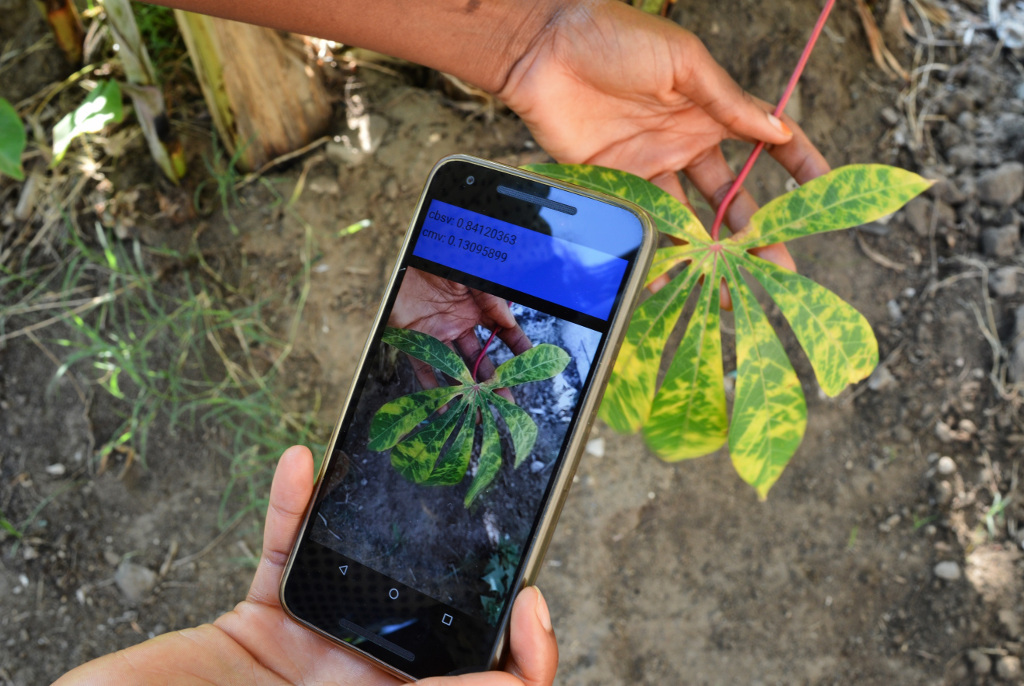
Picture of mobile phone being used in the field
The app is being field tested in Tanzania. Photo: IITA

Cassava brown streak disease is spreading westward across the African continent, and together with cassava mosaic disease, threatens the food and income security of over 30 million farmers in East and Central Africa. Likewise, banana is threatened by fungal and bacterial diseases including the devastating Banana bunchy top virus, while late blight still plagues potato farmers.

Farmers are often unable to properly identify these diseases, while researchers, plant health authorities and extension organizations lack the data to support them.

To stop the spread of these pests and diseases, a team under the CGIAR Research Program on Roots, Tubers and Bananas (RTB) has developed a revolutionary app to accurately diagnose diseases in the field, which will be combined with SMS services to send alerts to thous ands of rural farmers.

“Smartphones are becoming more and more common in rural Africa. Smallholders or extension officers with a basic smartphone with a camera will be able to download the app for free, fire it up, point it at a leaf with disease symptoms and get an instant diagnosis. That is truly revolutionary!” explained Dr. James Legg of the International Institute of Topical Agriculture (IITA), who leads the project together with Dr. David Hughes of Penn State.

The app will also provide the latest management advice for all major diseases and pests of root, tuber and banana crops, and pinpoint the location of the nearest agricultural extension support for farmers.

The team were winners of a $US100,000 grant as part of the CGIAR Platform for Big Data in Agriculture Inspire Challenges at the Big Data in Agriculture Convention 2017 in Cali, Colombia on 21 September.

Currently developed for cassava, the grant will allow researchers to exp and the app for other root, tuber and banana crops that are critical sources of food, nutrition and income security for millions.

“This prize is transformative. It allows us to exp and across multiple sites in Africa and multiple crops that are critical for food security on the continent. We can amplify by 100 times what we have achieved so far,” said Dr. David Hughes of Penn State.

Painstaking field work using cameras, spectrophotometers and drones at RTB cassava field sites in coastal Tanzania and on farms in western Kenya generated more than 200,000 images of diseased crops to train artificial intelligence (AI) algorithms.

Using many of these images, Hughes, Legg and collaborators developed an AI algorithm that can automatically classify five cassava diseases, and by collaborating with Google, the team were able to develop their smartphone app with TensorFlow. It is currently being field-tested in Tanzania.

Penn State has also developed a mobile spectrophotometer through a start-up called CROPTIX. Early results suggest it can accurately diagnose different viral diseases in the field, even if the plant looks healthy.

“The app employs AI in real time so the farmer can be an active participant in disease diagnosis and crop health management, leading to more yields for smallholder farmers. It is also revolutionary because our artificial intelligence is based on the world’s best human intelligence on African crops – the research scientists at CGIAR and RTB,” added Dr. Hughes.

The project team has developed linkages with the Vodafone agriculture SMS platform called DigiFarm, which will allow them to link digital diagnostics to large-scale rural text messaging services.

The team will deliver farmer tailored SMS alerts on crop diseases and pests to 350,000 Kenyan farmers by July 2018.

The project is being carried out by a global network of scientists from IITA, Penn State, the International Institute of Tropical Agriculture (CIAT), the International Potato Center (CIP) and Bioversity International, as part of the CGIAR Research Program on Roots, Tubers and Bananas (RTB).

# # # 

For interviews, photographs, and more information: 
Holly Holmes
h.holmes@cgiar.org 
Communication Specialist
CGIAR Research Program on Roots, Tubers and Bananas

About the CGIAR Research Program on Roots, Tubers and Bananas 

The CGIAR Research Program on Roots, Tubers and Bananas (RTB) is an alliance led by the International Potato Center implemented jointly with Bioversity International, the International Center for Tropical Agriculture (CIAT), the International Institute of Tropical Agriculture (IITA), and the Centre de Coopération Internationale en Recherche Agronomique pour le Développement (CIRAD), that includes a growing number of research and development partners. RTB brings together research on its m andate crops: bananas and plantains, cassava, potato, sweetpotato, yams, and minor roots and tubers, to improve nutrition and food security and foster greater gender equity especially among some of the world’s poorest and most vulnerable populations. www.rtb.cgiar.org 

About CGIAR  

CGIAR is a global research partnership for a food-secure future. Its science is carried out by 15 Research Centers in close collaboration with hundreds of partners across the globe. www.cgiar.org


Contributed by

Related news

No items found

Leave a Reply

Your email address will not be published. Required fields are marked *

Scroll to Top
Olaosebikan, Olamide

Olamide Deborah Nwanze is a Senior Research Associate specializing in gender mainstreaming research to inform participatory and inclusive breeding, variety development, and seed systems policies regarding root, tuber, and banana (RTB) crops in the International Institute of Tropical Agriculture Headquarters, Ibadan, Nigeria. She is a PhD candidate at the University of Ibadan and holds an MSc and B. Agric in Agricultural Extension and Rural Development. Olamide is a fellow of the African Women in Agricultural Research and Development – Gender Responsive Agricultural Systems Policy (AWARD-GRASP) and the Gender Responsive Researchers Equipped for Agricultural Transformation (GREAT). She seeks to apply her gender-mainstreaming learnings, gender-responsive research, and policy development, and review expertise to facilitate women, youth, children, and vulnerable social group’s access to and adoption of agricultural Innovations that guarantee food, nutrition, income, and livelihood security in Africa. Her current roles include mentoring research fellows, development of guides and training manuals, implementation and adaptation of gender frameworks and tools, value chain actors’ engagement as citizen science partners, policy review and redesign, data management, and analysis. Her current research explores mixed methods and participatory and interdisciplinary approaches to capture and highlight gender dynamics, needs, preferences, and challenges stakeholders face within the agricultural livelihood value chain to prioritize gender-inclusive strategies in breeding programs, policy design, and implementation.

At IITA, she contributes to the implementation of the CGIAR Accelerated Breeding Initiative and Genetic Innovation Programs; participatory and gender research within the NextGen CassavaHarvestPlusRTBFoods, and Tricot-ClimMob 1000Farms Projects; and gender knowledge communication via the G-LENS webinar series, video documentary, policy briefspublications, and blogs.


Recent publications

de Sousa, K., van Etten, J., Manners, R. Bello, A., Teeken, B., Olaosebikan, O., et al. 2024. The tricot approach: an agile framework for decentralized on-farm testing supported by citizen science. A retrospective. Agron. Sustain. Dev. 44, 8. https://doi.org/10.1007/s13593-023-00937-1

Madu, T., Onwuka, S., Nwafor, S., Onyemauwa, N., Ejechi, M., Ofoeze, M., Ukeje, B., Eluagu, C., Olaosebikan, O., Okoye, B., 2024. Gender-Inclusive Consumer Studies Improve Cassava Breeding in Nigeria in: Frontiers in Sociology, volume 9, number: 1224504, doi: 10.3389/fsoc.2024.1224504

Olaosebikan, O.; Bello, A.; Utoblo, O.; Okoye, B.; Olutegbe, N.; Garner, E.; Teeken, B.; Bryan, E.; Forsythe, L.; Cole, S.; Madu, T. 2023.  Stressors and Resilience within the Cassava Value Chain in Nigeria: Preferred Cassava Variety Traits and Response Strategies of Men and Women to Inform Breeding. Sustainability 15, 7837. https://doi.org/10.3390/su15107837

Okoye, B., Ofoeze, M., Ejechi, M., Onwuka, S., Nwafor, S., Onyemauwa, N., Ukeje, B., Eluagu, C., Obidiegwu, J.*, Olaosebikan, O., Madu, T.* 2023. Prioritizing preferred traits in the yam value chain in Nigeria: a gender situation analysis in: Frontiers in Sociology, volume 8, number: 1232626, pages 1 – 9, ISSN 2297-7775, 2023. https://www.frontiersin.org/articles/10.3389/fsoc.2023.1232626/full

Olaosebikan, O., Bello, A. A., de Sousa, K., Ndjouenkeu, R., Adesokan, M., Alamu, E. O., Agbona, A., van Etten, J., Kegah, F. N.*, Dufour, D., Bouniol, A., Teeken, B. 2023. Consumer acceptability of cassava gari-eba food products across cultural and environmental settings using the triadic comparison of technologies approach (tricot) in: Journal of the Science of Food and Agriculture,

Teeken, B., Olaosebikan, O., Bello, A. A., Madu, T.*, Cole, S. M. 2023. Qualitative assessment on the positionality and preferences of dyads in relation to cassava-related activities: working with tricot trial citizen scientists https://hdl.handle.net/10568/138326 Type: Manual

Bouniol, A., Ceballos, H., Bello, A. A., Teeken, B., Olaosebikan, O., Owoade, D., Agbona, A., Fotso Kuate, A., Madu, T.*, Okoye, B.*, Ofoeze, M.*, Nwafor, S.*, Onyemauwa, N.*, Adinsi, L.*, Forsythe, L., Dufour, D. 2023. Varietal impact on women’s labour, workload and related drudgery in processing root, tuber and banana crops: focus on cassava in sub-Saharan Africa in: Journal of the Science of Food and Agriculture, pages 1 – 25, ISSN 0022-5142,

Bello, A. A., Agbona, A., Olaosebikan, O., Edughaen, G., Dufour, D., Bouniol, A., Iluebbey, P., Ndjouenkeu, R.*, Rabbi, I. Y., Teeken, B. 2023. Genetic and environmental effects on processing productivity and food product yield: drudgery of women’s work in: Journal of the Science of Food and Agriculture, pages 1 – 32, ISSN 0022-5142, 5

Cavicchioli, M., Zimbiti, T., Teeken, B., Nwanze, D.O., Liani, M., Parkes, E. & Bello, A. 2023. IITA-Gender Responsive Breeding Training Report. Genetic Resources Center, IITA-HQ, Ibadan, 21-23 September, 2022. Ibadan, Nigeria: IITA, (34 p.).https://hdl.handle.net/10568/131368

Agbona, A. Peteti P., Teeken B., Olaosebikan O. Bello, A. A., Parkes, E., Rabbi, I. Y., Mueller, L., Egesi, C., Kulakow, P. 2022. Data Management in Multi-disciplinary African RTB Crop Breeding Programs. In: Williamson, H.F., Leonelli, S. (eds) Towards Responsible Plant Data Linkage: Data Challenges for Agricultural Research and Development. Springer, Cham. https://doi.org/10.1007/978-3-031-13276-6_5

Lora Forsythe, Pricilla Marimo, Sarah Mayanja, Olamide D. Olaosebikan, Esme Stuart, Bela Teeken, Benjamin Okoye, Tessy Madu, (2021). Cross-product Gender Analysis of RTBfoods Step 2 Gendered Food Mapping on RTB Products. Understanding the Drivers of Trait Preferences and the Development of Multi-user RTB Product Profiles, WP1. London, UK: RTBfoods Field Scientific Report, 30 p.

Teeken, B., Garner, E., Agbona, A., Balogun, I., Olaosebikan, O., Bello, A., Madu, T., Okoye, B., Egesi, C., Kulakow, P. and Tufan, H.A. 2021. Beyond “Women’s Traits”: Exploring How Gender, Social Difference, and Household Characteristics Influence Trait Preferences. Frontiers Sustainable Food Systems 5:740926. https://doi.org/10.3389/fsufs.2021.740926

Teeken, B., Agbona, A., Bello, A., Olaosebikan, O., Alamu, E., Adesokan, M., Awoyale, W., Madu, T., Okoye, B., Chijioke, U., Owoade, D., Okoro, M., Bouniol, A., Dufour, D., Hershey, C., Rabbi, I., Maziya‐Dixon, B., Egesi, C., Tufan, H. and Kulakow, P. (020. Understanding cassava varietal preferences through pairwise ranking of gari‐eba and fufu prepared by local farmer–processors. Int J Food Sci Technol. https://doi.org/10.1111/ijfs.14862

Bela Teeken, Olamide Olaosebikan, Ireti Balogun, Benjamin Okoye, Tessy Madu, Steven Cole, Abolore Bello, Elizabeth Parkes. (2020). Piloting the G+ customer and product profile tools for gender-responsive cassava breeding in Nigeria. Nigeria: International Institute of Tropical Agriculture (IITA). https://hdl.handle.net/20.500.11766/13000