
IITA NEWS

EAC policymakers trained on aflatoxins and their effective antidote, aflasafe
October 3, 2017

A week-long training for policymakers from the East Africa Community (EAC) partner states on aflatoxins and progress on efforts to reduce its contamination in food and feeds in the region is currently underway in Dar es Salaam, Tanzania.
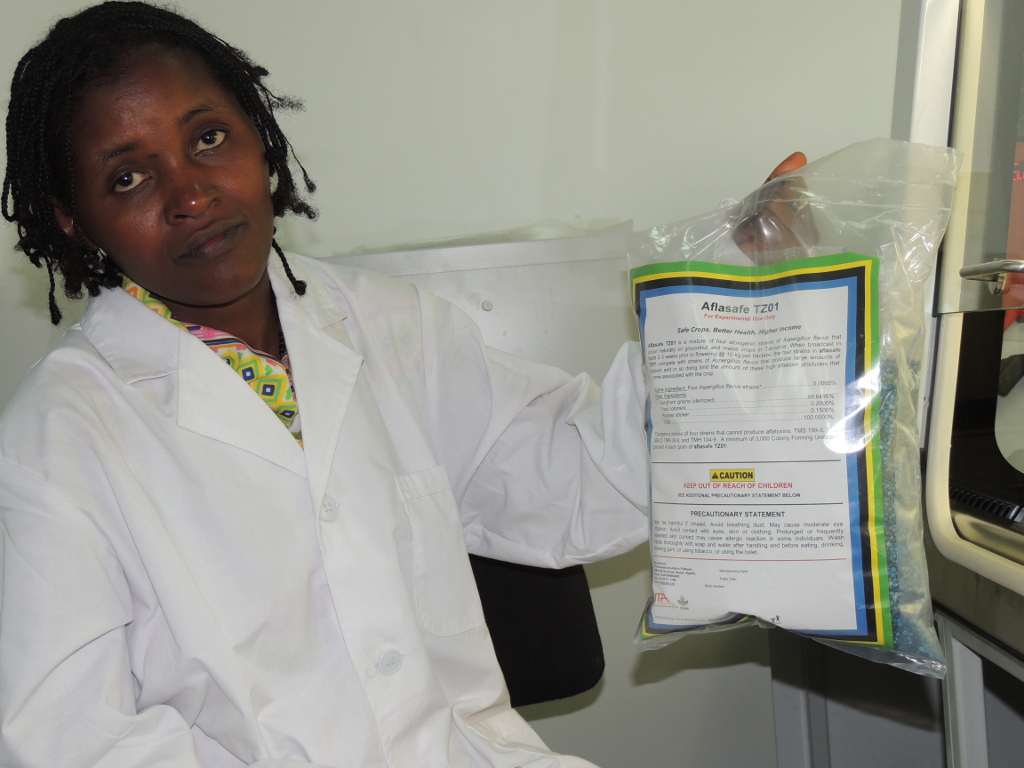
Picture of IITA researcher holding a bag of AflasafeTZ
IITA researcher holding a bag of AflasafeTZ.

The training is part of ongoing efforts by the EAC Secretariat in partnership with the Africa Union (AU), USAID, and the International Institute of Tropical Agriculture (IITA), among many other partners, to prevent and control aflatoxin contamination, a major threat to food security in the region, a health hazard, and which affects trade in food and agricultural commodities. The training is being conducted at and by IITA experts from 3 to 7 October 2017.

East Africa is a hotspot for aflatoxins—highly poisonous chemicals produced by the mold Aspergillus flavus which is found in soils. They affect both humans and animals that eat contaminated food and feed, and can cause liver disease (including cancer) and lower the body’s immunity. In children, aflatoxins impair growth leading to stunting. Acute exposure can lead to instant death.

The aflatoxin-producing molds affect many crops but the key staples of maize and groundnut are the most susceptible. Aflatoxin contamination also affects trade as grains that have high levels of the toxins cannot be exported and must be destroyed—at a cost.

“The multi-sectoral impacts and effects of aflatoxin constitute a significant challenge to agriculture, health, and trade. It is one of the challenges undermining the desired levels of social and economic transformation and regional integration in the East Africa Community,” said Fahari Marwa, a Principal Agricultural Economist at the EAC Secretariat.

“The EAC has been spearheading interventions aimed at addressing the incidences and impact of aflatoxins to enhance food utilization, nutrition, and food safety. The secretariat has developed the EAC Aflatoxin Prevention and Control Strategy which was approved at the 10th Sectoral Council on Agriculture and Food Security and will be presented to the full council of Ministers in November 2017,” Marwa said while delivering opening remarks at the training.

The training also focuses on strategies for preventing and controlling aflatoxin contamination including looking at the progress in developing and rolling out aflasafe—one of the technologies that has proven effective in reducing contamination—across the five EAC countries.

Aflasafe was developed by IITA in collaboration with the United States Department of Agriculture–Agricultural Research Service (USDA-ARS) and other local and international partners. Aflasafe is made up of the mold of the same family as the type that produces aflatoxins but which do not produce the toxin and can displace their toxin-producing relatives from the soil. Aflasafe has been able to consistently reduce aflatoxin contamination in crops by over 80% in trials across the continent.

“Aflatoxin is a silent killer and a major health problem all over the world. It has no smell, taste, or color, therefore millions of people in Africa including infants and children, are exposed to the poison without their knowledge. Testing in the laboratories is the only sure way to know if aflatoxin is present in the food and feed but this is very expensive. Therefore, reducing the mold that produces aflatoxins is one of the effective ways to reduce the contamination,” said Dr Victor Manyong, IITA Director for Eastern Africa while also speaking at the training’s opening session.

“Aflasafe is a very cost effective and efficient technology in reducing aflatoxin contamination in food and feed. Together with our partners we are working with many countries all over Africa to develop their own product using locally sourced strains of the non-toxic mold.  We have developed local products for over 10 countries in Africa,” he said.

In East Africa, Kenya is at an advanced stage as AflasafeKE has been registered in the country through a partnership between IITA and the Kenya Agriculture Livestock Research Organization (KALRO) and the construction of a plant to manufacture it locally has almost been completed.

In Tanzania, the Ministry of Agriculture, Livestock and Fisheries and IITA have developed their local product AflasafeTZ and put together the dossier for its registration. In Burundi, Rw anda, and Ug anda, the development of their local product is ongoing.

“Aflatoxins are often looked at as a postharvest issue while in fact they are a preharvest problem. This is because contamination takes place while the crops are still in the field. The fungi then continue to produce aflatoxins during postharvest h andling and storage. Therefore, preharvest management is a very critical stage for preventing and reducing contamination of crops while in the field and this will reduce contamination while in storage,” said George Mahuku, IITA plant pathologist, and one of the trainers.

“Good postharvest and storage management of the aflatoxin-free produce is also important to reduce the risk of further contamination. These include not spreading the produce on bare soils to dry, ensuring they are dried properly to a safe moisture content of 12% or below, and use of clean and dry storage that will keep away moisture and pests,” he added.

The training will, therefore, enable policymakers to get a better underst anding of the aflatoxin problem and the biocontrol technology, Aflasafe. The training also covers efficacy of the aflasafe technology and its benefits, and how it is produced. Policymakers will also review the status and the progress made in the transfer and application of aflasafe technology in the EAC Partner States and discuss sustainable models and identify strategic pathways for upscaling and out scaling of aflasafe in the EAC.

Media contacts: Katherine Lopez, Head of Communication, k.lopez@cgiar.org, +234 803 978 4454

Katherine Lopez, Head of Communication, k.lopez@cgiar.org, +234 803 978 4454

Catherine Njuguna, IITA Eastern Africa, c.njuguna@cgiar.org, +255 767 361 255

About IITA, iita.org The International Institute of Tropical Agriculture (IITA) is a not-for-profit institution that generates agricultural innovations to meet Africa’s most pressing challenges of hunger, malnutrition, poverty, and natural resource degradation. Working with various partners across sub-Saharan Africa, we improve livelihoods, enhance food and nutrition security, increase employment, and preserve natural resource integrity. IITA is a member of CGIAR, a global agriculture research partnership for a food-secure future.


Contributed by

Related news

No items found

Leave a Reply

Your email address will not be published. Required fields are marked *

Scroll to Top
Olaosebikan, Olamide

Olamide Deborah Nwanze is a Senior Research Associate specializing in gender mainstreaming research to inform participatory and inclusive breeding, variety development, and seed systems policies regarding root, tuber, and banana (RTB) crops in the International Institute of Tropical Agriculture Headquarters, Ibadan, Nigeria. She is a PhD candidate at the University of Ibadan and holds an MSc and B. Agric in Agricultural Extension and Rural Development. Olamide is a fellow of the African Women in Agricultural Research and Development – Gender Responsive Agricultural Systems Policy (AWARD-GRASP) and the Gender Responsive Researchers Equipped for Agricultural Transformation (GREAT). She seeks to apply her gender-mainstreaming learnings, gender-responsive research, and policy development, and review expertise to facilitate women, youth, children, and vulnerable social group’s access to and adoption of agricultural Innovations that guarantee food, nutrition, income, and livelihood security in Africa. Her current roles include mentoring research fellows, development of guides and training manuals, implementation and adaptation of gender frameworks and tools, value chain actors’ engagement as citizen science partners, policy review and redesign, data management, and analysis. Her current research explores mixed methods and participatory and interdisciplinary approaches to capture and highlight gender dynamics, needs, preferences, and challenges stakeholders face within the agricultural livelihood value chain to prioritize gender-inclusive strategies in breeding programs, policy design, and implementation.

At IITA, she contributes to the implementation of the CGIAR Accelerated Breeding Initiative and Genetic Innovation Programs; participatory and gender research within the NextGen CassavaHarvestPlusRTBFoods, and Tricot-ClimMob 1000Farms Projects; and gender knowledge communication via the G-LENS webinar series, video documentary, policy briefspublications, and blogs.


Recent publications

de Sousa, K., van Etten, J., Manners, R. Bello, A., Teeken, B., Olaosebikan, O., et al. 2024. The tricot approach: an agile framework for decentralized on-farm testing supported by citizen science. A retrospective. Agron. Sustain. Dev. 44, 8. https://doi.org/10.1007/s13593-023-00937-1

Madu, T., Onwuka, S., Nwafor, S., Onyemauwa, N., Ejechi, M., Ofoeze, M., Ukeje, B., Eluagu, C., Olaosebikan, O., Okoye, B., 2024. Gender-Inclusive Consumer Studies Improve Cassava Breeding in Nigeria in: Frontiers in Sociology, volume 9, number: 1224504, doi: 10.3389/fsoc.2024.1224504

Olaosebikan, O.; Bello, A.; Utoblo, O.; Okoye, B.; Olutegbe, N.; Garner, E.; Teeken, B.; Bryan, E.; Forsythe, L.; Cole, S.; Madu, T. 2023.  Stressors and Resilience within the Cassava Value Chain in Nigeria: Preferred Cassava Variety Traits and Response Strategies of Men and Women to Inform Breeding. Sustainability 15, 7837. https://doi.org/10.3390/su15107837

Okoye, B., Ofoeze, M., Ejechi, M., Onwuka, S., Nwafor, S., Onyemauwa, N., Ukeje, B., Eluagu, C., Obidiegwu, J.*, Olaosebikan, O., Madu, T.* 2023. Prioritizing preferred traits in the yam value chain in Nigeria: a gender situation analysis in: Frontiers in Sociology, volume 8, number: 1232626, pages 1 – 9, ISSN 2297-7775, 2023. https://www.frontiersin.org/articles/10.3389/fsoc.2023.1232626/full

Olaosebikan, O., Bello, A. A., de Sousa, K., Ndjouenkeu, R., Adesokan, M., Alamu, E. O., Agbona, A., van Etten, J., Kegah, F. N.*, Dufour, D., Bouniol, A., Teeken, B. 2023. Consumer acceptability of cassava gari-eba food products across cultural and environmental settings using the triadic comparison of technologies approach (tricot) in: Journal of the Science of Food and Agriculture,

Teeken, B., Olaosebikan, O., Bello, A. A., Madu, T.*, Cole, S. M. 2023. Qualitative assessment on the positionality and preferences of dyads in relation to cassava-related activities: working with tricot trial citizen scientists https://hdl.handle.net/10568/138326 Type: Manual

Bouniol, A., Ceballos, H., Bello, A. A., Teeken, B., Olaosebikan, O., Owoade, D., Agbona, A., Fotso Kuate, A., Madu, T.*, Okoye, B.*, Ofoeze, M.*, Nwafor, S.*, Onyemauwa, N.*, Adinsi, L.*, Forsythe, L., Dufour, D. 2023. Varietal impact on women’s labour, workload and related drudgery in processing root, tuber and banana crops: focus on cassava in sub-Saharan Africa in: Journal of the Science of Food and Agriculture, pages 1 – 25, ISSN 0022-5142,

Bello, A. A., Agbona, A., Olaosebikan, O., Edughaen, G., Dufour, D., Bouniol, A., Iluebbey, P., Ndjouenkeu, R.*, Rabbi, I. Y., Teeken, B. 2023. Genetic and environmental effects on processing productivity and food product yield: drudgery of women’s work in: Journal of the Science of Food and Agriculture, pages 1 – 32, ISSN 0022-5142, 5

Cavicchioli, M., Zimbiti, T., Teeken, B., Nwanze, D.O., Liani, M., Parkes, E. & Bello, A. 2023. IITA-Gender Responsive Breeding Training Report. Genetic Resources Center, IITA-HQ, Ibadan, 21-23 September, 2022. Ibadan, Nigeria: IITA, (34 p.).https://hdl.handle.net/10568/131368

Agbona, A. Peteti P., Teeken B., Olaosebikan O. Bello, A. A., Parkes, E., Rabbi, I. Y., Mueller, L., Egesi, C., Kulakow, P. 2022. Data Management in Multi-disciplinary African RTB Crop Breeding Programs. In: Williamson, H.F., Leonelli, S. (eds) Towards Responsible Plant Data Linkage: Data Challenges for Agricultural Research and Development. Springer, Cham. https://doi.org/10.1007/978-3-031-13276-6_5

Lora Forsythe, Pricilla Marimo, Sarah Mayanja, Olamide D. Olaosebikan, Esme Stuart, Bela Teeken, Benjamin Okoye, Tessy Madu, (2021). Cross-product Gender Analysis of RTBfoods Step 2 Gendered Food Mapping on RTB Products. Understanding the Drivers of Trait Preferences and the Development of Multi-user RTB Product Profiles, WP1. London, UK: RTBfoods Field Scientific Report, 30 p.

Teeken, B., Garner, E., Agbona, A., Balogun, I., Olaosebikan, O., Bello, A., Madu, T., Okoye, B., Egesi, C., Kulakow, P. and Tufan, H.A. 2021. Beyond “Women’s Traits”: Exploring How Gender, Social Difference, and Household Characteristics Influence Trait Preferences. Frontiers Sustainable Food Systems 5:740926. https://doi.org/10.3389/fsufs.2021.740926

Teeken, B., Agbona, A., Bello, A., Olaosebikan, O., Alamu, E., Adesokan, M., Awoyale, W., Madu, T., Okoye, B., Chijioke, U., Owoade, D., Okoro, M., Bouniol, A., Dufour, D., Hershey, C., Rabbi, I., Maziya‐Dixon, B., Egesi, C., Tufan, H. and Kulakow, P. (020. Understanding cassava varietal preferences through pairwise ranking of gari‐eba and fufu prepared by local farmer–processors. Int J Food Sci Technol. https://doi.org/10.1111/ijfs.14862

Bela Teeken, Olamide Olaosebikan, Ireti Balogun, Benjamin Okoye, Tessy Madu, Steven Cole, Abolore Bello, Elizabeth Parkes. (2020). Piloting the G+ customer and product profile tools for gender-responsive cassava breeding in Nigeria. Nigeria: International Institute of Tropical Agriculture (IITA). https://hdl.handle.net/20.500.11766/13000