
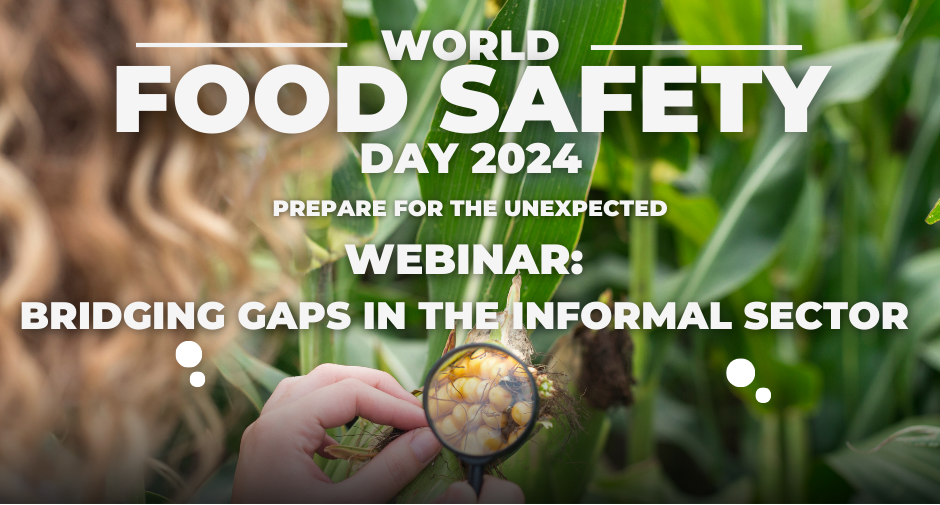
Un webinaire de haut niveau commémorant la Journée mondiale de la sécurité des aliments 2024, le 7 juin, sur le thème “ Être préparé à l'inattendu ”, a été organisé par AUDA-NEPAD et PACA de Union africaine et co-organisé par deux projets EU HORIZON—Projet Sécurité sanitaire des aliments pour l'Afrique (FS4Africa) (dirigé par IITA) et Projet de Partenariat UE-UA pour des systèmes alimentaires résilients, inclusifs et sûrs pour tous (UP-RISE) (dirigé par l'Université de Gand). Ce webinaire intitulé “ Combler les lacunes dans le secteur informel ” s'est tenu virtuellement le 27 juin, attirant plus de 120 participants inscrits à l'échelle mondiale.
Dans ses remarques de bienvenue, Hans-Joerg Lutzeyer, Senior actif pour les systèmes alimentaires R&I UE-Union africaine à la Commission européenne, a parlé de l'importance du partenariat UE-UA et a élaboré sur le cadre politique de la Commission européenne visant à soutenir ces efforts. Il a salué les contributions des deux projets de l'UE à l'amélioration de la sécurité sanitaire des aliments dans le secteur informel africain.
La cheffe du développement rural et cheffe par intérim de l'agriculture et de la sécurité alimentaire de la Commission de l'UA, Janet Edeme, représentée par Amare Ayalew, a délivré un message soulignant l'importance de la sécurité sanitaire des aliments. Elle a célébré le lancement du Plateforme de connaissances FS4Africa, a salué le soutien des projets FS4Africa et UP-RISE, et a exprimé son impatience quant aux idées générées par ce webinaire. La Directrice de l'Agriculture, de la Sécurité alimentaire et de la Durabilité environnementale de l'AUDA-NEPAD, Estherine Lisinge-Fotabong, a souligné l'impact de la sécurité sanitaire des aliments sur la santé, les moyens de subsistance et les revenus. Elle a partagé des points de vue sur les initiatives de l'Union africaine visant à donner la priorité à la sécurité sanitaire des aliments en Afrique, notamment par la mise en place de cadres politiques pour y parvenir.
Les coordinateurs de projet des deux projets EU HORIZON ont présenté un aperçu de ceux-ci lors de leurs interventions. Titilayo Falade, du projet FS4Africa, et Sarah De Saeger, du projet UP-RISE, ont exposé les visions et les stratégies de leurs projets respectifs. Ils ont souligné le rôle important du secteur informel dans la sécurité alimentaire et ont encouragé les participants à tisser des liens et à en apprendre davantage sur la sécurité sanitaire des aliments via les sites web de leurs projets. Les problèmes de sécurité sanitaire des aliments traités dans le cadre de leurs projets incluent les mycotoxines (UP-RISE et FS4Africa), les résidus de pesticides, les métaux lourds, la falsification des aliments et la contamination microbienne (FS4Africa). Le développement des capacités, le mentorat et la production de données probantes pour l'élaboration des politiques font partie des stratégies qui seront mises en œuvre au sein des projets.
En parlant de la sécurité des aliments dans le secteur informel, la représentante du Bureau du scientifique en chef de l'Autorité européenne de sécurité des aliments (EFSA), Rumbidzai Changwa, a discuté du rôle central de l'EFSA dans la garantie de la sécurité des aliments à travers l'Europe, englobant un large éventail de responsabilités, notamment l'évaluation des risques, la coopération scientifique et la communication sur les risques.
De plus, la professeure en systèmes de salubrité des aliments au Natural Resources Institute et scientifique nommée conjointement à l'ILRI, Delia Grace Randolph, a analysé la sécurité sanitaire des aliments dans le secteur informel. Elle a partagé le concept du marché alimentaire traditionnel, en explorant la dynamique essentielle à la sécurité alimentaire mais manquant souvent de protocoles de sécurité adéquats. Randolph a présenté l'approche de la “ chaise à trois pieds ” en matière de sécurité sanitaire des aliments, qui comprend un environnement propice, la motivation, la formation et la technologie.
Le conseiller SPS de la Commission de l'Union africaine, Chiluba Mwape, a fait un exposé sur le renforcement des normes africaines de sécurité sanitaire des aliments. Il a présenté le cadre politique continental et le rôle de divers acteurs, notamment la participation à l'élaboration des normes et des réglementations nationales, le respect des normes de sécurité sanitaire des aliments et des réglementations techniques, et le renforcement de la contribution du secteur privé au processus international d'établissement de normes alimentaires. Le PDG de Food Systems Transformation Solutions, Fadel Ndiame, a modéré ces sessions.
Lors d'un panel animé par le coordinateur des organisations de la société civile du Programme détaillé de développement de l'agriculture en Afrique (PDDAA), Chris Muyunda, des acteurs des secteurs informel et formel ont été mis à l'honneur. D'importants points ont été discutés, et des messages percutants ont été tirés des différentes contributions. Shahat Selim, de Kenya Dairy Farmers Holdings, a déclaré que “ la sécurité sanitaire des aliments coûte de l'argent ” ; par conséquent, l'investissement dans la sécurité sanitaire des aliments est important. Le directeur des normes et des mesures SPS de Trademark Africa, Andrew Edewa, a souligné la “ nécessité de mettre en œuvre des normes et des réglementations et de mener une évaluation des risques plus large ”. De même, le président de l'Association des agriculteurs du gouvernement local d'Akinyele, Salami Ayoola, a insisté sur la nécessité de créer des entrepôts dans les marchés ouverts pour les cultures vivrières, garantissant ainsi la sécurité et la régulation des prix. Le président du Forum de coopétition pour les produits agricoles à teneur réduite en aflatoxines (CFARAP) et directeur général d'AHALSON Nig Ltd (Nigéria), Ali Ahmed Alli, a également encouragé une formation adéquate des agriculteurs sur la gestion des dangers grâce à l'application de technologies de lutte contre les mycotoxines et les nuisibles. Il a en outre mentionné la nécessité pour les agriculteurs d'avoir accès à des machines de nettoyage industrielles et à une électricité fiable pour maintenir les normes de sécurité sanitaire des aliments et accroître la sensibilisation des consommateurs à ce sujet. Winnie Kemboi, membre du Kenya Dairy Board, a mentionné qu'un accès à des installations d'analyse adaptées au secteur informel et une formation aux bonnes pratiques de manipulation sont nécessaires.
Un point fort majeur pour conclure la réunion a été le lancement de la version bêta de la plateforme de connaissances FS4Africa, animée par Fabiola Rezende d'Ubuntoo. Elle a proposé une visite virtuelle de la plateforme en présentant les trois principaux outils verticaux : Découvrez—offrir aux utilisateurs un accès rapide et efficace à un large éventail d'informations pertinentes, servant de passerelle pour découvrir de nouvelles perspectives et ressources ; Apprenez—fournir un large éventail de ressources éducatives pour répondre à différents niveaux de compétences et domaines d'intérêt ; et le Ubuntoo AI—révolutionner l'expérience utilisateur en fournissant des analyses et des recommandations personnalisées.
En plus de ces outils essentiels, Fabiola a mis en avant plusieurs autres fonctionnalités passionnantes de la plateforme qui promettent d'améliorer l'engagement des utilisateurs et le partage des connaissances. Ces fonctionnalités créent une expérience utilisateur fluide et enrichissante, favorisant une communauté collaborative et informée.
Pour conclure, Amare Ayalew a présenté appel à l'action. Il résume les enseignements du webinaire et appelle à un effort collectif de tous les secteurs pour utiliser les plateformes de connaissances FS4A afin d'améliorer la connaissance de la sécurité sanitaire des aliments, d'accroître la sensibilisation à ce sujet et de promouvoir des solutions innovantes.
Contribué par Iremide Olasope et Titilayo Falade
Contribué par
Histoires récentes