
IITA NEWS

Overcoming food safety challenges in the informal sector
July 19, 2024

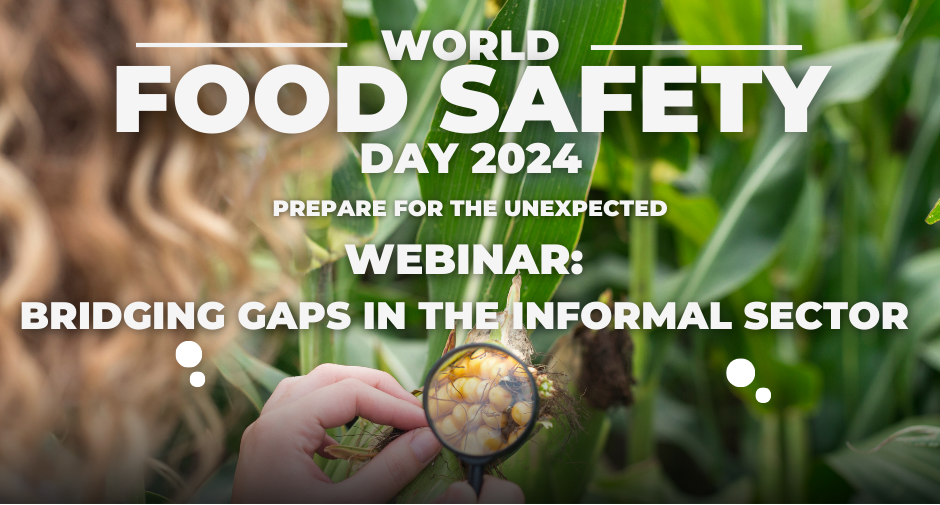
A high-level webinar commemorating the 2024 World Food Safety Day on 7 June, themed “Prepare for the unexpected,” was convened by AUDA-NEPAD and PACA of the African Union and co-hosted by two EU HORIZON projects—Food Safety for Africa (FS4Africa) Project (led by IITA) and EU-AU Partnership for Resilient, Inclusive and Safe food systems for Everyone (UP-RISE) Project (led by the University of Ghent). This webinar titled “Bridging gaps in the informal sector” was held virtually on 27 June, attracting over 120 registered participants globally.
In his welcome remarks, an Active Senior of the EU-African Union Food Systems R&I, European Commission, Hans-Joerg Lutzeyer, spoke about the importance of the EU-AU partnership and elaborated on the EU Commission’s policy framework aimed at supporting these efforts. He lauded the contributions of the two EU projects to improving food safety in the African informal sector.

The AU Commission Head of Rural Development and Acting Head of Agriculture and Food Security, Janet Edeme, represented by Amare Ayalew, delivered a message emphasizing the importance of food safety. She celebrated the launch of the FS4Africa Knowledge Platform, commended the support of the FS4Africa and UP-RISE projects, and expressed anticipation for the ideas generated from this webinar. The Director of Agriculture, Food Security, and Environmental Sustainability, AUDANEPAD, Estherine Lisinge-Fotabong, highlighted the impact of food safety on health, livelihoods, and income. She shared insights on the initiatives of the African Union in prioritizing food safety in Africa, including establishing policy frameworks towards achieving food safety in Africa.

The Project Coordinators of the two EU HORIZON projects provided overviews of the projects in their presentations. Titilayo Falade of the FS4Africa Project and Sarah De Saeger of the UP-RISE project outlined the visions and strategies of their projects. They emphasized the important role of the informal sector in food security and encouraged participants to connect and learn more about food safety via their project websites. Food safety issues addressed in their projects include mycotoxins (UP-RISE and FS4Africa), pesticide residues, heavy metals, food adulteration, and microbial contamination (FS4Africa). Capacity development, mentoring, and evidence generation for policy are some strategies that will be used within the projects.

In speaking about food safety in the informal sector, the representative from the Chief Scientist Office of the European Food Safety Authority (EFSA), Rumbidzai Changwa, discussed the pivotal role of EFSA in ensuring food safety across Europe, encompassing a broad range of responsibilities, including risk assessment, scientific cooperation, and risk communication.

Additionally, the Professor of Food Safety Systems, Natural Resources Institute, Joint Appointed Scientist ILRI, Delia Grace Randolph, analyzed food safety in the informal sector. She shared the concept of the traditional food market, exploring the dynamics vital for food security but often lacking adequate safety protocols. Randolph introduced the “three-legged stool” approach to food safety, which comprises an enabling environment, motivation, training, and technology.

The SPS Advisor of the African Union Commission, Chiluba Mwape, presented on strengthening African food safety standards. He outlined the continental policy framework and the role of various stakeholders, some of which include participating in national standards and regulation formulations, complying with food safety standards and technical regulations, and enhancing the contribution of the private sector in the international food standards-setting process. The CEO of Food Systems Transformation Solutions, Fadel Ndiame, moderated these sessions.

In a panel discussion moderated by the CSO Coordinator of the Comprehensive Africa Agriculture Development Programme (CAADP), Chris Muyunda, actors from the informal and formal sectors were featured. Important points were discussed, with cogent messages extracted from different contributors. Shahat Selim of Kenya Dairy Farmers Holdings stated that “food safety costs money;” therefore, investment in food safety is important. The Director of Standards and SPS Measures of Trademark Africa, Andrew Edewa, highlighted the “need to implement standards and regulations and to conduct broader risk assessment.” Similarly, the chairman of the Akinyele Local Government Farmers Association, Salami Ayoola, emphasized the need to establish warehouses in open markets for food crops, ensuring security and price control. The Chairman of the Coopetition Forum for Aflatoxin Reduced Agricultural Produce (CFARAP), MD of AHALSON Nig Ltd, Nigeria, Ali Ahmed Alli, also encouraged adequate training for farmers on the management of hazards through the application of technologies for mycotoxin and pest control. He further mentioned the need for farmers to access industrial cleaning machines and reliable electrical power to maintain food safety standards and increase consumer education on food safety. Kenya Dairy Board member Winnie Kemboi mentioned that access to testing facilities suited to the informal sector and training in good handling practices is necessary.

A major highlight to conclude the meeting was the beta launch of the FS4Africa Knowledge Platform facilitated by Fabiola Rezende of Ubuntoo. She provided a virtual tour of the platform showing the three main vertical tools: Discover—to give users quick and effective access to a wide range of pertinent information, serving as a pathway to discovering new insights and resources; Learn—to provide a wide range of educational resources to meet different skill levels and areas of interest; and the Ubuntoo AI—to revolutionize the user experience by delivering personalized insights and recommendations.

In addition to these core tools, Fabiola highlighted several other exciting platform features that promise to enhance user engagement and knowledge sharing. These features create a seamless and enriching user experience, fostering a collaborative and informed community.

To conclude, Amare Ayalew presented the call to action. It summarizes the insights from the webinar and calls for a collective effort from all sectors to utilize the FS4A Knowledge platforms to enhance knowledge of food safety, increase awareness of food safety, and promote innovative solutions.

Contributed by Iremide Olasope and Titilayo Falade


Contributed by

Recent stories

No items found

Leave a Reply

Your email address will not be published. Required fields are marked *

Scroll to Top
Olaosebikan, Olamide

Olamide Deborah Nwanze is a Senior Research Associate specializing in gender mainstreaming research to inform participatory and inclusive breeding, variety development, and seed systems policies regarding root, tuber, and banana (RTB) crops in the International Institute of Tropical Agriculture Headquarters, Ibadan, Nigeria. She is a PhD candidate at the University of Ibadan and holds an MSc and B. Agric in Agricultural Extension and Rural Development. Olamide is a fellow of the African Women in Agricultural Research and Development – Gender Responsive Agricultural Systems Policy (AWARD-GRASP) and the Gender Responsive Researchers Equipped for Agricultural Transformation (GREAT). She seeks to apply her gender-mainstreaming learnings, gender-responsive research, and policy development, and review expertise to facilitate women, youth, children, and vulnerable social group’s access to and adoption of agricultural Innovations that guarantee food, nutrition, income, and livelihood security in Africa. Her current roles include mentoring research fellows, development of guides and training manuals, implementation and adaptation of gender frameworks and tools, value chain actors’ engagement as citizen science partners, policy review and redesign, data management, and analysis. Her current research explores mixed methods and participatory and interdisciplinary approaches to capture and highlight gender dynamics, needs, preferences, and challenges stakeholders face within the agricultural livelihood value chain to prioritize gender-inclusive strategies in breeding programs, policy design, and implementation.

At IITA, she contributes to the implementation of the CGIAR Accelerated Breeding Initiative and Genetic Innovation Programs; participatory and gender research within the NextGen CassavaHarvestPlusRTBFoods, and Tricot-ClimMob 1000Farms Projects; and gender knowledge communication via the G-LENS webinar series, video documentary, policy briefspublications, and blogs.


Recent publications

de Sousa, K., van Etten, J., Manners, R. Bello, A., Teeken, B., Olaosebikan, O., et al. 2024. The tricot approach: an agile framework for decentralized on-farm testing supported by citizen science. A retrospective. Agron. Sustain. Dev. 44, 8. https://doi.org/10.1007/s13593-023-00937-1

Madu, T., Onwuka, S., Nwafor, S., Onyemauwa, N., Ejechi, M., Ofoeze, M., Ukeje, B., Eluagu, C., Olaosebikan, O., Okoye, B., 2024. Gender-Inclusive Consumer Studies Improve Cassava Breeding in Nigeria in: Frontiers in Sociology, volume 9, number: 1224504, doi: 10.3389/fsoc.2024.1224504

Olaosebikan, O.; Bello, A.; Utoblo, O.; Okoye, B.; Olutegbe, N.; Garner, E.; Teeken, B.; Bryan, E.; Forsythe, L.; Cole, S.; Madu, T. 2023.  Stressors and Resilience within the Cassava Value Chain in Nigeria: Preferred Cassava Variety Traits and Response Strategies of Men and Women to Inform Breeding. Sustainability 15, 7837. https://doi.org/10.3390/su15107837

Okoye, B., Ofoeze, M., Ejechi, M., Onwuka, S., Nwafor, S., Onyemauwa, N., Ukeje, B., Eluagu, C., Obidiegwu, J.*, Olaosebikan, O., Madu, T.* 2023. Prioritizing preferred traits in the yam value chain in Nigeria: a gender situation analysis in: Frontiers in Sociology, volume 8, number: 1232626, pages 1 – 9, ISSN 2297-7775, 2023. https://www.frontiersin.org/articles/10.3389/fsoc.2023.1232626/full

Olaosebikan, O., Bello, A. A., de Sousa, K., Ndjouenkeu, R., Adesokan, M., Alamu, E. O., Agbona, A., van Etten, J., Kegah, F. N.*, Dufour, D., Bouniol, A., Teeken, B. 2023. Consumer acceptability of cassava gari-eba food products across cultural and environmental settings using the triadic comparison of technologies approach (tricot) in: Journal of the Science of Food and Agriculture,

Teeken, B., Olaosebikan, O., Bello, A. A., Madu, T.*, Cole, S. M. 2023. Qualitative assessment on the positionality and preferences of dyads in relation to cassava-related activities: working with tricot trial citizen scientists https://hdl.handle.net/10568/138326 Type: Manual

Bouniol, A., Ceballos, H., Bello, A. A., Teeken, B., Olaosebikan, O., Owoade, D., Agbona, A., Fotso Kuate, A., Madu, T.*, Okoye, B.*, Ofoeze, M.*, Nwafor, S.*, Onyemauwa, N.*, Adinsi, L.*, Forsythe, L., Dufour, D. 2023. Varietal impact on women’s labour, workload and related drudgery in processing root, tuber and banana crops: focus on cassava in sub-Saharan Africa in: Journal of the Science of Food and Agriculture, pages 1 – 25, ISSN 0022-5142,

Bello, A. A., Agbona, A., Olaosebikan, O., Edughaen, G., Dufour, D., Bouniol, A., Iluebbey, P., Ndjouenkeu, R.*, Rabbi, I. Y., Teeken, B. 2023. Genetic and environmental effects on processing productivity and food product yield: drudgery of women’s work in: Journal of the Science of Food and Agriculture, pages 1 – 32, ISSN 0022-5142, 5

Cavicchioli, M., Zimbiti, T., Teeken, B., Nwanze, D.O., Liani, M., Parkes, E. & Bello, A. 2023. IITA-Gender Responsive Breeding Training Report. Genetic Resources Center, IITA-HQ, Ibadan, 21-23 September, 2022. Ibadan, Nigeria: IITA, (34 p.).https://hdl.handle.net/10568/131368

Agbona, A. Peteti P., Teeken B., Olaosebikan O. Bello, A. A., Parkes, E., Rabbi, I. Y., Mueller, L., Egesi, C., Kulakow, P. 2022. Data Management in Multi-disciplinary African RTB Crop Breeding Programs. In: Williamson, H.F., Leonelli, S. (eds) Towards Responsible Plant Data Linkage: Data Challenges for Agricultural Research and Development. Springer, Cham. https://doi.org/10.1007/978-3-031-13276-6_5

Lora Forsythe, Pricilla Marimo, Sarah Mayanja, Olamide D. Olaosebikan, Esme Stuart, Bela Teeken, Benjamin Okoye, Tessy Madu, (2021). Cross-product Gender Analysis of RTBfoods Step 2 Gendered Food Mapping on RTB Products. Understanding the Drivers of Trait Preferences and the Development of Multi-user RTB Product Profiles, WP1. London, UK: RTBfoods Field Scientific Report, 30 p.

Teeken, B., Garner, E., Agbona, A., Balogun, I., Olaosebikan, O., Bello, A., Madu, T., Okoye, B., Egesi, C., Kulakow, P. and Tufan, H.A. 2021. Beyond “Women’s Traits”: Exploring How Gender, Social Difference, and Household Characteristics Influence Trait Preferences. Frontiers Sustainable Food Systems 5:740926. https://doi.org/10.3389/fsufs.2021.740926

Teeken, B., Agbona, A., Bello, A., Olaosebikan, O., Alamu, E., Adesokan, M., Awoyale, W., Madu, T., Okoye, B., Chijioke, U., Owoade, D., Okoro, M., Bouniol, A., Dufour, D., Hershey, C., Rabbi, I., Maziya‐Dixon, B., Egesi, C., Tufan, H. and Kulakow, P. (020. Understanding cassava varietal preferences through pairwise ranking of gari‐eba and fufu prepared by local farmer–processors. Int J Food Sci Technol. https://doi.org/10.1111/ijfs.14862

Bela Teeken, Olamide Olaosebikan, Ireti Balogun, Benjamin Okoye, Tessy Madu, Steven Cole, Abolore Bello, Elizabeth Parkes. (2020). Piloting the G+ customer and product profile tools for gender-responsive cassava breeding in Nigeria. Nigeria: International Institute of Tropical Agriculture (IITA). https://hdl.handle.net/20.500.11766/13000