
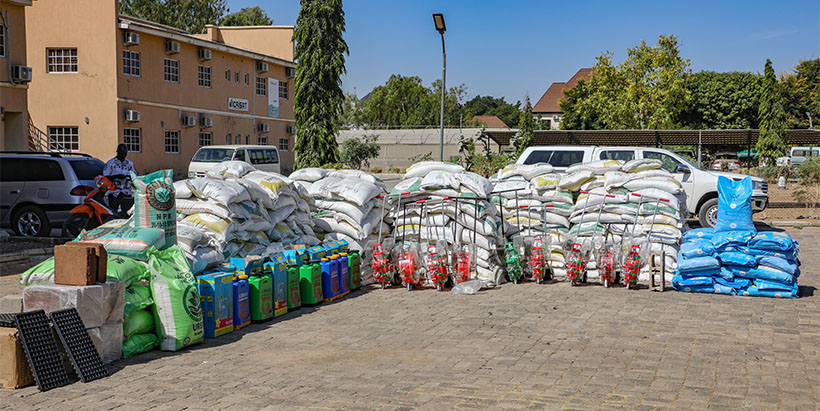
The IITA Youth in Agribusiness (YAS) project has donated various farming equipment and inputs to no fewer than 400 young farmers in Kano State. These donations were additional support to the participants, who had previously been trained in the value chain of various agricultural commodities, including poultry, horticulture, and aquaculture.
With funding support from the Embassy of the Kingdom of the Netherlands in Nigeria, the items distributed by the project included bags of chicken and fish feed, knapsack sprayers, bags of fertilizer, chicks, planter machines, seedling trays, coco peat, packs of sweet pepper and tomato seeds, among others.
The Project Coordinator, Adebayo Awotodunbo, said the process started with extensive technical and business training, followed by the empowerment to enable them to either start profitable agribusinesses or scale up existing ones.
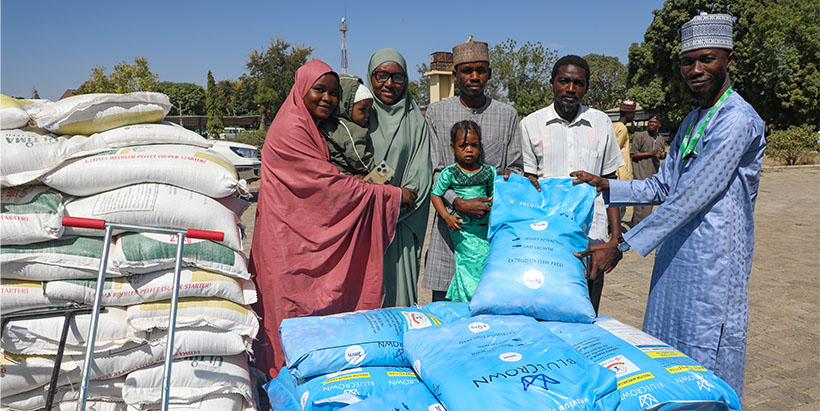
Awotodunbo, who represented the YAS team lead, Aline Mugisho, stated, “The purpose of empowering these youths is geared towards increased agricultural productivity, better yield, and improved livelihoods. It is also intended to equip them to contribute to food security in Nigeria.”
“When we started the training, we informed those already into agribusiness that we would support them after visiting their farms for verification. Our monitoring and evaluation team visited their farms and assessed their specific needs. Based on that exercise, they were given the specific things they needed. We have set up hubs for those new to agriculture, whom we call incubators, to facilitate experiential learning.’
‘I want to appeal to you, the participants, not to sell or mismanage these items but to use them judiciously. We expect that you would deploy these resources appropriately to expand your business and be able to employ or create wealth for more youths,” he added.
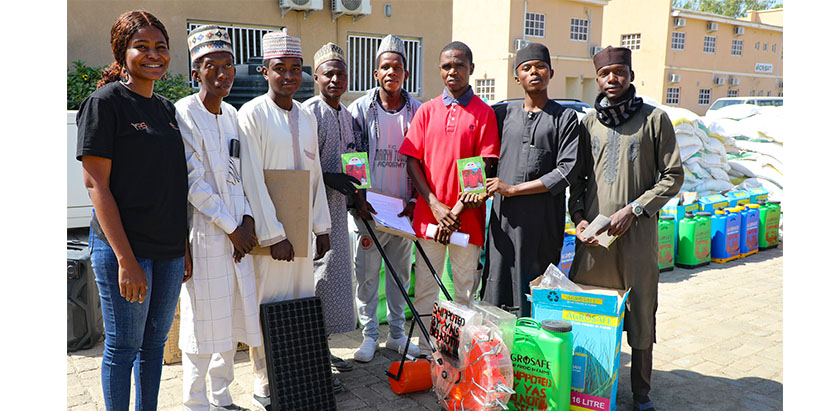
The IITA Station Administrator in Kano, Rabo Ado, congratulated the youths for participating in the program, saying, “You have been trained for free, and in addition to that, received input to start or scale up your business. We hope you will utilize them well and become an employer of labor in no distant time.’
‘We will monitor your use of these items and hope you will maximize them. We know that in the past when receiving this kind of support, some people sold the items. That was why we have grouped people into clusters so that no one can singlehandedly decide what happens to the items. In each group, we expect that members will take responsibility on the right usage of the items.”
The elated beneficiaries who have been trained and received the inputs across the various commodities applauded the project for the qualitative training they received, saying it exposed them to modern practices that will help to boost their yield and income.
A beneficiary, Ibrahim Said, noted that the YAS project has influenced his business significantly, adding, “From the training, I got the knowledge to improve my poultry farm, and with great impact on my business. I learned how best to raise the birds, market them, and maximize my income. In my group, we got 100 birds and ten bags of feed. That’s a lot for me. When we sell them in the next five to six weeks, we should be able to stock more than that. I know this support will aid our growth.”
Present at the event were the Head of the Institute for Agricultural Research and Training (I.A.R.T) in Kano State, Dr Alhassan Gabasawa; the Country Representative of the International Crops Research Institute for the Semi-Arid Tropics (ICRISAT), Dr Ignatius Ijantiku; and the Assistant Chief Regulatory Officer, National Agency for Food and Drug Administration and Control (NAFDAC) in Kano State, Hajiya Halima Abdulkarim.
Others were Najeeb Yunusa, Executive Director of Vertical Farms; Kabir Ademoh, the lead of the Netherlands-African Business Council; Jamiu Wahab of Syngenta Foundation; and Ridwan Adebisi, the CEO of Smart Agribus.
With a mandate to train 10,000 youths in Kano, Oyo, Ogun, and the Federal Capital Territory (FCT) within three years, the YAS project has, since its commencement in 2023, trained over 7,000 youths in the value chains of aquaculture, horticulture, cassava, maize, yam, groundnut, and soybean. So far, support has also been given to many of the farmers to scale up their enterprises.
Proposé par Babatunde Ajaja
Contribué par
Histoires récentes