
IITA NEWS

YAS distributes farm inputs and equipment to empower young farmers in Kano
January 9, 2025

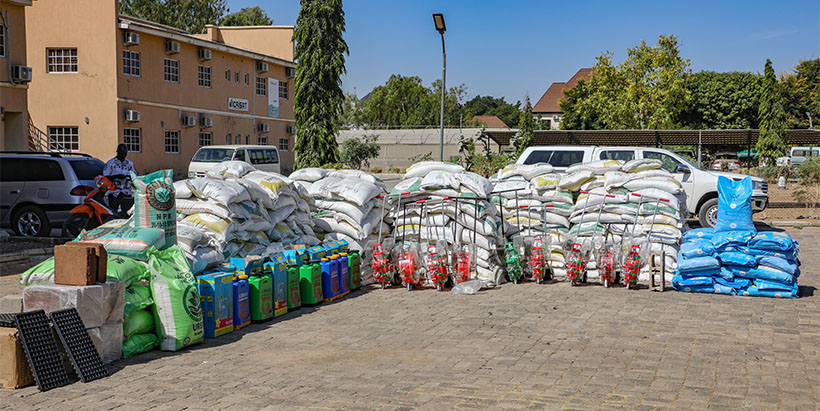
The items distributed to the participants

The IITA Youth in Agribusiness (YAS) project has donated various farming equipment and inputs to no fewer than 400 young farmers in Kano State. These donations were additional support to the participants, who had previously been trained in the value chain of various agricultural commodities, including poultry, horticulture, and aquaculture.

With funding support from the Embassy of the Kingdom of the Netherlands in Nigeria, the items distributed by the project included bags of chicken and fish feed, knapsack sprayers, bags of fertilizer, chicks, planter machines, seedling trays, coco peat, packs of sweet pepper and tomato seeds, among others.

The Project Coordinator, Adebayo Awotodunbo, said the process started with extensive technical and business training, followed by the empowerment to enable them to either start profitable agribusinesses or scale up existing ones.
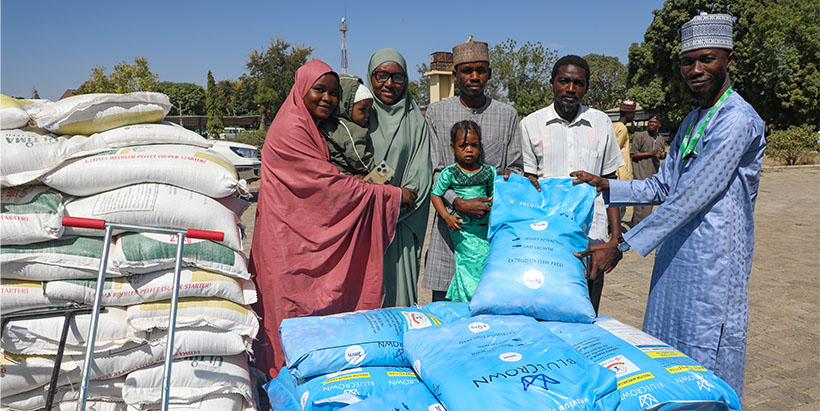
Bags of fish feed being presented to some fish farmers.

Awotodunbo, who represented the YAS team lead, Aline Mugisho, stated, “The purpose of empowering these youths is geared towards increased agricultural productivity, better yield, and improved livelihoods. It is also intended to equip them to contribute to food security in Nigeria.”

“When we started the training, we informed those already into agribusiness that we would support them after visiting their farms for verification. Our monitoring and evaluation team visited their farms and assessed their specific needs. Based on that exercise, they were given the specific things they needed. We have set up hubs for those new to agriculture, whom we call incubators, to facilitate experiential learning.’

‘I want to appeal to you, the participants, not to sell or mismanage these items but to use them judiciously. We expect that you would deploy these resources appropriately to expand your business and be able to employ or create wealth for more youths,” he added.
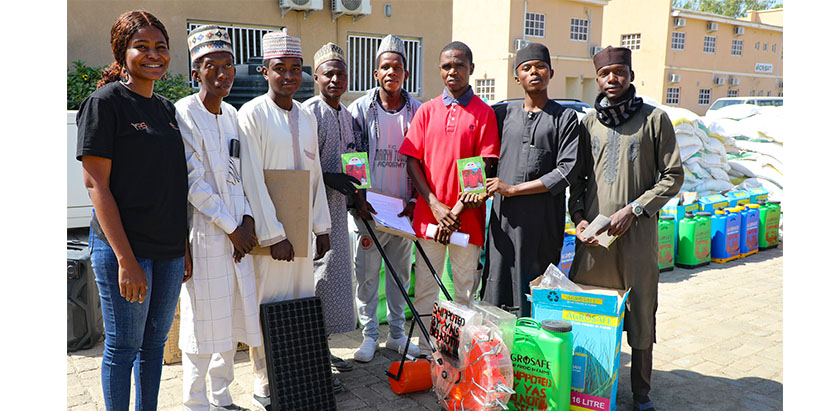
Planter machine, knapsack sprayer and other items being presented to horticultural farmers.

The IITA Station Administrator in Kano, Rabo Ado, congratulated the youths for participating in the program, saying, “You have been trained for free, and in addition to that, received input to start or scale up your business. We hope you will utilize them well and become an employer of labor in no distant time.’

‘We will monitor your use of these items and hope you will maximize them. We know that in the past when receiving this kind of support, some people sold the items. That was why we have grouped people into clusters so that no one can singlehandedly decide what happens to the items. In each group, we expect that members will take responsibility on the right usage of the items.”

The elated beneficiaries who have been trained and received the inputs across the various commodities applauded the project for the qualitative training they received, saying it exposed them to modern practices that will help to boost their yield and income.

A beneficiary, Ibrahim Said, noted that the YAS project has influenced his business significantly, adding, “From the training, I got the knowledge to improve my poultry farm, and with great impact on my business. I learned how best to raise the birds, market them, and maximize my income. In my group, we got 100 birds and ten bags of feed. That’s a lot for me. When we sell them in the next five to six weeks, we should be able to stock more than that. I know this support will aid our growth.”

Present at the event were the Head of the Institute for Agricultural Research and Training (I.A.R.T) in Kano State, Dr Alhassan Gabasawa; the Country Representative of the International Crops Research Institute for the Semi-Arid Tropics (ICRISAT), Dr Ignatius Ijantiku; and the Assistant Chief Regulatory Officer, National Agency for Food and Drug Administration and Control (NAFDAC) in Kano State, Hajiya Halima Abdulkarim.

Others were Najeeb Yunusa, Executive Director of Vertical Farms; Kabir Ademoh, the lead of the Netherlands-African Business Council; Jamiu Wahab of Syngenta Foundation; and Ridwan Adebisi, the CEO of Smart Agribus.

With a mandate to train 10,000 youths in Kano, Oyo, Ogun, and the Federal Capital Territory (FCT) within three years, the YAS project has, since its commencement in 2023, trained over 7,000 youths in the value chains of aquaculture, horticulture, cassava, maize, yam, groundnut, and soybean. So far, support has also been given to many of the farmers to scale up their enterprises.

Contributed by Babatunde Ajaja


Contributed by

Recent stories

No items found

Leave a Reply

Your email address will not be published. Required fields are marked *

Scroll to Top
Olaosebikan, Olamide

Olamide Deborah Nwanze is a Senior Research Associate specializing in gender mainstreaming research to inform participatory and inclusive breeding, variety development, and seed systems policies regarding root, tuber, and banana (RTB) crops in the International Institute of Tropical Agriculture Headquarters, Ibadan, Nigeria. She is a PhD candidate at the University of Ibadan and holds an MSc and B. Agric in Agricultural Extension and Rural Development. Olamide is a fellow of the African Women in Agricultural Research and Development – Gender Responsive Agricultural Systems Policy (AWARD-GRASP) and the Gender Responsive Researchers Equipped for Agricultural Transformation (GREAT). She seeks to apply her gender-mainstreaming learnings, gender-responsive research, and policy development, and review expertise to facilitate women, youth, children, and vulnerable social group’s access to and adoption of agricultural Innovations that guarantee food, nutrition, income, and livelihood security in Africa. Her current roles include mentoring research fellows, development of guides and training manuals, implementation and adaptation of gender frameworks and tools, value chain actors’ engagement as citizen science partners, policy review and redesign, data management, and analysis. Her current research explores mixed methods and participatory and interdisciplinary approaches to capture and highlight gender dynamics, needs, preferences, and challenges stakeholders face within the agricultural livelihood value chain to prioritize gender-inclusive strategies in breeding programs, policy design, and implementation.

At IITA, she contributes to the implementation of the CGIAR Accelerated Breeding Initiative and Genetic Innovation Programs; participatory and gender research within the NextGen CassavaHarvestPlusRTBFoods, and Tricot-ClimMob 1000Farms Projects; and gender knowledge communication via the G-LENS webinar series, video documentary, policy briefspublications, and blogs.


Recent publications

de Sousa, K., van Etten, J., Manners, R. Bello, A., Teeken, B., Olaosebikan, O., et al. 2024. The tricot approach: an agile framework for decentralized on-farm testing supported by citizen science. A retrospective. Agron. Sustain. Dev. 44, 8. https://doi.org/10.1007/s13593-023-00937-1

Madu, T., Onwuka, S., Nwafor, S., Onyemauwa, N., Ejechi, M., Ofoeze, M., Ukeje, B., Eluagu, C., Olaosebikan, O., Okoye, B., 2024. Gender-Inclusive Consumer Studies Improve Cassava Breeding in Nigeria in: Frontiers in Sociology, volume 9, number: 1224504, doi: 10.3389/fsoc.2024.1224504

Olaosebikan, O.; Bello, A.; Utoblo, O.; Okoye, B.; Olutegbe, N.; Garner, E.; Teeken, B.; Bryan, E.; Forsythe, L.; Cole, S.; Madu, T. 2023.  Stressors and Resilience within the Cassava Value Chain in Nigeria: Preferred Cassava Variety Traits and Response Strategies of Men and Women to Inform Breeding. Sustainability 15, 7837. https://doi.org/10.3390/su15107837

Okoye, B., Ofoeze, M., Ejechi, M., Onwuka, S., Nwafor, S., Onyemauwa, N., Ukeje, B., Eluagu, C., Obidiegwu, J.*, Olaosebikan, O., Madu, T.* 2023. Prioritizing preferred traits in the yam value chain in Nigeria: a gender situation analysis in: Frontiers in Sociology, volume 8, number: 1232626, pages 1 – 9, ISSN 2297-7775, 2023. https://www.frontiersin.org/articles/10.3389/fsoc.2023.1232626/full

Olaosebikan, O., Bello, A. A., de Sousa, K., Ndjouenkeu, R., Adesokan, M., Alamu, E. O., Agbona, A., van Etten, J., Kegah, F. N.*, Dufour, D., Bouniol, A., Teeken, B. 2023. Consumer acceptability of cassava gari-eba food products across cultural and environmental settings using the triadic comparison of technologies approach (tricot) in: Journal of the Science of Food and Agriculture,

Teeken, B., Olaosebikan, O., Bello, A. A., Madu, T.*, Cole, S. M. 2023. Qualitative assessment on the positionality and preferences of dyads in relation to cassava-related activities: working with tricot trial citizen scientists https://hdl.handle.net/10568/138326 Type: Manual

Bouniol, A., Ceballos, H., Bello, A. A., Teeken, B., Olaosebikan, O., Owoade, D., Agbona, A., Fotso Kuate, A., Madu, T.*, Okoye, B.*, Ofoeze, M.*, Nwafor, S.*, Onyemauwa, N.*, Adinsi, L.*, Forsythe, L., Dufour, D. 2023. Varietal impact on women’s labour, workload and related drudgery in processing root, tuber and banana crops: focus on cassava in sub-Saharan Africa in: Journal of the Science of Food and Agriculture, pages 1 – 25, ISSN 0022-5142,

Bello, A. A., Agbona, A., Olaosebikan, O., Edughaen, G., Dufour, D., Bouniol, A., Iluebbey, P., Ndjouenkeu, R.*, Rabbi, I. Y., Teeken, B. 2023. Genetic and environmental effects on processing productivity and food product yield: drudgery of women’s work in: Journal of the Science of Food and Agriculture, pages 1 – 32, ISSN 0022-5142, 5

Cavicchioli, M., Zimbiti, T., Teeken, B., Nwanze, D.O., Liani, M., Parkes, E. & Bello, A. 2023. IITA-Gender Responsive Breeding Training Report. Genetic Resources Center, IITA-HQ, Ibadan, 21-23 September, 2022. Ibadan, Nigeria: IITA, (34 p.).https://hdl.handle.net/10568/131368

Agbona, A. Peteti P., Teeken B., Olaosebikan O. Bello, A. A., Parkes, E., Rabbi, I. Y., Mueller, L., Egesi, C., Kulakow, P. 2022. Data Management in Multi-disciplinary African RTB Crop Breeding Programs. In: Williamson, H.F., Leonelli, S. (eds) Towards Responsible Plant Data Linkage: Data Challenges for Agricultural Research and Development. Springer, Cham. https://doi.org/10.1007/978-3-031-13276-6_5

Lora Forsythe, Pricilla Marimo, Sarah Mayanja, Olamide D. Olaosebikan, Esme Stuart, Bela Teeken, Benjamin Okoye, Tessy Madu, (2021). Cross-product Gender Analysis of RTBfoods Step 2 Gendered Food Mapping on RTB Products. Understanding the Drivers of Trait Preferences and the Development of Multi-user RTB Product Profiles, WP1. London, UK: RTBfoods Field Scientific Report, 30 p.

Teeken, B., Garner, E., Agbona, A., Balogun, I., Olaosebikan, O., Bello, A., Madu, T., Okoye, B., Egesi, C., Kulakow, P. and Tufan, H.A. 2021. Beyond “Women’s Traits”: Exploring How Gender, Social Difference, and Household Characteristics Influence Trait Preferences. Frontiers Sustainable Food Systems 5:740926. https://doi.org/10.3389/fsufs.2021.740926

Teeken, B., Agbona, A., Bello, A., Olaosebikan, O., Alamu, E., Adesokan, M., Awoyale, W., Madu, T., Okoye, B., Chijioke, U., Owoade, D., Okoro, M., Bouniol, A., Dufour, D., Hershey, C., Rabbi, I., Maziya‐Dixon, B., Egesi, C., Tufan, H. and Kulakow, P. (020. Understanding cassava varietal preferences through pairwise ranking of gari‐eba and fufu prepared by local farmer–processors. Int J Food Sci Technol. https://doi.org/10.1111/ijfs.14862

Bela Teeken, Olamide Olaosebikan, Ireti Balogun, Benjamin Okoye, Tessy Madu, Steven Cole, Abolore Bello, Elizabeth Parkes. (2020). Piloting the G+ customer and product profile tools for gender-responsive cassava breeding in Nigeria. Nigeria: International Institute of Tropical Agriculture (IITA). https://hdl.handle.net/20.500.11766/13000