L'espoir renaît pour les bananiers tanzaniens avec le lancement officiel de nouveaux hybrides de “ matooke ”
juillet 29, 2021
La Tanzanie a officiellement lancé quatre nouveaux hybrides améliorés du “ matooke ”, une importante banane à cuire de base. Ce sont les tout premiers hybrides de bananes matooke lancés en Tanzanie. Ces hybrides sont résistants aux ravageurs et aux maladies majeurs qui déciment les variétés actuelles cultivées par des millions d'agriculteurs à travers le pays et annoncent ainsi une ère passionnante pour la culture de la banane dans le pays.
Les nouveaux hybrides de matooke ont été développés pour la première fois par le Institut International d'Agriculture Tropicale (IIAT) et le Organisation nationale de recherche agricole (NARO) de l'Ouganda et nommé NARITA. Ils ont ensuite été testés en Tanzanie par le Institut de recherche agricole de Tanzanie et ses partenaires IITA, NARO et Alliance de Bioversity International et du CIAT, afin d'identifier ceux qui conviennent le mieux aux champs tanzaniens et aux agriculteurs tanzaniens.
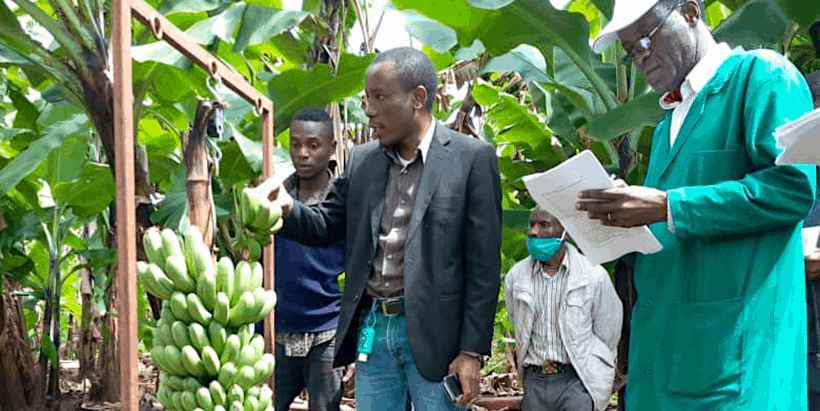
Des responsables du TOSCI collectent des données lors de l'essai d'uniformité et de stabilité distinctives avant l'approbation de la commercialisation des hybrides (Photo par Mpkoki/TARI)
Les quatre hybrides NARITA, désormais appelés TARIBAN 1 à 4, ont été officiellement lancés en mars et annoncés par le ministre de l'Agriculture, l'honorable professeur Adolf Faustine Mkenda, lors de son discours sur le budget au parlement en mai 2021. Les nouvelles variétés sont résistantes à la maladie des taches noires de Sigatoka et aux charançons du bananier, avec un potentiel rendements allant de 18 à 35 t/ha/an. Actuellement, la productivité moyenne des agriculteurs est d'environ 7 t/ha/an.
La banane à cuire des hauts plateaux d'Afrique de l'Est, appelée localement ’ matooke “, est consommée cuite à la vapeur ou à l'eau, et parfois écrasée avant d'être consommée. C'est l'aliment de base de millions de personnes dans toute la région, où les champs de bananiers couvrent souvent des collines entières, stabilisent le paysage et constituent une source de revenus essentielle pour les communautés de la région des Grands Lacs en Afrique.
Les agriculteurs tanzaniens cultivent les mêmes variétés de bananes ancestrales depuis des centaines d'années. Les ravageurs et les maladies affligent perpétuellement ces variétés, affectant le rendement et la qualité.
Le coordinateur national de la recherche sur la banane à l'IRET, responsable de la direction de cette recherche, le Dr Mpoki Shimwela, noté qu'il s'agissait d'une réalisation majeure pour les efforts du pays visant à améliorer sa sécurité alimentaire et les revenus des agriculteurs ruraux. Il a joué un rôle déterminant en démontrant la valeur de ceux-ci des hybrides aux agriculteurs tanzaniens lors de la journée nationale des agriculteurs Nane Nane.“ C'est une très bonne nouvelle pour les agriculteurs, car ils attendaient ces variétés avec impatience, les leurs étant très sensibles et leur production ayant été ravagée par les ravageurs et les maladies pendant de nombreuses années. Bon nombre d'entre eux avaient complètement abandonné la culture de la bananière, bien qu'il s'agisse d'une culture de base majeure dans de nombreuses régions du pays ”, a-t-il déclaré.
Rony Swennen, qui dirige la sélection de bananes de l'IITA, a salué la nouvelle de cette homologue officielle, la qualifiant d'étape majeure pour le pays et la région. Il a également attribué ce succès à l'excellente collaboration entre les partenaires nationaux, la NARO et la TARI, et les partenaires internationaux, l'IITA et Bioversity International, qui a permis d'accélérer cette homologation — un processus qui aurait autrement été long et fastidieux. Cependant, le parcours a commencé il y a de nombreuses années en Ouganda, à la suite de plus de 20 ans de collaboration en matière de sélection entre l'IITA et la NARO, qui a vu le développement de 27 hybrides de matooke (NARITA).
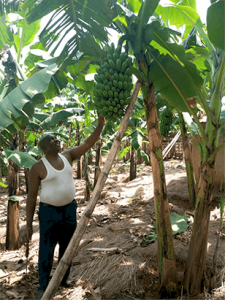
Agriculteur admirant TARIBAN lors d'un des essais agronomiques à Bukoba, en Tanzanie
La mise en circulation des NARITA en Tanzanie en provenance d'Ouganda renforce le partenariat entre les programmes nationaux des deux pays dans l'esprit de la coopération est-africaine par la recherche, donnant ainsi à la NARO et à la TARI un rôle à jouer dans le programme de développement régional. Les NARITA ont d'abord été amenés à la TARI pour tester le rendement et l'acceptabilité locale dans toutes les zones de production bananière sous la direction de l'IITA. Projet d'amélioration des bananes.Sur la base de diverses caractéristiques telles que le goût, la texture de cuisson et le rendement, les quatre meilleures variétés ont été identifiées comme étant celles préférées par les agriculteurs. Cela a été accompli en un temps record de cinq ans. Les prochaines étapes consisteront à développer un système robuste de production et de distribution de plantules des nouveaux hybrides afin de permettre aux agriculteurs d'y accéder dans tout le pays.
Pour plus d'informations, contactez le Dr Mpoki Shimwale (TARI), mpokis@yahoo.com; Dr. Priver Namanya (NARO), bwesigyep@gmail.com; et le prof. Rony Swennen (IITA), r.swennen@cgiar.org.
Ce travail fait partie du Programme de recherche du CGIAR sur les racines, les tubercules et les bananes (RTB)
Olamide Deborah Nwanze est une chercheuse principale spécialisée dans la recherche sur l'approche "genre" afin d'éclairer les politiques de sélection participative et inclusive, de développement de variétés et de systèmes semenciers concernant les cultures de racines, tubercules et bananes (RTB) au siège de l'Institut International d'Agriculture Tropicale, à Ibadan, au Nigeria. Elle est candidate au doctorat à l'Université d'Ibadan et titulaire d'un master et d'un diplôme d'ingénieur agronome en vulgarisation agricole et développement rural. Olamide est membre du programme African Women in Agricultural Research and Development – Gender Responsive Agricultural Systems Policy (SAISIE DE RÉCOMPENSEet les Chercheuses Sensibles au Genre Équipées pour la Transformation Agricole (SUPER. Elle cherche à appliquer ses apprentissages en matière d’approche genre, recherche sensible au genre, et expertise en développement et examen de politiques pour faciliter l’accès et l’adoption par les femmes, les jeunes, les enfants et les groupes sociaux vulnérables aux innovations agricoles qui garantissent la sécurité alimentaire, nutritionnelle, des revenus et des moyens de subsistance en Afrique. Ses rôles actuels comprennent le mentorat de chercheurs stagiaires, le développement de guides et manuels de formation, la mise en œuvre et l'adaptation de cadres et d'outils genre, l'engagement des acteurs de la chaîne de valeur en tant que partenaires de la science citoyenne, l'examen et la refonte des politiques, la gestion et l'analyse des données. Ses recherches actuelles portent sur les méthodes mixtes ainsi que sur les approches participatives et interdisciplinaires pour saisir et mettre en évidence les dynamiques de genre, les besoins, les préférences et les défis rencontrés par les parties prenantes au sein de la chaîne de valeur des moyens de subsistance agricoles afin de prioriser des stratégies axées sur le genre dans les programmes de sélection, la conception et la mise en œuvre des politiques.
de Sousa, K., van Etten, J., Manners, R. Bello, A., Teeken, B., Olaosebikan, O., et al. 2024. L'approche tricot : un cadre agile pour les essais décentralisés à la ferme soutenus par la science citoyenne. Une rétrospective. Agron. Sustain. Dev. 44, 8. https://doi.org/10.1007/s13593-023-00937-1
Madu, T., Onwuka, S., Nwafor, S., Onyemauwa, N., Ejechi, M., Ofoeze, M., Ukeje, B., Eluagu, C., Olaosebikan, O., Okoye, B., 2024. Les études sur les consommateurs inclusifs en matière de genre améliorent l'amélioration du manioc au Nigeria dans : Frontiers in Sociology, volume 9, numéro : 1224504, doi : 10.3389/fsoc.2024.1224504
Olaosebikan, O. ; Bello, A. ; Utoblo, O. ; Okoye, B. ; Olutegbe, N. ; Garner, E. ; Teeken, B. ; Bryan, E. ; Forsythe, L. ; Cole, S. ; Madu, T. 2023. Facteurs de stress et résilience au sein de la chaîne de valeur du manioc au Nigeria : Caractéristiques préférées des variétés de manioc et stratégies de réponse des hommes et des femmes pour informer l'amélioration variétale. Sustainability 15, 7837. https://doi.org/10.3390/su15107837
Okoye, B., Ofoeze, M., Ejechi, M., Onwuka, S., Nwafor, S., Onyemauwa, N., Ukeje, B., Eluagu, C., Obidiegwu, J.*, Olaosebikan, O., Madu, T.* 2023. Priorisation des traits préférés dans la chaîne de valeur de l'igname au Nigeria : une analyse de la situation en matière de genre in: Frontiers in Sociology, volume 8, numéro : 1232626, pages 1 – 9, ISSN 2297-7775, 2023. https://www.frontiersin.org/articles/10.3389/fsoc.2023.1232626/full
Olaosebikan, O., Bello, A. A., de Sousa, K., Ndjouenkeu, R., Adesokan, M., Alamu, E. O., Agbona, A., van Etten, J., Kegah, F. N.*, Dufour, D., Bouniol, A., Teeken, B. 2023. Acceptabilité par les consommateurs des produits alimentaires à base de gari-eba de manioc dans des contextes culturels et environnementaux variés en utilisant l'approche triade de comparaison des technologies (tricot) dans : Journal of the Science of Food and Agriculture,
Teeken, B., Olaosebikan, O., Bello, A. A., Madu, T.*, Cole, S. M. 2023. Évaluation qualitative de la positionnalité et des préférences des dyades en relation avec les activités liées au manioc : travailler avec des scientifiques citoyens du procès tricot https://hdl.handle.net/10568/138326 Type : Manuel
Bouniol, A., Ceballos, H., Bello, A. A., Teeken, B., Olaosebikan, O., Owoade, D., Agbona, A., Fotso Kuate, A., Madu, T.*, Okoye, B.*, Ofoeze, M.*, Nwafor, S.*, Onyemauwa, N.*, Adinsi, L.*, Forsythe, L., Dufour, D. 2023. Impact variétal sur le travail des femmes, la charge de travail et la pénibilité associée dans le traitement des plantes à racines, tubercules et bananes : focus sur le manioc en Afrique subsaharienne dans : Journal of the Science of Food and Agriculture, pages 1 – 25, ISSN 0022-5142,
Bello, A. A., Agbona, A., Olaosebikan, O., Edughaen, G., Dufour, D., Bouniol, A., Iluebbey, P., Ndjouenkeu, R.*, Rabbi, I. Y., Teeken, B. 2023. Effets génétiques et environnementaux sur la productivité de la transformation et le rendement des produits alimentaires : la pénibilité du travail des femmes dans : Journal of the Science of Food and Agriculture, pages 1 – 32, ISSN 0022-5142, 5
Cavicchioli, M., Zimbiti, T., Teeken, B., Nwanze, D.O., Liani, M., Parkes, E. & Bello, A. 2023. Rapport sur la formation en sélection génétique sensible au genre à l'IITA. Genetic Resources Center, IITA-HQ, Ibadan, 21-23 septembre 2022. Ibadan, Nigéria : IITA, (34 p.).https://hdl.handle.net/10568/131368
Agbona, A. Peteti P., Teeken B., Olaosebikan O. Bello, A. A., Parkes, E., Rabbi, I. Y., Mueller, L., Egesi, C., Kulakow, P. 2022. Gestion des données dans les programmes d'amélioration des cultures RTB africaines multidisciplinaires. In : Williamson, H.F., Leonelli, S. (eds) Towards Responsible Plant Data Linkage: Data Challenges for Agricultural Research and Development. Springer, Cham. https://doi.org/10.1007/978-3-031-13276-6_5
Lora Forsythe, Pricilla Marimo, Sarah Mayanja, Olamide D. Olaosebikan, Esme Stuart, Bela Teeken, Benjamin Okoye, Tessy Madu, (2021). Analyse transversale du genre dans RTBfoods Étape 2 Cartographie des genres sur les produits RTB. Comprendre les moteurs des préférences en matière de traits et le développement de profils de produits RTB multi-utilisateurs, WP1. Londres, Royaume-Uni : Rapport scientifique de terrain RTBfoods, 30 p.
Teeken, B., Garner, E., Agbona, A., Balogun, I., Olaosebikan, O., Bello, A., Madu, T., Okoye, B., Egesi, C., Kulakow, P. et Tufan, H.A. 2021. Au-delà des “ traits des femmes ” : explorer comment le genre, les différences sociales et les caractéristiques des ménages influencent les préférences pour les traits. Frontiers Systèmes alimentaires durables 5:740926. https://doi.org/10.3389/fsufs.2021.740926
Teeken, B., Agbona, A., Bello, A., Olaosebikan, O., Alamu, E., Adesokan, M., Awoyale, W., Madu, T., Okoye, B., Chijioke, U., Owoade, D., Okoro, M., Bouniol, A., Dufour, D., Hershey, C., Rabbi, I., Maziya‐Dixon, B., Egesi, C., Tufan, H. et Kulakow, P. (020. Comprendre les préférences variétales du manioc par le classement par paires du gari-eba et du fufu préparés par des agriculteurs-transformateurs locaux. Int J Food Sci Technol.https://doi.org/10.1111/ijfs.14862
Bela Teeken, Olamide Olaosebikan, Ireti Balogun, Benjamin Okoye, Tessy Madu, Steven Cole, Abolore Bello, Elizabeth Parkes. (2020). Pilotage des outils de profil client et produit G+ pour l'amélioration sensible au genre du manioc au Nigeria. Nigeria : Institut international d'agriculture tropicale (IIAT). https://hdl.handle.net/20.500.11766/13000