Hope for Tanzanian banana farmers with the official release of new “matooke” hybrids
July 29, 2021
Tanzania has officially released four new, improved hybrids of the important staple cooking banana, “matooke”. These are the first-ever matooke banana hybrids released in Tanzania. These hybrids are resistant to important pests and diseases ravaging the current varieties that millions of farmers across the country are growing and, as such, herald an exciting era for banana cultivation in the country.
The new matooke hybrids were first developed by the International Institute of Tropical Agriculture (IITA) and the National Agriculture Research Organization (NARO) of Uganda and named NARITAs. They were later tested in Tanzania by the Tanzania Agriculture Research Institute (TARI) and its partners IITA, NARO, and Alliance of Bioversity International and CIAT, to identify those most suited to Tanzanian fields and Tanzanian farmers.
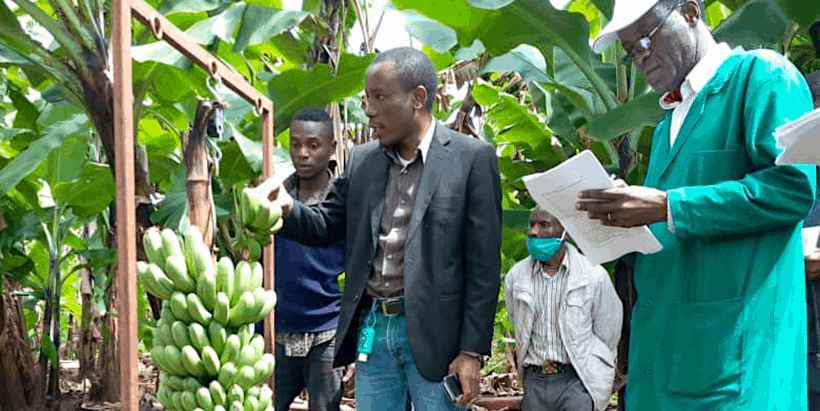
TOSCI officials collecting data from Distinctive Uniformity and Stability Trial before approval for release of the hybrids (Photo by Mpkoki/TARI)
The four NARITA hybrids, now called TARIBAN 1–4, were officially released in March and announced by the Minister of Agriculture, Hon. Prof. Adolf Faustine Mkenda, during his budget speech in parliament in May 2021. The new varieties are resistant to black Sigatoka leaf disease and banana weevils, with potential yields ranging from 18 to 35 t/ha/year. Currently, farmers’ average productivity is around 7 t/ha/year.
The East Africa Highland cooking banana, locally referred to as “matooke”, are steamed or boiled, and then sometimes mashed before consumption. They are the main staple for millions of people across the region, where banana fields often blanket whole hillsides, stabilize the landscape, and provide a key source of income to communities in the Great Lakes Region of Africa.
Farmers in Tanzania have been growing the same ancient banana varieties for hundreds of years. Pests and diseases perpetually afflict these varieties affecting yield and quality.
The National Coordinator for banana research at TARI responsible for leading this research, Dr Mpoki Shimwela, noted this was a major achievement for the country’s efforts to improve its food security and the incomes of rural farmers. He was instrumental in demonstrating the value of these hybrids to the Tanzanian farmers during the Nane Nane national farmers’ day.
“This is very good news for the farmers as they have been eagerly waiting for these varieties as theirs (varieties) are highly susceptible and production has been devastated by pests and diseases for many years. Many of the farmers had given up on growing banana altogether despite it being a major staple crop for many parts of the country,” he said.
Rony Swennen, who leads IITA’s banana breeding, welcomed the news of this official release noting it as a huge milestone for the country and region. He also attributed the success to the excellent collaboration between the national partners, NARO and TARI, and the international partners, IITA and Bioversity International, that facilitated the fast-tracking of this release—an otherwise long, drawn-out process. However, the journey began many years ago in Uganda, following more than 20 years of breeding collaboration between IITA and NARO, which saw 27 matooke hybrids (NARITAs) developed.
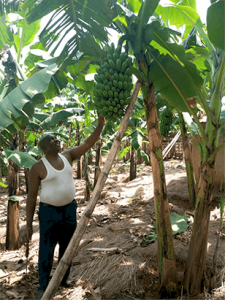
Farmer admiring TARIBAN in one of the farmer field trials in Bukoba, Tanzania
The release of NARITAs into Tanzania from Uganda strengthens the partnership between the national programs of both countries in the spirit of East African cooperation through research, thereby giving NARO and TARI a stake in the agenda for regional development. The NARITAs were first brought to TARI to test yield performance and local acceptability in all the banana production areas under the IITA-led Breeding Better Bananas project.
Based on various characteristics such as taste, cooking texture, and yield, the best four were identified as those that farmers preferred. This was achieved in a record five years. The next steps will be to develop a robust seedling production and distribution system of the new hybrids to enable farmers to access them across the country.
For more information, contact Dr Mpoki Shimwale (TARI), mpokis@yahoo.com; Dr. Priver Namanya (NARO), bwesigyep@gmail.com; and Prof Rony Swennen (IITA), r.swennen@cgiar.org.
This work is part of the CGIAR Research Program on Roots, Tubers and Bananas (RTB)
Olamide Deborah Nwanze is a Senior Research Associate specializing in gender mainstreaming research to inform participatory and inclusive breeding, variety development, and seed systems policies regarding root, tuber, and banana (RTB) crops in the International Institute of Tropical Agriculture Headquarters, Ibadan, Nigeria. She is a PhD candidate at the University of Ibadan and holds an MSc and B. Agric in Agricultural Extension and Rural Development. Olamide is a fellow of the African Women in Agricultural Research and Development – Gender Responsive Agricultural Systems Policy (AWARD-GRASP) and the Gender Responsive Researchers Equipped for Agricultural Transformation (GREAT). She seeks to apply her gender-mainstreaming learnings, gender-responsive research, and policy development, and review expertise to facilitate women, youth, children, and vulnerable social group’s access to and adoption of agricultural Innovations that guarantee food, nutrition, income, and livelihood security in Africa. Her current roles include mentoring research fellows, development of guides and training manuals, implementation and adaptation of gender frameworks and tools, value chain actors’ engagement as citizen science partners, policy review and redesign, data management, and analysis. Her current research explores mixed methods and participatory and interdisciplinary approaches to capture and highlight gender dynamics, needs, preferences, and challenges stakeholders face within the agricultural livelihood value chain to prioritize gender-inclusive strategies in breeding programs, policy design, and implementation.
de Sousa, K., van Etten, J., Manners, R. Bello, A., Teeken, B., Olaosebikan, O., et al. 2024. The tricot approach: an agile framework for decentralized on-farm testing supported by citizen science. A retrospective. Agron. Sustain. Dev. 44, 8. https://doi.org/10.1007/s13593-023-00937-1
Madu, T., Onwuka, S., Nwafor, S., Onyemauwa, N., Ejechi, M., Ofoeze, M., Ukeje, B., Eluagu, C., Olaosebikan, O., Okoye, B., 2024. Gender-Inclusive Consumer Studies Improve Cassava Breeding in Nigeria in: Frontiers in Sociology, volume 9, number: 1224504, doi: 10.3389/fsoc.2024.1224504
Olaosebikan, O.; Bello, A.; Utoblo, O.; Okoye, B.; Olutegbe, N.; Garner, E.; Teeken, B.; Bryan, E.; Forsythe, L.; Cole, S.; Madu, T. 2023. Stressors and Resilience within the Cassava Value Chain in Nigeria: Preferred Cassava Variety Traits and Response Strategies of Men and Women to Inform Breeding. Sustainability 15, 7837. https://doi.org/10.3390/su15107837
Okoye, B., Ofoeze, M., Ejechi, M., Onwuka, S., Nwafor, S., Onyemauwa, N., Ukeje, B., Eluagu, C., Obidiegwu, J.*, Olaosebikan, O., Madu, T.* 2023. Prioritizing preferred traits in the yam value chain in Nigeria: a gender situation analysis in: Frontiers in Sociology, volume 8, number: 1232626, pages 1 – 9, ISSN 2297-7775, 2023. https://www.frontiersin.org/articles/10.3389/fsoc.2023.1232626/full
Olaosebikan, O., Bello, A. A., de Sousa, K., Ndjouenkeu, R., Adesokan, M., Alamu, E. O., Agbona, A., van Etten, J., Kegah, F. N.*, Dufour, D., Bouniol, A., Teeken, B. 2023. Consumer acceptability of cassava gari-eba food products across cultural and environmental settings using the triadic comparison of technologies approach (tricot) in: Journal of the Science of Food and Agriculture,
Teeken, B., Olaosebikan, O., Bello, A. A., Madu, T.*, Cole, S. M. 2023. Qualitative assessment on the positionality and preferences of dyads in relation to cassava-related activities: working with tricot trial citizen scientists https://hdl.handle.net/10568/138326 Type: Manual
Bouniol, A., Ceballos, H., Bello, A. A., Teeken, B., Olaosebikan, O., Owoade, D., Agbona, A., Fotso Kuate, A., Madu, T.*, Okoye, B.*, Ofoeze, M.*, Nwafor, S.*, Onyemauwa, N.*, Adinsi, L.*, Forsythe, L., Dufour, D. 2023. Varietal impact on women’s labour, workload and related drudgery in processing root, tuber and banana crops: focus on cassava in sub-Saharan Africa in: Journal of the Science of Food and Agriculture, pages 1 – 25, ISSN 0022-5142,
Bello, A. A., Agbona, A., Olaosebikan, O., Edughaen, G., Dufour, D., Bouniol, A., Iluebbey, P., Ndjouenkeu, R.*, Rabbi, I. Y., Teeken, B. 2023. Genetic and environmental effects on processing productivity and food product yield: drudgery of women’s work in: Journal of the Science of Food and Agriculture, pages 1 – 32, ISSN 0022-5142, 5
Cavicchioli, M., Zimbiti, T., Teeken, B., Nwanze, D.O., Liani, M., Parkes, E. & Bello, A. 2023. IITA-Gender Responsive Breeding Training Report. Genetic Resources Center, IITA-HQ, Ibadan, 21-23 September, 2022. Ibadan, Nigeria: IITA, (34 p.).https://hdl.handle.net/10568/131368
Agbona, A. Peteti P., Teeken B., Olaosebikan O. Bello, A. A., Parkes, E., Rabbi, I. Y., Mueller, L., Egesi, C., Kulakow, P. 2022. Data Management in Multi-disciplinary African RTB Crop Breeding Programs. In: Williamson, H.F., Leonelli, S. (eds) Towards Responsible Plant Data Linkage: Data Challenges for Agricultural Research and Development. Springer, Cham. https://doi.org/10.1007/978-3-031-13276-6_5
Lora Forsythe, Pricilla Marimo, Sarah Mayanja, Olamide D. Olaosebikan, Esme Stuart, Bela Teeken, Benjamin Okoye, Tessy Madu, (2021). Cross-product Gender Analysis of RTBfoods Step 2 Gendered Food Mapping on RTB Products. Understanding the Drivers of Trait Preferences and the Development of Multi-user RTB Product Profiles, WP1. London, UK: RTBfoods Field Scientific Report, 30 p.
Teeken, B., Garner, E., Agbona, A., Balogun, I., Olaosebikan, O., Bello, A., Madu, T., Okoye, B., Egesi, C., Kulakow, P. and Tufan, H.A. 2021. Beyond “Women’s Traits”: Exploring How Gender, Social Difference, and Household Characteristics Influence Trait Preferences. Frontiers Sustainable Food Systems 5:740926. https://doi.org/10.3389/fsufs.2021.740926
Teeken, B., Agbona, A., Bello, A., Olaosebikan, O., Alamu, E., Adesokan, M., Awoyale, W., Madu, T., Okoye, B., Chijioke, U., Owoade, D., Okoro, M., Bouniol, A., Dufour, D., Hershey, C., Rabbi, I., Maziya‐Dixon, B., Egesi, C., Tufan, H. and Kulakow, P. (020. Understanding cassava varietal preferences through pairwise ranking of gari‐eba and fufu prepared by local farmer–processors. Int J Food Sci Technol.https://doi.org/10.1111/ijfs.14862
Bela Teeken, Olamide Olaosebikan, Ireti Balogun, Benjamin Okoye, Tessy Madu, Steven Cole, Abolore Bello, Elizabeth Parkes. (2020). Piloting the G+ customer and product profile tools for gender-responsive cassava breeding in Nigeria. Nigeria: International Institute of Tropical Agriculture (IITA). https://hdl.handle.net/20.500.11766/13000