
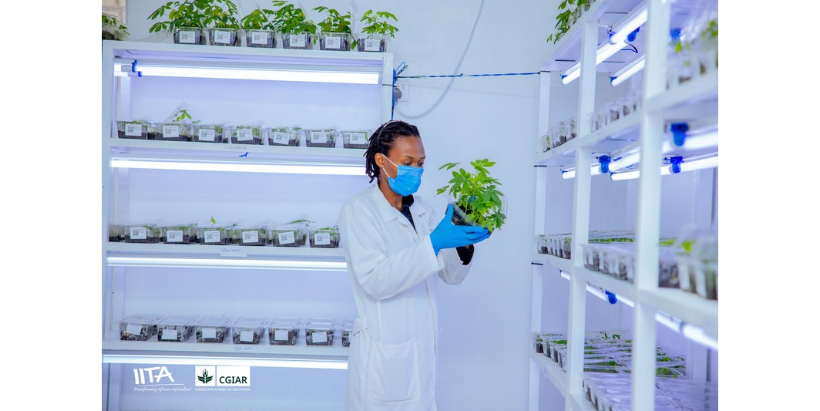
IITA introduced Semi-Autotrophic Hydroponics (SAH) at the RAB Rubona station to increase multiplication rates while improving the quality and survival of tissue-culture-derived cassava plantlets. The technology has provided a faster, more efficient approach to multiplying clean planting materials within a relatively small space and a short period. Since its introduction in Rwanda in 2019, SAH has revolutionized cassava seed multiplication by enabling the national seed system to produce up to three times as much clean cassava planting material.
This increased capacity is important for the young cassava seed system in Rwanda, where access to sufficient quantities of healthy planting material is essential for farmers to grow productive crops. Cassava is particularly vulnerable to the accumulation and spread of viral diseases through vegetative planting materials, making the availability of clean seed critical to maintaining crop health.
At the Rwanda Agriculture and Animal Resources Development Board (RAB)-Rubona station, the SAH laboratory provides a controlled environment for rapidly multiplying clean cassava planting materials. RAB technicians report that the technology has increased the laboratory’s annual multiplication capacity from about 100,000 plantlets produced by conventional methods to as many as 300,000.
“In one year here in SAH, we are now able to at least produce 300,000 plantlets, an impressive increase from 100,000 cuttings previously produced with the conventional method under a screenhouse. So, this has enabled us to multiply an increased number of cassava seeds in a very limited space and short time, as well as limiting the spread of diseases and increasing the quantity of plantlets produced,” said Severin Ntivuguruzwa, Cassava Breeder Research Fellow at RAB.
Beyond establishing the laboratory, IITA has supported the development of national capacity by training RAB technicians in SAH operation and management. This approach has helped ensure that the technology and expertise are available to Rwanda’s national agricultural research system.
Sabrine Umugwaneza, one of the RAB technicians trained at IITA headquarters in Ibadan, Nigeria, in 2019, has been operating the SAH laboratory in Rwanda and has accumulated tangible experience. “I received SAH training in 2019 at IITA headquarters in Ibadan, Nigeria. I learned about SAH operations and how it’s used to produce clean cassava planting materials. I immediately started operating the SAH lab in Rwanda, and since then, the plantlet multiplication rate has increased considerably. We are producing more seeds. The most important aspect of SAH is that it’s cheap and uses fewer, simpler materials (no laminar flow for sterilization). It’s multiplying faster than the traditional approach,” said Umugwaneza.
Watch this vidéo about how Semi-Autotrophic Hydroponics (SAH) is transforming Rwanda’s cassava seed system.
“SAH is a novel technology that has been acquired and used by IITA to increase the rapid multiplication of cassava seedlings. The technology has been very important in increasing cassava multiplication rates. It has also been very useful in reducing the cost of cassava seed production. With these two dimensions, we can to generate more affordable planting materials,” said Dr Silver Tumwegamire, IITA Cassava Breeder.
The technology is part of a broader effort by IITA and its partners to strengthen Rwanda’s cassava seed system, from the production of clean pre-basic materials to their field multiplication and distribution to farmers. IITA has worked with RAB on cassava seed systems, plant health, and improved resistant varieties, with SAH serving as one component of the clean seed production pathway.
From the SAH laboratory and screenhouse, the planting materials move through a network of seed multipliers who further multiply them under inspected field conditions to produce and supply larger quantities of clean cassava seeds closer to farmers. Through the ViRCA Deployment project, 52 cassava seed entrepreneurs across Rwanda have been trained and supported to multiply clean cassava seed and distribute it to farmers while maintaining its quality.
For Mukamusoni Alexia, a cassava seed entrepreneur in Ruhango District, local seed multipliers play an important role in making clean planting materials more accessible to farming communities. “This technology has helped to increase the availability of clean cassava planting materials in our community. As a seed multiplier, I am connected with other seed entrepreneurs in the cassava seed system, and we ensure we multiply as many seeds as possible. We have been trained by various partners, including MEDA, RAB, IITA, and Ingabo Syndicate, to effectively perform the multiplication of cassava seeds,” said Mukamusoni.
She is a certified seed entrepreneur currently multiplying more than 32,000 plantlets during the agricultural season and expects to produce more than 300,000 plantlets at harvest. These will be distributed to other seed multipliers, who will continue multiplication to produce quality-declared seeds (QDS) that will provide cassava growers with disease-free, affordable seeds.
The growing demand for clean cassava planting materials is also prompting further expansion of the technology. RAB is building additional SAH facilities in collaboration with its partners to increase multiplication capacity and improve the availability of clean cassava planting materials nationwide. With four SAH facilities already built across Rwanda, the expansion provides an opportunity to further strengthen Rwanda’s cassava seed system by increasing the volume of clean planting materials available for multiplication and distribution to farmers.
Contribué par
Ritha Bumwe, Silver Tumwegamire and Yvonne Ishimwe