
Pathology Laboratory
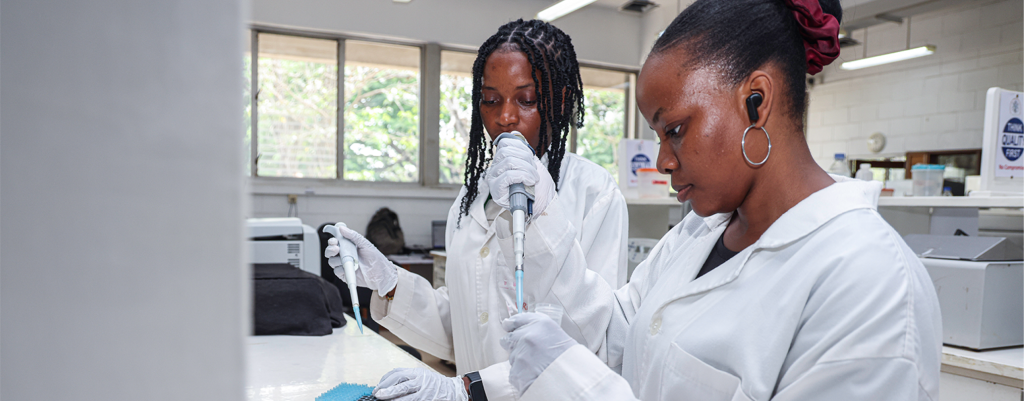
Pathology LAB– Ibadan, Nigeria
The Pathology Laboratory at IITA is a specialized research facility dedicated to the detection, diagnosis, study, and management of plant diseases that affect key food and export crops across sub-Saharan Africa. The lab plays a central role in supporting crop improvement, germplasm conservation, and sustainable production by providing the scientific basis for understanding plant disease dynamics and developing effective control strategies.
Mission and core functions
- Diagnose plant diseases impacting crops such as cassava, maize, yam, cowpea, soybean, banana, and sweet potato.
- Characterize disease-causing pathogens — including fungi, bacteria, viruses, nematodes, and other microorganisms — using both classical and modern methods.
- Support research and breeding programs by identifying resistant varieties and elucidating disease mechanisms.
- Provide technical expertise and advisory services on disease management and control.
- Train scientists, technicians, and students in plant pathology and diagnostic methods.
Key laboratory activities
- Disease diagnostics
The laboratory identifies and confirms plant disease agents using a combination of:
- Microscopy
- Culture‑based techniques
- Serological tests (e.g., ELISA)
- Molecular diagnostics (e.g., PCR, qPCR)
These approaches ensure precise and reliable detection of pathogens affecting crops in research plots, germplasm collections, and farmer fields.
- Pathogen characterization and research
Once a pathogen is detected, the lab conducts in-depth studies on:
- Disease biology and life cycles
- Epidemiology (how diseases spread)
- Host–pathogen interactions
- Resistance mechanisms in crops
This information guides breeding programs by identifying sources of resistance and traits critical for developing disease-resilient varieties.
- Support for germplasm and breeding programs
The Pathology Laboratory closely collaborates with:
- The Genetic Resources Center (Genebank) to ensure healthy germplasm
- The Molecular Genetics/Bioscience Center for advanced diagnostics and marker-assisted studies
- Crop improvement teams to screen breeding lines for disease resistance
This integrated support accelerates the development and deployment of healthier, more productive crop varieties.
- Field surveys and epidemiological studies
The lab conducts field surveys to monitor disease incidence and severity across agroecological zones. These surveys help:
- Track emerging disease threats
- Understand spatial and temporal disease patterns
- Inform extension services on proactive disease management practices
- Training and capacity building
The laboratory provides hands-on training to:
- Graduate and postgraduate students
- Young researchers
- Technicians from national agricultural research systems
- Extension agents
Training typically covers disease diagnosis, sample collection, laboratory protocols, and interpretation of results — building capacity across the agricultural research ecosystem.
Tools and techniques
| Category | Examples |
| Classical Methods | Microscopy, culture isolation |
| Serological Tests | Enzyme-linked immunosorbent assay (ELISA) |
| Molecular Diagnostics | Polymerase Chain Reaction (PCR), qPCR |
| Bioinformatics | Sequence analysis, pathogen genotyping |
Strategic importance
-
- Ensuring plant health: Accurately detecting and diagnosing pathogens to protect crops and genetic resources.
- Supporting crop improvement: Identifying disease resistance traits and integrating findings into breeding pipelines.
- Safeguarding germplasm integrity: Working with the Germplasm Health Unit and Genebank to ensure disease-free materials for research and distribution.
- Informing sustainable management: Providing science-based insights that fuel integrated disease management strategies for farmers.
- Reducing crop losses: Through early detection and targeted advice, the lab helps reduce pre-‑ and post-harvest losses due to disease.
Collaborative networks
The Pathology Laboratory collaborates with:
- National agricultural research systems
- Regional and international plant pathology networks
- Virology and molecular biology units
- Extension and advisory services
These partnerships strengthen diagnostics, surveillance, and disease response across the region.
- Comprehensive disease diagnostics
- Advanced research on pathogen biology
- Support for breeding and germplasm programs
- Capacity building for researchers and technicians
- Evidence for integrated disease management strategies
Pathology LAB– YAOUNDE, CAMEROON
The Pathology Laboratory at IITA Cameroon studies pests and diseases and develops crop protection strategies using microbial agents to control them.
Established in 1998, the Pathology Lab initially covered cassava root rots. These days the key research areas are more diverse, including the isolation and identification of fungi, the maintenance of the IITA entomopathogenic fungi collection, recording climate change and entomopathogenic pathogenic fungi behavior, biopesticide development and research into cocoyam diseases.
The lab has welcomed many national students from different universities across Cameroon in areas such as cassava diseases study, selection of resistant variety of cocoyam disease, and the management of banana weevil and cacao mirid using entomopathogenic fungi.