IITA and partners rename improved cassava varieties for the international market
October 23, 2020
The Federal Government of Nigeria recently approved new names for 10 improved cassava varieties as part of efforts to brand the root crop for easy identification, cultivation, and marketing of cassava stems.
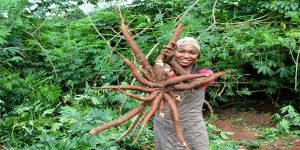
A farmer proudly displays the TME419 cassava variety
The renamed varieties comprise six released varieties and four yet-to be-released varieties. The released varieties and their new names are IBA961632 (Farmer’s Pride), IBA980581 (Dixon), CR36-5 (Ayaya), IBA070593 (Sunshine), and IBA980505 (Fine Face). TME 419, which is popular among farmers, remained unchanged. The yet-to-be-released varieties include TMS13F1160P0004 (Game Changer), TMS13F1343P0022 (Obasanjo-2), NR130124 (Hope), and TMEB693 (Poundable).
Cassava is a major staple crop grown in about 40 countries across Africa and that feeds millions on the Continent. With about 90% of production taking place in small farms, cassava is mostly grown by smallholder farmers in the rural areas with little access to improved technologies to increase their productivity. Yet, research has been a major contributor to helping the smallholder farmers in Africa increase their productivity and profit, with the release of improved varieties that promote increased yield and are resistant to pests and diseases.
While these improved varieties have code names, research shows that these names are not easy for most farmers to adopt and remember. This led IITA, in collaboration with partners and major stakeholders, to organize an event to rename selected improved varieties.
The virtual event was attended by major stakeholders in the cassava sector within and outside Nigeria.
Speaking at the event, the representative of the Minister for Agriculture in Nigeria, Karima Babangida, Director, Federal Department of Agriculture, said that it was a welcome development since cassava is a major crop in Nigeria. “With the new names, it will make it easier for farmers to pronounce and identify these
varieties.”
According to IITA Deputy Director General (Partnerships for Delivery), Kenton Dashiell, “The renaming of the varieties will help the cassava sector in a big way.”
During his opening remarks, Prof Ukpabi C. Ukpabi, Executive Director of the National Root Crops Research Institute (NRCRI), Umudike said, “The renaming of improved varieties will change the game in the seed system of root and tuber crops in Nigeria and also serve as a model for other African countries.”
Most end-users find it difficult to remember code names of improved cassava varieties, which can lead to a mix-up during sourcing, so substituting them with brand names will make it easier for people to identify them. The renaming also targets promoting the adoption of the varieties among farmers. Major stakeholders like farmers, “seedpreneurs,” and scientists participated in the naming process.
Chiedozie Egesi, Project Manager for the NextGen Cassava Breeding (NextGen Cassava) project, during the ceremony, said, “We know that cassava production has evolved from subsistence to industrial, with cassava becoming an economic crop. This is changing the lives of farmers, seed entrepreneurs, and processors at an industrial scale. Substituting the official names of the varieties with simpler or more relatable brand names will make farmers more familiar and closer to the varieties.”
Further reiterating the significance of the event, Lateef Sanni, Project Manager of Building an Economically Sustainable, Integrated and Economically Sustainable Cassava Seed System, Phase 2 (BASICS-II), said, “Cassava is an engine for creating wealth and farmers need to have marketable names to be able to sell to the international market.”
From the BASICS-II project, two early generation seed companies, IITA GoSeed and Umudike Seeds, have been set up to ensure the production and commercialization of breeder and foundation seeds in a sustainable manner to ensure constant access to quality planting material of improved varieties,” Sanni explained.
The naming of the varieties was facilitated by BASICS-II that is being led by IITA and NextGen Cassava in partnership with NRCRI.
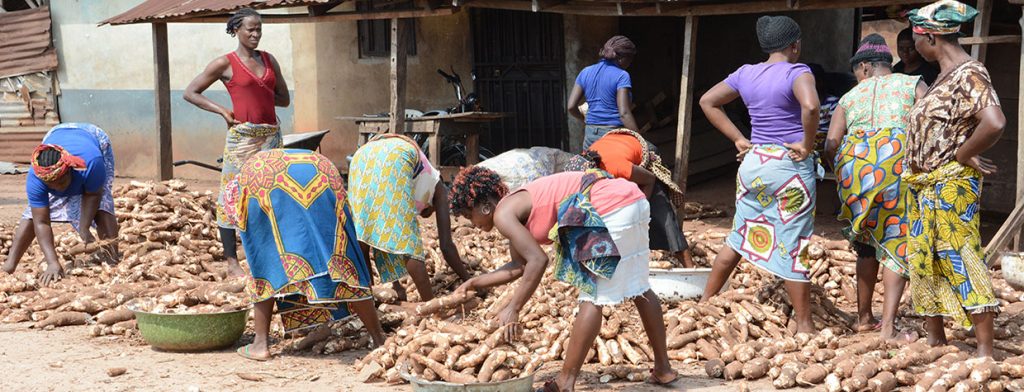
Women traders in a cassava market in Southwest Nigeria.
Olamide Deborah Nwanze is a Senior Research Associate specializing in gender mainstreaming research to inform participatory and inclusive breeding, variety development, and seed systems policies regarding root, tuber, and banana (RTB) crops in the International Institute of Tropical Agriculture Headquarters, Ibadan, Nigeria. She is a PhD candidate at the University of Ibadan and holds an MSc and B. Agric in Agricultural Extension and Rural Development. Olamide is a fellow of the African Women in Agricultural Research and Development – Gender Responsive Agricultural Systems Policy (AWARD-GRASP) and the Gender Responsive Researchers Equipped for Agricultural Transformation (GREAT). She seeks to apply her gender-mainstreaming learnings, gender-responsive research, and policy development, and review expertise to facilitate women, youth, children, and vulnerable social group’s access to and adoption of agricultural Innovations that guarantee food, nutrition, income, and livelihood security in Africa. Her current roles include mentoring research fellows, development of guides and training manuals, implementation and adaptation of gender frameworks and tools, value chain actors’ engagement as citizen science partners, policy review and redesign, data management, and analysis. Her current research explores mixed methods and participatory and interdisciplinary approaches to capture and highlight gender dynamics, needs, preferences, and challenges stakeholders face within the agricultural livelihood value chain to prioritize gender-inclusive strategies in breeding programs, policy design, and implementation.
de Sousa, K., van Etten, J., Manners, R. Bello, A., Teeken, B., Olaosebikan, O., et al. 2024. The tricot approach: an agile framework for decentralized on-farm testing supported by citizen science. A retrospective. Agron. Sustain. Dev. 44, 8. https://doi.org/10.1007/s13593-023-00937-1
Madu, T., Onwuka, S., Nwafor, S., Onyemauwa, N., Ejechi, M., Ofoeze, M., Ukeje, B., Eluagu, C., Olaosebikan, O., Okoye, B., 2024. Gender-Inclusive Consumer Studies Improve Cassava Breeding in Nigeria in: Frontiers in Sociology, volume 9, number: 1224504, doi: 10.3389/fsoc.2024.1224504
Olaosebikan, O.; Bello, A.; Utoblo, O.; Okoye, B.; Olutegbe, N.; Garner, E.; Teeken, B.; Bryan, E.; Forsythe, L.; Cole, S.; Madu, T. 2023. Stressors and Resilience within the Cassava Value Chain in Nigeria: Preferred Cassava Variety Traits and Response Strategies of Men and Women to Inform Breeding. Sustainability 15, 7837. https://doi.org/10.3390/su15107837
Okoye, B., Ofoeze, M., Ejechi, M., Onwuka, S., Nwafor, S., Onyemauwa, N., Ukeje, B., Eluagu, C., Obidiegwu, J.*, Olaosebikan, O., Madu, T.* 2023. Prioritizing preferred traits in the yam value chain in Nigeria: a gender situation analysis in: Frontiers in Sociology, volume 8, number: 1232626, pages 1 – 9, ISSN 2297-7775, 2023. https://www.frontiersin.org/articles/10.3389/fsoc.2023.1232626/full
Olaosebikan, O., Bello, A. A., de Sousa, K., Ndjouenkeu, R., Adesokan, M., Alamu, E. O., Agbona, A., van Etten, J., Kegah, F. N.*, Dufour, D., Bouniol, A., Teeken, B. 2023. Consumer acceptability of cassava gari-eba food products across cultural and environmental settings using the triadic comparison of technologies approach (tricot) in: Journal of the Science of Food and Agriculture,
Teeken, B., Olaosebikan, O., Bello, A. A., Madu, T.*, Cole, S. M. 2023. Qualitative assessment on the positionality and preferences of dyads in relation to cassava-related activities: working with tricot trial citizen scientists https://hdl.handle.net/10568/138326 Type: Manual
Bouniol, A., Ceballos, H., Bello, A. A., Teeken, B., Olaosebikan, O., Owoade, D., Agbona, A., Fotso Kuate, A., Madu, T.*, Okoye, B.*, Ofoeze, M.*, Nwafor, S.*, Onyemauwa, N.*, Adinsi, L.*, Forsythe, L., Dufour, D. 2023. Varietal impact on women’s labour, workload and related drudgery in processing root, tuber and banana crops: focus on cassava in sub-Saharan Africa in: Journal of the Science of Food and Agriculture, pages 1 – 25, ISSN 0022-5142,
Bello, A. A., Agbona, A., Olaosebikan, O., Edughaen, G., Dufour, D., Bouniol, A., Iluebbey, P., Ndjouenkeu, R.*, Rabbi, I. Y., Teeken, B. 2023. Genetic and environmental effects on processing productivity and food product yield: drudgery of women’s work in: Journal of the Science of Food and Agriculture, pages 1 – 32, ISSN 0022-5142, 5
Cavicchioli, M., Zimbiti, T., Teeken, B., Nwanze, D.O., Liani, M., Parkes, E. & Bello, A. 2023. IITA-Gender Responsive Breeding Training Report. Genetic Resources Center, IITA-HQ, Ibadan, 21-23 September, 2022. Ibadan, Nigeria: IITA, (34 p.).https://hdl.handle.net/10568/131368
Agbona, A. Peteti P., Teeken B., Olaosebikan O. Bello, A. A., Parkes, E., Rabbi, I. Y., Mueller, L., Egesi, C., Kulakow, P. 2022. Data Management in Multi-disciplinary African RTB Crop Breeding Programs. In: Williamson, H.F., Leonelli, S. (eds) Towards Responsible Plant Data Linkage: Data Challenges for Agricultural Research and Development. Springer, Cham. https://doi.org/10.1007/978-3-031-13276-6_5
Lora Forsythe, Pricilla Marimo, Sarah Mayanja, Olamide D. Olaosebikan, Esme Stuart, Bela Teeken, Benjamin Okoye, Tessy Madu, (2021). Cross-product Gender Analysis of RTBfoods Step 2 Gendered Food Mapping on RTB Products. Understanding the Drivers of Trait Preferences and the Development of Multi-user RTB Product Profiles, WP1. London, UK: RTBfoods Field Scientific Report, 30 p.
Teeken, B., Garner, E., Agbona, A., Balogun, I., Olaosebikan, O., Bello, A., Madu, T., Okoye, B., Egesi, C., Kulakow, P. and Tufan, H.A. 2021. Beyond “Women’s Traits”: Exploring How Gender, Social Difference, and Household Characteristics Influence Trait Preferences. Frontiers Sustainable Food Systems 5:740926. https://doi.org/10.3389/fsufs.2021.740926
Teeken, B., Agbona, A., Bello, A., Olaosebikan, O., Alamu, E., Adesokan, M., Awoyale, W., Madu, T., Okoye, B., Chijioke, U., Owoade, D., Okoro, M., Bouniol, A., Dufour, D., Hershey, C., Rabbi, I., Maziya‐Dixon, B., Egesi, C., Tufan, H. and Kulakow, P. (020. Understanding cassava varietal preferences through pairwise ranking of gari‐eba and fufu prepared by local farmer–processors. Int J Food Sci Technol.https://doi.org/10.1111/ijfs.14862
Bela Teeken, Olamide Olaosebikan, Ireti Balogun, Benjamin Okoye, Tessy Madu, Steven Cole, Abolore Bello, Elizabeth Parkes. (2020). Piloting the G+ customer and product profile tools for gender-responsive cassava breeding in Nigeria. Nigeria: International Institute of Tropical Agriculture (IITA). https://hdl.handle.net/20.500.11766/13000