
For generations, the global coffee story has largely belonged to two names: Arabica and Robusta. Prized for its delicate flavors and dominant position in the specialty market, Arabica has long been synonymous with premium coffee. Robusta, on the other hand, has built its own formidable global footprint, valued for its strength, resilience, and role in commercial blends. However, in the shadow of these two names is a third species, rarer, larger, deeply rooted in West African history, and gradually gaining recognition in the coffee market. The name is Coffea liberica.
In Liberia, the nation whose name this coffee species carries, a quiet agricultural restoration is underway. Across five counties, hundreds of thousands of young coffee plants are moving from nurseries directly into farmers’ fields.
Driving this transformation on the ground is the EU-funded Seeds4Liberia project, a flagship initiative designed to bolster seed and food systems across five critical value chains: rice, cassava, coffee, soybean, and aquaculture. Led by AfricaRice alongside IITA–CGIAR, WorldFish, and key Liberian government agencies, the Seeds4Liberia project bridges international expertise with local execution, while the coffee component relies on a collaboration among IITA-CGIAR, the Central Agricultural Research Institution (CARI), the Liberia Agriculture Commodity Regulatory Authority (LACRA), the Farmers Union Network of Liberia (FUNL), and the Ministry of Agriculture (MoA).
This extends far beyond putting seedlings in the ground. It is about rebuilding an entire sector, restoring an indigenous crop to prominence, and carving out a distinct space in the international market for Coffea liberica.
Walk into a coffee shop in Kenya, Lagos, London, or New York, and you will find coffee labeled Arabica or Robusta dominates the menu. Coffea liberica remains largely unfamiliar to the average consumer. Yet, as an indigenous species, Liberica carries a national identity few countries can claim. Recognizing this edge, the Liberian government placed Coffea liberica at the center of its agricultural strategy, designating it as the primary commodity under the Food and Agriculture Organization’s (FAO) One Country One Priority Product (OCOP) initiative.
Dr Ranjana Bhattacharjee, IITA Molecular Geneticist and Senior Scientist, and Coffee Lead for the Seeds4Liberia project, pointed to the crop’s rarity, distinctive bold flavor profile, climate resilience, and specialty potential as key drivers for long-term investment. She said the goal is not to compete directly with Arabica or Robusta. Instead, Liberica’s strength lies in its uniqueness and distinctiveness, occupying a middle ground in bean quality characteristics while offering higher productivity and resilience to climate change.
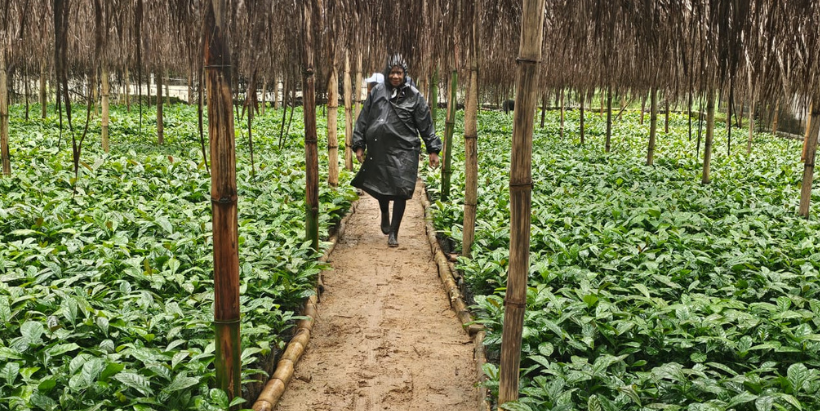
“As global consumers increasingly seek unique origins, micro-lots, and climate-resilient varieties, Liberica offers an identity that cannot easily be replicated elsewhere,” she added. She further said the initial goal of the project was to raise 400,000 seedlings through four centralized coffee seedling nursery facilities: three based at LACRA compounds in Bong, Lofa, and Nimba counties, and a fourth at a private farm, namely Arjay Farms.
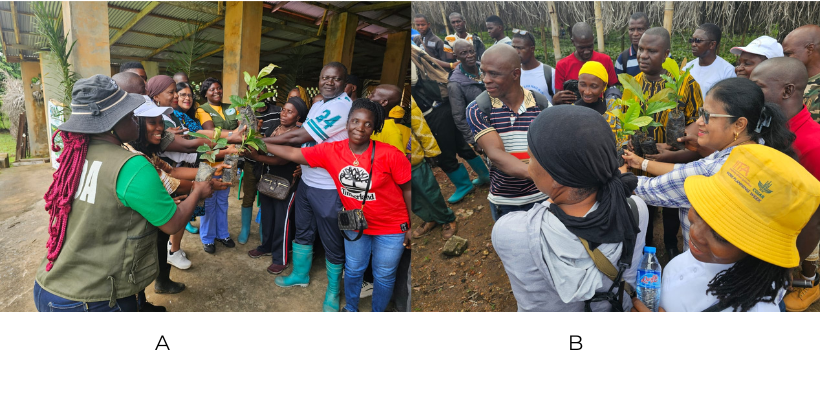
However, joint execution allowed the team to scale beyond the initial plan. While IITA-CGIAR raised about 450,000 seedlings, LACRA established supplementary capacity to produce an additional 300,000. This expanded the total inventory to nearly 750,000 seedlings, roughly 68% of which are pure Coffea liberica seedlings, with the remainder comprising Arabica and Robusta selections. This enabled the expansion of network operations across Bong, Lofa, Nimba, Montserrado, and Bomi Counties, thereby scaling its impact. Originally targeted to support 350 beneficiaries, the distribution has now reached roughly 1,000 farmers through local cooperatives and community groups. With over 900,000 coffee seedlings distributed free of charge over the project’s first two years, the initiative is closing in on its overall three-year target of 1.1 million, well ahead of schedule.
The distribution process was strategically designed to maximize survival rates and reduce friction for growers. It included direct community delivery with distribution points set up directly within target districts. Seedlings were delivered at the 6- to 8-leaf stage, allowing farmers to plant directly into their fields without managing an intermediate nursery. With these objectives, the distribution campaign was launched on 28 July in Bong County and concluded on 3 August in Montserrado County, completing a week-long distribution across the five counties. In addition, each beneficiary received working lots of at least 500 seedlings, and farmers who were unable to plant their full allocation were encouraged to freely pass extra seedlings to neighboring families rather than resell them.
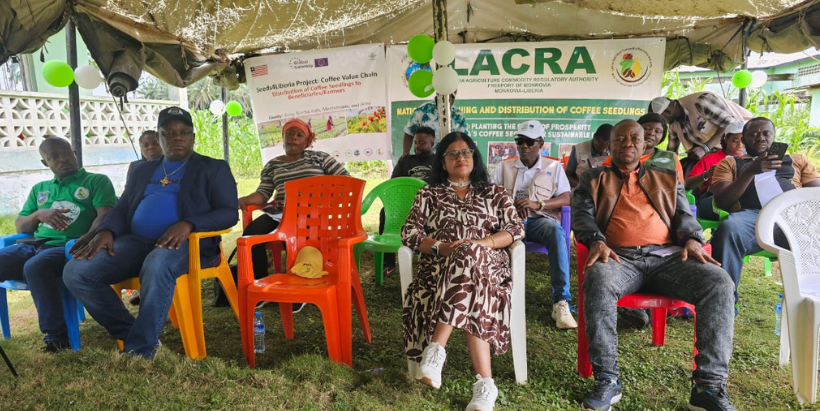
At an official handover ceremony on 5 August 2026 at CARI in Suakoko, Bong County, senior officials and all stakeholders, including representatives from the EU, MoA, LACRA, and CARI, met with development partners to review progress and distribute field equipment and seedlings. Dr Bhattacharjee gave special recognition to LACRA’s Director General, Christopher D. Sankolo, and Deputy Director General for Operations and Technical Services, Alpha Gongolee, for leading nursery operations and managing distribution logs across all five counties. Highlighting the initiative’s economic goal, LACRA Director General Christopher Sankolo emphasized the household-level impact during his address at CARI. He stated that “Liberians should grow Coffea liberica because it has the potential to transform livelihoods and reduce poverty across many households. The world is demanding Coffea liberica; we simply need to increase our production and take advantage of this growing market.”
For Dr Bhattacharjee, distributing planting material is only the starting point. Long-term economic success requires good agronomic practices, quality processing, and verified supply chains. The creation of market demand for this unique coffee species, Liberica, is also essential for economic success. Beneficiaries of the coffee planting material distribution were trained in proper field spacing, demonstrating a standard 3-meter grid using simple bamboo guides. Building on this method, an expanded Training-of-Trainers program is in the pipeline with a target of 350 lead farmers, and a curriculum covering the following areas:
Climate-smart agronomy: Integrating nitrogen-fixing legume cover crops to build topsoil and limit reliance on synthetic inputs.
Agroforestry systems: Intercropping coffee with plantains and native canopy trees to provide microclimate shade and income diversification.
Water and soil management: On-farm composting and rainwater catchment systems.
Traceability and certification: Establishing clear chain-of-custody data that can help the farmers gain international market access and presence.
To bridge the gap between rural farms and foreign buyers, the initiative is coordinating with the International Trade Centre (ITC) to develop commercial branding and market routes. The primary objective for Liberia is not to displace traditional Arabica markets, but to establish a distinct, high-value segment for Liberica. As climate volatility affects traditional growing zones in the country and specialty roasters seek out novel flavor profiles, Coffea liberica offers structural resilience, deep historic roots, and an identity tied directly to its home country.
Multiplied across hundreds of farms, supported by expert recommendations, strong agronomic training, and a connection to international markets, these Liberica plants are laying the foundation for a sustainable agricultural future for Liberia and Africa.
Contributed by