

The Program for Seed System Innovation for Vegetatively Propagated Crops in Africa (PROSSIVA), with a renewed focus on scaling seed innovations across Africa, is advancing efforts to strengthen Ghana’s yam seed system by promoting innovative propagation technologies, building stakeholder linkages, and supporting the transition to a more formal and resilient seed system. These efforts reached an important milestone at the National Yam Advocacy Summit, held on 6 August 2026 in Accra, following a high-level engagement with Ghana’s Minister of Food and Agriculture, Hon. Eric Opoku, on 5 August.
During the ministerial engagement, the PROSSIVA team explained how Leaf Bud Cutting (LBC) technology can rapidly multiply high-quality planting materials for yam production. The Minister welcomed the technology as a promising and practical innovation, expressing interest in deploying it in Ghana to boost farmers’ productivity and livelihoods. He emphasized, however, that increased production must be matched with strong export and processing market linkages to ensure farmers can profitably absorb the gains from improved productivity.

Convened by PROSSIVA, an IITA-led initiative, in collaboration with Ghana’s Ministry of Food and Agriculture (MoFA), the National Yam Advocacy Summit brought together regulators, policymakers, researchers, seed enterprises, farmers, processors, exporters, development partners, investors, and other actors across the yam value chain. The summit provided a national platform to showcase the LBC technique and other innovations that can improve the availability, quality, and affordability of planting materials while strengthening linkages among value chain actors.
Yams are a major food and economic crop in Ghana, supporting thousands of households and contributing to domestic and export markets. However, limited access to quality planting materials, low multiplication rates, high seed costs, pest and disease pressures, and inconsistent seed quality continue to constrain productivity. The summit, therefore, focused on innovations to address these constraints and unlock greater potential within the yam sector.
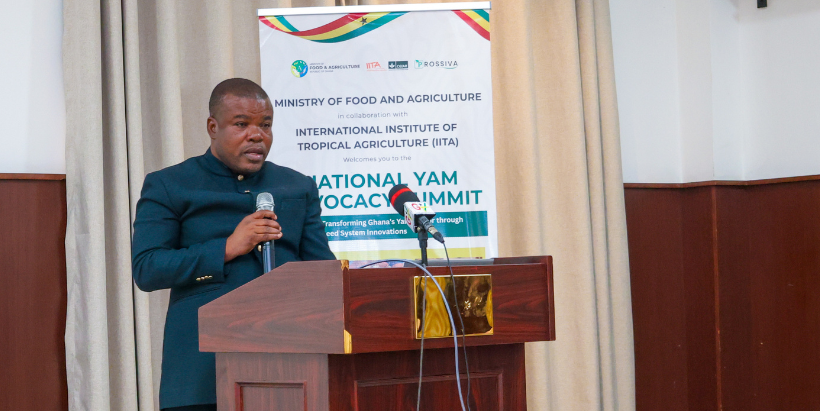
Delivering the keynote address on behalf of the Minister, the National Coordinator of the Feed Ghana Program, Hon. Bright Demordzi, highlighted yams’ strategic importance to Ghana’s agricultural economy, noting that the country produces more than 11 million metric tonnes annually and recorded approximately US$48 million in yam exports in 2021. He added that successful national adoption of the LBC technique for yam multiplication would further strengthen the sector by boosting productivity, improving farmers’ incomes, and contributing to Ghana’s broader agricultural development agenda.
Against this backdrop, the summit showcased the LBC technique as a method with the potential to rapidly multiply high-quality planting materials while reducing certain risks associated with conventional seed production. Dr Beatrice Aighewi, Lead of the Yam Component of PROSSIVA, highlighted the potential of vine-based propagation to reduce the risk of soil-borne disease spread, support faster multiplication, enable year-round production, facilitate the rapid dissemination of improved yam varieties, and create opportunities to increase the value of yam production.

During her presentation on PROSSIVA, Project Lead Dr Delphine Amah highlighted the project’s three focus crops and their respective innovations, including Semi-Autotrophic Hydroponics (SAH) for cassava and macropropagation for plantain seed production. She also spotlighted SeedTracker for traceability and market linkages. The presentation generated interest beyond yam, with state representatives and other participants seeking information on the availability and application of PROSSIVA’s cassava and banana technologies. This response underscored the relevance and practical potential of the project’s innovative approaches to addressing persistent challenges in the production of vegetatively propagated crops.
Through two focused panel discussions, stakeholders examined how to move quality seed yam innovations from research to widespread adoption and stimulate demand through markets, investment, and enterprise. The discussions highlighted that scaling up improved seed technologies must go hand in hand with stronger market linkages, private-sector investment, and viable business opportunities across the yam value chain. Stakeholders noted that the high cost of planting material remains a major constraint for farmers but emphasized that wider adoption of improved multiplication technologies could substantially reduce these costs while expanding access to quality seed yams.
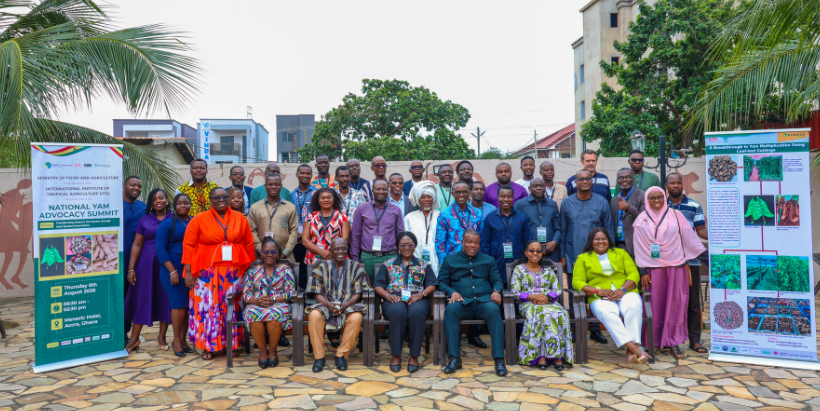
The strong interest from participants was evident in their inquiries about the availability and practical applications of PROSSIVA’s yam, cassava, and banana technologies, underscoring the relevance and potential of the project’s innovative approaches to addressing persistent challenges in vegetatively propagated crops. The Program emerged as a timely opportunity to scale these innovations, linking improved seed technologies and productivity gains to the country’s broader food security and agricultural transformation agenda.
The National Yam Advocacy Summit marks the start of a broader collaborative effort towards scaling innovative seed technologies in Ghana. Building on the momentum from the Summit, CGIAR-NARS research institutions, the private sector, and other value-chain actors will work together to strengthen capacity, expand demonstrations, and create the market and institutional linkages needed to scale seed system innovations.
Contributed by
Isaac Ajayi, Francisca Ocloo, Beatrice Aighewi, Delphine Amah, and Daniel Aihebhoria
Recent stories