Strengthening the soybean variety development and testing network: IITA hosts collaborative training for West African breeders
July 8, 2024
The IITA Soybean program organized a training session for National Agricultural Research Systems (NARS) partners in West Africa under the ‘Strengthening soybean improvement for Africa’ project. The Bill & Melinda Gates Foundation-funded project aims to strengthen the CGIAR-NARS partnership on variety development and testing efforts. The inaugural training, held at the IITA headquarters from 19 to 22 June, aimed to harmonize and standardize soybean variety development, evaluation, testing schemes, and data collection and management techniques among IITA–CGIAR and NARS partners.
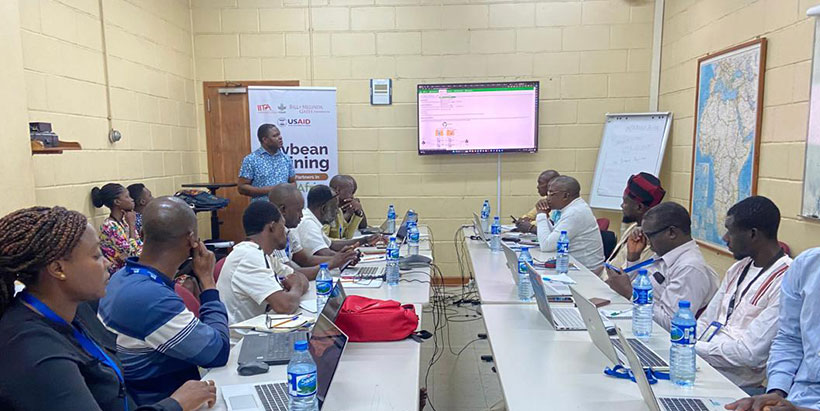
Participants listening to a facilitator during the workshop.
IITA Soybean Breeder and event convener, Abush Abebe, emphasized that the meeting was not merely a training session but a platform to share experiences and create a common understanding among the breeders representing the various NARS partners, i.e., the National Soybean Breeding Programs of Benin, Mali, and Nigeria, and Universities in Nigeria (the Ajayi Crowther University, University of Ilorin, and Joseph Sarwuan Tarka University (JoSTUM) (Formerly the Federal University of Agriculture) Makurdi, and the University of Ekiti) on various areas of collaborations with the NARS partners. He stressed the importance of strengthening partnerships and developing a standardized variety testing and evaluation protocol to increase efficiency and improve soybean breeding and research. “Bad data misleads the end-users, but good data equals good decisions,” he said, highlighting the critical role of high-quality data.
In his opening remarks, IITA Deputy Director General, Partnerships for Delivery (DDG-P4D), Kenton Dashiell, a soybean breeder at IITA from 1983 to 2001, expressed his enthusiasm in the meeting. He encouraged the network to expand its breeding program and build a strong team to achieve its goals more effectively. “The success of this program is based on the work you do in your stations, which is why this workshop is important,” he stated.
The IITA Soybean Breeding Program Lead, Godfree Chigeza, spoke on the importance of the CGIAR-NARS partnership and the African soybean improvement network. He outlined the network’s goals, framework, expectations, and partnership requirements, emphasizing the shift from participatory variety selection to participatory breeding, where joint priority and decision-making are crucial.
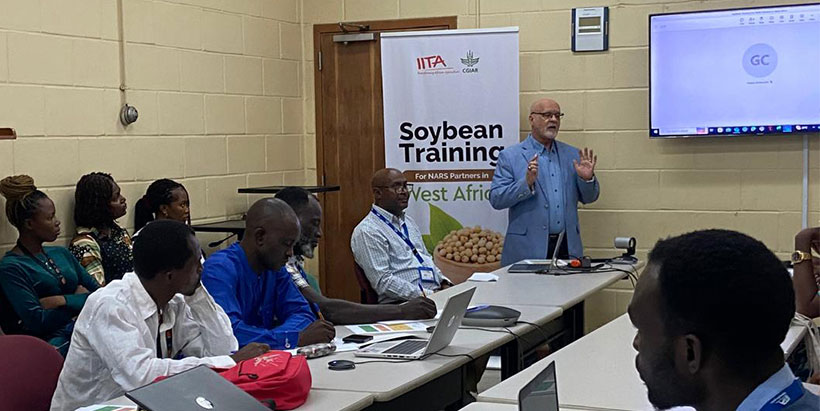
IITA Deputy Director General Partnerships for Delivery Dr Kenton Dashiell during the opening remarks on the first day of the workshop.
IITA Head of Breeding Mushoriwa Hapson highlighted the shift from capacity building to capacity sharing, focusing on exchanging ideas and information. He noted that the training should enhance the network’s collaboration to deliver better results and amplify impact. The IITA soybean program aims to build an inclusive seed system to produce adequate seed and deliver high-yielding, farmers- and market-preferred soybean varieties. “I hope that the soybean breeding program, together with you, will co-develop, co-implement, and co-deliver the best results in soybean breeding,” he said.
Abebe presented an overview of soybean research in West Africa, tracing the history of the soybean improvement program at IITA that began in 1974. He noted initial challenges such as low yields, poor seed viability, inadequate nodulation with native Rhizobium, high shattering in different zones, and limited utilization due to few suitable recipes for small-scale farmers were the main drivers for establishing the IITA soybean improvement program. He underscored the need for a strategy to regularly replace varieties to ensure higher productivity, reduce the impact of emerging diseases and pests, respond to changing consumer and market preferences, and increase adoption rates. Factors driving the demand for new varieties include enhancing yield potential, quality, and maturity and mitigating climate change.
Highlighting some of the key reasons for exerting aggressive efforts to develop new varieties in West Africa, Abebe mentioned very low soybean yields in many of the SSA countries, expanded soybean production on the continent, which demands more new varieties, increasing interest in soybean research for delivery, increased demand for soybean products like soy oil and soy meal, limited national breeding programs that resulted in weak variety testing and registration networks, and slow rate of replacing old varieties with new and high yielding varieties.
Ibnou Dieng, a biometrician at IITA, discussed the need to ensure data quality and integrity, the implications of poor data, and ways to minimize experimental error. He also provided a practical demonstration of breeding analysis using the CGIAR market intelligence app. Dean Muungani, IITA Product Manager for Grain Crops, guided participants through soybean tricot on-farm testing, breeding program assessment, and costing. Participants also toured the IITA soybean breeding program facilities and conducted practical field demonstrations on trial layout, planting, and crossing.
At the end of the training, participants were provided with digital tools like tablets for effective electronic data capturing. Abebe noted that plans are in place to provide more tools to help standardize the data collection techniques and ensure data quality.
Olamide Deborah Nwanze is a Senior Research Associate specializing in gender mainstreaming research to inform participatory and inclusive breeding, variety development, and seed systems policies regarding root, tuber, and banana (RTB) crops in the International Institute of Tropical Agriculture Headquarters, Ibadan, Nigeria. She is a PhD candidate at the University of Ibadan and holds an MSc and B. Agric in Agricultural Extension and Rural Development. Olamide is a fellow of the African Women in Agricultural Research and Development – Gender Responsive Agricultural Systems Policy (AWARD-GRASP) and the Gender Responsive Researchers Equipped for Agricultural Transformation (GREAT). She seeks to apply her gender-mainstreaming learnings, gender-responsive research, and policy development, and review expertise to facilitate women, youth, children, and vulnerable social group’s access to and adoption of agricultural Innovations that guarantee food, nutrition, income, and livelihood security in Africa. Her current roles include mentoring research fellows, development of guides and training manuals, implementation and adaptation of gender frameworks and tools, value chain actors’ engagement as citizen science partners, policy review and redesign, data management, and analysis. Her current research explores mixed methods and participatory and interdisciplinary approaches to capture and highlight gender dynamics, needs, preferences, and challenges stakeholders face within the agricultural livelihood value chain to prioritize gender-inclusive strategies in breeding programs, policy design, and implementation.
de Sousa, K., van Etten, J., Manners, R. Bello, A., Teeken, B., Olaosebikan, O., et al. 2024. The tricot approach: an agile framework for decentralized on-farm testing supported by citizen science. A retrospective. Agron. Sustain. Dev. 44, 8. https://doi.org/10.1007/s13593-023-00937-1
Madu, T., Onwuka, S., Nwafor, S., Onyemauwa, N., Ejechi, M., Ofoeze, M., Ukeje, B., Eluagu, C., Olaosebikan, O., Okoye, B., 2024. Gender-Inclusive Consumer Studies Improve Cassava Breeding in Nigeria in: Frontiers in Sociology, volume 9, number: 1224504, doi: 10.3389/fsoc.2024.1224504
Olaosebikan, O.; Bello, A.; Utoblo, O.; Okoye, B.; Olutegbe, N.; Garner, E.; Teeken, B.; Bryan, E.; Forsythe, L.; Cole, S.; Madu, T. 2023. Stressors and Resilience within the Cassava Value Chain in Nigeria: Preferred Cassava Variety Traits and Response Strategies of Men and Women to Inform Breeding. Sustainability 15, 7837. https://doi.org/10.3390/su15107837
Okoye, B., Ofoeze, M., Ejechi, M., Onwuka, S., Nwafor, S., Onyemauwa, N., Ukeje, B., Eluagu, C., Obidiegwu, J.*, Olaosebikan, O., Madu, T.* 2023. Prioritizing preferred traits in the yam value chain in Nigeria: a gender situation analysis in: Frontiers in Sociology, volume 8, number: 1232626, pages 1 – 9, ISSN 2297-7775, 2023. https://www.frontiersin.org/articles/10.3389/fsoc.2023.1232626/full
Olaosebikan, O., Bello, A. A., de Sousa, K., Ndjouenkeu, R., Adesokan, M., Alamu, E. O., Agbona, A., van Etten, J., Kegah, F. N.*, Dufour, D., Bouniol, A., Teeken, B. 2023. Consumer acceptability of cassava gari-eba food products across cultural and environmental settings using the triadic comparison of technologies approach (tricot) in: Journal of the Science of Food and Agriculture,
Teeken, B., Olaosebikan, O., Bello, A. A., Madu, T.*, Cole, S. M. 2023. Qualitative assessment on the positionality and preferences of dyads in relation to cassava-related activities: working with tricot trial citizen scientists https://hdl.handle.net/10568/138326 Type: Manual
Bouniol, A., Ceballos, H., Bello, A. A., Teeken, B., Olaosebikan, O., Owoade, D., Agbona, A., Fotso Kuate, A., Madu, T.*, Okoye, B.*, Ofoeze, M.*, Nwafor, S.*, Onyemauwa, N.*, Adinsi, L.*, Forsythe, L., Dufour, D. 2023. Varietal impact on women’s labour, workload and related drudgery in processing root, tuber and banana crops: focus on cassava in sub-Saharan Africa in: Journal of the Science of Food and Agriculture, pages 1 – 25, ISSN 0022-5142,
Bello, A. A., Agbona, A., Olaosebikan, O., Edughaen, G., Dufour, D., Bouniol, A., Iluebbey, P., Ndjouenkeu, R.*, Rabbi, I. Y., Teeken, B. 2023. Genetic and environmental effects on processing productivity and food product yield: drudgery of women’s work in: Journal of the Science of Food and Agriculture, pages 1 – 32, ISSN 0022-5142, 5
Cavicchioli, M., Zimbiti, T., Teeken, B., Nwanze, D.O., Liani, M., Parkes, E. & Bello, A. 2023. IITA-Gender Responsive Breeding Training Report. Genetic Resources Center, IITA-HQ, Ibadan, 21-23 September, 2022. Ibadan, Nigeria: IITA, (34 p.).https://hdl.handle.net/10568/131368
Agbona, A. Peteti P., Teeken B., Olaosebikan O. Bello, A. A., Parkes, E., Rabbi, I. Y., Mueller, L., Egesi, C., Kulakow, P. 2022. Data Management in Multi-disciplinary African RTB Crop Breeding Programs. In: Williamson, H.F., Leonelli, S. (eds) Towards Responsible Plant Data Linkage: Data Challenges for Agricultural Research and Development. Springer, Cham. https://doi.org/10.1007/978-3-031-13276-6_5
Lora Forsythe, Pricilla Marimo, Sarah Mayanja, Olamide D. Olaosebikan, Esme Stuart, Bela Teeken, Benjamin Okoye, Tessy Madu, (2021). Cross-product Gender Analysis of RTBfoods Step 2 Gendered Food Mapping on RTB Products. Understanding the Drivers of Trait Preferences and the Development of Multi-user RTB Product Profiles, WP1. London, UK: RTBfoods Field Scientific Report, 30 p.
Teeken, B., Garner, E., Agbona, A., Balogun, I., Olaosebikan, O., Bello, A., Madu, T., Okoye, B., Egesi, C., Kulakow, P. and Tufan, H.A. 2021. Beyond “Women’s Traits”: Exploring How Gender, Social Difference, and Household Characteristics Influence Trait Preferences. Frontiers Sustainable Food Systems 5:740926. https://doi.org/10.3389/fsufs.2021.740926
Teeken, B., Agbona, A., Bello, A., Olaosebikan, O., Alamu, E., Adesokan, M., Awoyale, W., Madu, T., Okoye, B., Chijioke, U., Owoade, D., Okoro, M., Bouniol, A., Dufour, D., Hershey, C., Rabbi, I., Maziya‐Dixon, B., Egesi, C., Tufan, H. and Kulakow, P. (020. Understanding cassava varietal preferences through pairwise ranking of gari‐eba and fufu prepared by local farmer–processors. Int J Food Sci Technol.https://doi.org/10.1111/ijfs.14862
Bela Teeken, Olamide Olaosebikan, Ireti Balogun, Benjamin Okoye, Tessy Madu, Steven Cole, Abolore Bello, Elizabeth Parkes. (2020). Piloting the G+ customer and product profile tools for gender-responsive cassava breeding in Nigeria. Nigeria: International Institute of Tropical Agriculture (IITA). https://hdl.handle.net/20.500.11766/13000