
IITA NEWS

The Collaborative Breeding Leadership Program: Bridging the skills gap in plant breeding
July 8, 2024

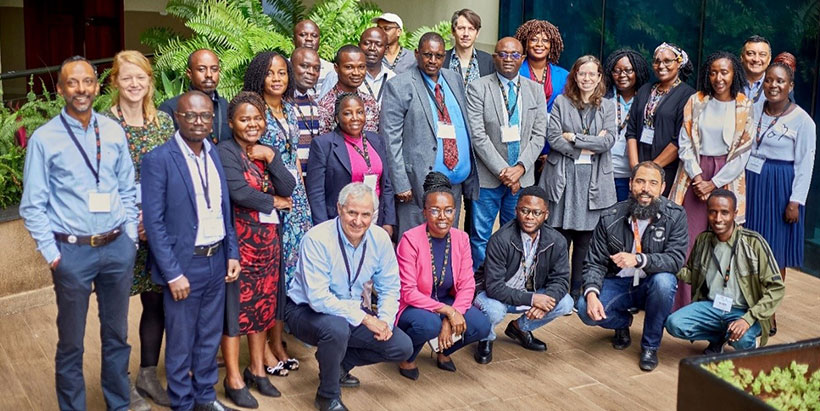
Participants at the foundation workshop in Nairobi, 24-29 June.

By 2050, our planet will be home to over 10 billion people, with Africa alone needing to feed more than 2.5 billion—a monumental task amidst climate crises and global uncertainties. Today, we stand at a pivotal moment. The disparity between population growth and food production in sub-Saharan Africa emphasizes the urgency for innovative solutions. A recent joint paper by Australia’s National Science Agency, CSIRO, Lincoln University in New Zealand, and McGill University in Canada highlights the urgency of this mission. The paper presents a concerned picture of the future capacity in the plant breeding area, emphasizing the critical need to address the skills shortage to maintain our agri-food, fiber, and feed production level. This shortage has been building for some time and poses a significant threat to agricultural production worldwide. This is where public breeding programs like National Agricultural Research and Extension Systems (NARES) and CGIAR play an important role. We must develop resilient, nutritious, and market-driven crop varieties reinforced by advanced agronomic practices.
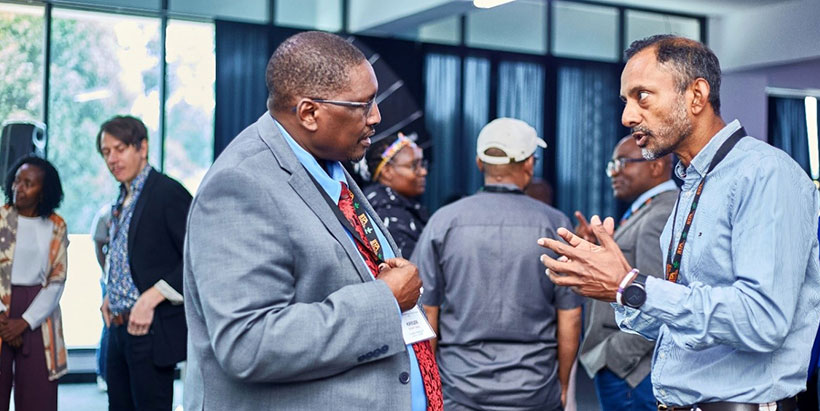
CGIAR-NARES Breeding Network Coordinator, Bish Das, discussing with the Kenya Agricultural and Livestock Research Organisation (KALRO) Director General, Dr Eliud Kireger.

The Collaborative Breeding Leadership Program (CBLP) is a beacon of innovation in plant-breeding capacity-sharing. This groundbreaking NARES and One CGIAR initiative integrates practical know-how with theoretical foundations, promoting a new cadre of breeders skilled at tackling complex agricultural challenges. This program ensures inclusive access to cutting-edge knowledge, nurturing talent across the global south through a hybrid training model, a face-to-face foundation training workshop, scientific placement, and expansive online resources.
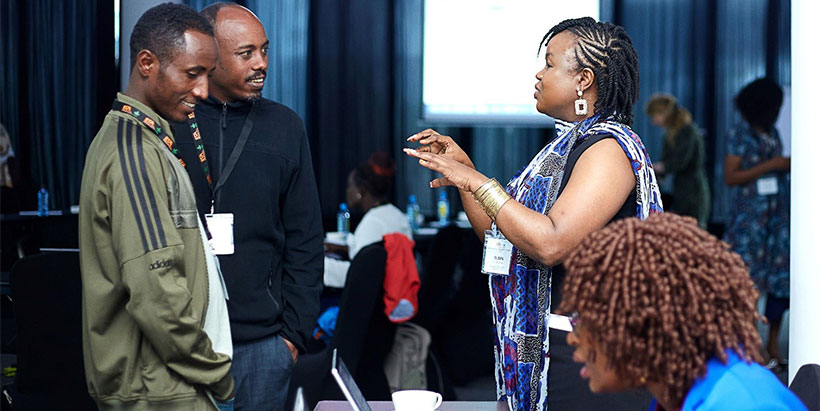
Participants getting a run through the registration process.

At its core, the CBLP emphasizes collaborative excellence. With the aim to amplify breeders’ impact on smallholder farmers and the broader agricultural value chain, the curriculum enhances teamwork and the building of robust networks. The goal is to cultivate a continuous stream of skilled professionals who will drive progress across NARES and CGIAR breeding networks in the global south.

With the foundation workshop on course in Nairobi, Kenya, young breeders selected through a targeted but competitive process are getting a front-row seat to the fundamentals of running a successful breeding program. They will soon be placed in different breeding programs within the CGIAR, universities, and other NARES.

“Unlike other breeding academies, the CBLP offers an in-house leadership model that encourages peer-to-peer learning,” said Javier Betran, Advisor and Chief Mentor of the program. Kenya Agricultural and Livestock Research Organisation (KALRO) Director General Dr Eliud Kireger reiterated the importance of this program, especially for NARES scientists, given the long-standing relationship with the CGIAR.

Beyond technical proficiency, the approach is around developing well-rounded leaders equipped with essential skills—management, leadership, and more—critical for navigating diverse cultural contexts and achieving sustainable agricultural outcomes. “We are happy to see more women in agricultural spaces and also happy to see the different realms covered in this program spanning from social sciences to gender inclusion in breeding,” said GIZ representative Birthe Paul. IITA Eastern Africa Hub Director Leena Tripathi emphasized the need to support and inspire talented individuals who will make a real difference in agriculture and beyond. She believes that CBLP is going to create something truly impactful.

This program has been developed and implemented by assembling a multidisciplinary team of experts across the One CGIAR, NARES, and subregional organizations. The team comprises CGIAR Genetic Innovation leadership (John Derera), technical expertise and Breeding Optimization Lead (Dorcus Gemenet), CBLP advisor and mentor (Betran), CG-NARES Breeding networks (Bish Das), program management (Trushar Shah, IITA), CGIAR Capacity sharing (Zainatou Sore, Javier Mateo-Vega, and Charles Kleinermann), and the NARES and Subregional Organization Leadership (Godfrey Asea from NARO-Uganda, Hortense Mafousssam from IRAD-Cameroon, Busiso Mavankeni from CBI-Zimbabwe, and Ousmane Ndoye from CORAF). IITA hosts the CBLP office.

The rationale behind the CBLP is rooted in collaboration and mutual learning. Aligned with the CGIAR 2030 Research and Innovation Strategy, this program pioneers a dynamic capacity-sharing model. Bridging gaps and fostering South-to-South collaboration paves the way for game-changing agricultural research and innovation advancements.

Contributed by John Derera, Trushar Shah, and Rose Harriet Okech


Contributed by

Recent stories

No items found

Leave a Reply

Your email address will not be published. Required fields are marked *

Scroll to Top
Olaosebikan, Olamide

Olamide Deborah Nwanze is a Senior Research Associate specializing in gender mainstreaming research to inform participatory and inclusive breeding, variety development, and seed systems policies regarding root, tuber, and banana (RTB) crops in the International Institute of Tropical Agriculture Headquarters, Ibadan, Nigeria. She is a PhD candidate at the University of Ibadan and holds an MSc and B. Agric in Agricultural Extension and Rural Development. Olamide is a fellow of the African Women in Agricultural Research and Development – Gender Responsive Agricultural Systems Policy (AWARD-GRASP) and the Gender Responsive Researchers Equipped for Agricultural Transformation (GREAT). She seeks to apply her gender-mainstreaming learnings, gender-responsive research, and policy development, and review expertise to facilitate women, youth, children, and vulnerable social group’s access to and adoption of agricultural Innovations that guarantee food, nutrition, income, and livelihood security in Africa. Her current roles include mentoring research fellows, development of guides and training manuals, implementation and adaptation of gender frameworks and tools, value chain actors’ engagement as citizen science partners, policy review and redesign, data management, and analysis. Her current research explores mixed methods and participatory and interdisciplinary approaches to capture and highlight gender dynamics, needs, preferences, and challenges stakeholders face within the agricultural livelihood value chain to prioritize gender-inclusive strategies in breeding programs, policy design, and implementation.

At IITA, she contributes to the implementation of the CGIAR Accelerated Breeding Initiative and Genetic Innovation Programs; participatory and gender research within the NextGen CassavaHarvestPlusRTBFoods, and Tricot-ClimMob 1000Farms Projects; and gender knowledge communication via the G-LENS webinar series, video documentary, policy briefspublications, and blogs.


Recent publications

de Sousa, K., van Etten, J., Manners, R. Bello, A., Teeken, B., Olaosebikan, O., et al. 2024. The tricot approach: an agile framework for decentralized on-farm testing supported by citizen science. A retrospective. Agron. Sustain. Dev. 44, 8. https://doi.org/10.1007/s13593-023-00937-1

Madu, T., Onwuka, S., Nwafor, S., Onyemauwa, N., Ejechi, M., Ofoeze, M., Ukeje, B., Eluagu, C., Olaosebikan, O., Okoye, B., 2024. Gender-Inclusive Consumer Studies Improve Cassava Breeding in Nigeria in: Frontiers in Sociology, volume 9, number: 1224504, doi: 10.3389/fsoc.2024.1224504

Olaosebikan, O.; Bello, A.; Utoblo, O.; Okoye, B.; Olutegbe, N.; Garner, E.; Teeken, B.; Bryan, E.; Forsythe, L.; Cole, S.; Madu, T. 2023.  Stressors and Resilience within the Cassava Value Chain in Nigeria: Preferred Cassava Variety Traits and Response Strategies of Men and Women to Inform Breeding. Sustainability 15, 7837. https://doi.org/10.3390/su15107837

Okoye, B., Ofoeze, M., Ejechi, M., Onwuka, S., Nwafor, S., Onyemauwa, N., Ukeje, B., Eluagu, C., Obidiegwu, J.*, Olaosebikan, O., Madu, T.* 2023. Prioritizing preferred traits in the yam value chain in Nigeria: a gender situation analysis in: Frontiers in Sociology, volume 8, number: 1232626, pages 1 – 9, ISSN 2297-7775, 2023. https://www.frontiersin.org/articles/10.3389/fsoc.2023.1232626/full

Olaosebikan, O., Bello, A. A., de Sousa, K., Ndjouenkeu, R., Adesokan, M., Alamu, E. O., Agbona, A., van Etten, J., Kegah, F. N.*, Dufour, D., Bouniol, A., Teeken, B. 2023. Consumer acceptability of cassava gari-eba food products across cultural and environmental settings using the triadic comparison of technologies approach (tricot) in: Journal of the Science of Food and Agriculture,

Teeken, B., Olaosebikan, O., Bello, A. A., Madu, T.*, Cole, S. M. 2023. Qualitative assessment on the positionality and preferences of dyads in relation to cassava-related activities: working with tricot trial citizen scientists https://hdl.handle.net/10568/138326 Type: Manual

Bouniol, A., Ceballos, H., Bello, A. A., Teeken, B., Olaosebikan, O., Owoade, D., Agbona, A., Fotso Kuate, A., Madu, T.*, Okoye, B.*, Ofoeze, M.*, Nwafor, S.*, Onyemauwa, N.*, Adinsi, L.*, Forsythe, L., Dufour, D. 2023. Varietal impact on women’s labour, workload and related drudgery in processing root, tuber and banana crops: focus on cassava in sub-Saharan Africa in: Journal of the Science of Food and Agriculture, pages 1 – 25, ISSN 0022-5142,

Bello, A. A., Agbona, A., Olaosebikan, O., Edughaen, G., Dufour, D., Bouniol, A., Iluebbey, P., Ndjouenkeu, R.*, Rabbi, I. Y., Teeken, B. 2023. Genetic and environmental effects on processing productivity and food product yield: drudgery of women’s work in: Journal of the Science of Food and Agriculture, pages 1 – 32, ISSN 0022-5142, 5

Cavicchioli, M., Zimbiti, T., Teeken, B., Nwanze, D.O., Liani, M., Parkes, E. & Bello, A. 2023. IITA-Gender Responsive Breeding Training Report. Genetic Resources Center, IITA-HQ, Ibadan, 21-23 September, 2022. Ibadan, Nigeria: IITA, (34 p.).https://hdl.handle.net/10568/131368

Agbona, A. Peteti P., Teeken B., Olaosebikan O. Bello, A. A., Parkes, E., Rabbi, I. Y., Mueller, L., Egesi, C., Kulakow, P. 2022. Data Management in Multi-disciplinary African RTB Crop Breeding Programs. In: Williamson, H.F., Leonelli, S. (eds) Towards Responsible Plant Data Linkage: Data Challenges for Agricultural Research and Development. Springer, Cham. https://doi.org/10.1007/978-3-031-13276-6_5

Lora Forsythe, Pricilla Marimo, Sarah Mayanja, Olamide D. Olaosebikan, Esme Stuart, Bela Teeken, Benjamin Okoye, Tessy Madu, (2021). Cross-product Gender Analysis of RTBfoods Step 2 Gendered Food Mapping on RTB Products. Understanding the Drivers of Trait Preferences and the Development of Multi-user RTB Product Profiles, WP1. London, UK: RTBfoods Field Scientific Report, 30 p.

Teeken, B., Garner, E., Agbona, A., Balogun, I., Olaosebikan, O., Bello, A., Madu, T., Okoye, B., Egesi, C., Kulakow, P. and Tufan, H.A. 2021. Beyond “Women’s Traits”: Exploring How Gender, Social Difference, and Household Characteristics Influence Trait Preferences. Frontiers Sustainable Food Systems 5:740926. https://doi.org/10.3389/fsufs.2021.740926

Teeken, B., Agbona, A., Bello, A., Olaosebikan, O., Alamu, E., Adesokan, M., Awoyale, W., Madu, T., Okoye, B., Chijioke, U., Owoade, D., Okoro, M., Bouniol, A., Dufour, D., Hershey, C., Rabbi, I., Maziya‐Dixon, B., Egesi, C., Tufan, H. and Kulakow, P. (020. Understanding cassava varietal preferences through pairwise ranking of gari‐eba and fufu prepared by local farmer–processors. Int J Food Sci Technol. https://doi.org/10.1111/ijfs.14862

Bela Teeken, Olamide Olaosebikan, Ireti Balogun, Benjamin Okoye, Tessy Madu, Steven Cole, Abolore Bello, Elizabeth Parkes. (2020). Piloting the G+ customer and product profile tools for gender-responsive cassava breeding in Nigeria. Nigeria: International Institute of Tropical Agriculture (IITA). https://hdl.handle.net/20.500.11766/13000