
The IITA Gender Science Network (GSN) has organized a webinar series to enhance gender research and its communication and impact. Integrating gender within other (research) domains is a key objective. Therefore the webinar serves as a learning and engaging platform for the IITA community to dialogue, better understand, adapt, and implement new and existing gender initiatives, methodologies, tools, and approaches in projects and more extensive research programs.
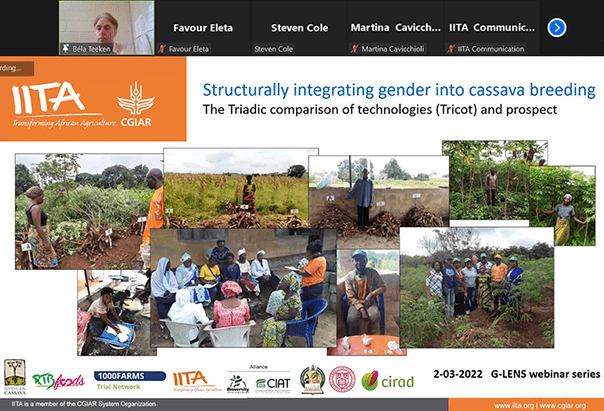
On 2 March, the first webinar entitled “Structurally integrating gender into cassava breeding: The Triadic comparison of technologies (Tricot) and prospects” was held. The meeting was successful, given the high number of attendees and their active feedback. Béla Teeken, Associate Social and Gender Scientist, presented with support from Olamide Olaosebikan – Senior Research Associate and Bello Abolore – Senior Research Supervisor. Steven Cole, Senior Gender specialist and GSN Coordinator, and Martina Cavicchioli, CIM Gender Scientist, moderated the session.
In his presentation, Teeken shared insights from research on cassava users’ livelihoods and varietal preferences. This research evolved from surveys to more engaged research using participatory variety selection (PVS) methods to inform breeders’ selection. He highlighted that because women are majorly into processing and selling food products and men usually sell more fresh roots; women prioritize processing and food product quality traits.
Through a cooperation between the Nextgen Cassava and RTB Foods projects, the research compared contrasting clones with farmers and processors to elicit and specify processing-related traits by using a “mother-baby trial” in two locations. They followed up with a scaled “baby trial” (Tricot approach) in which farmers and processors rank different combinations of only three varieties in their field. “Mother trial evaluation is statistically more informative; therefore, a scalable version of the baby trial format was needed to socially and inclusively represent users and their preferences on their farm, within their livelihood,” Teeken said.
The Tricot approach offers an online platform, CLimMob, that can archive and systematically store and analyze PVS data. The aim is to integrate ClimMob with breeder data platforms such as BreedBase/ CassavaBase, through the recently launched 1000-farm network project using the Tricot approach. This will help breeders determine their most important customer segments (types of farmers, processors, marketers, and consumers) and their preferences as to determine the “recipes” (product profiles) of varieties to be developed to achieve socially inclusive and economic impact in line with the sustainable development goals. The research team led by Teeken is working with the Tricot and ClimMob creators from the Alliance of Bioversity and CIAT to improve the approach and make it more socially and gender-inclusive and better tailored to RTB crops.

The presentation received positive comments and there was a lively question and answer session. One of the participants, Millicent Liani, commended the team for their excellent work and stated that she looks forward to learning more from the presenter and about the Tricot approach. Another participant, Pheneas Ntawuruhunga, shared what he had learned, mentioning the many steps tricot has, from planting to processing evaluation with many farmers and processors to farmers’ and lead farmers’ socially inclusive selection and training.
In his closing remarks, Cole appreciated the team for the great work in their research and presentation. He also thanked the participants for their time and engagement and announced that participants should anticipate the next webinar in May.
Contributed by Favour Ochuwa Eleta
Contributed by
Recent stories