
The project Building Economically Sustainable Seed Systems for Cassava, Phase 2 (BASICS-II) organized a day-long National Cassava Business Summit towards developing a cassava seed system in the country. The summit was held on 17 February in Dodoma, Tanzania.
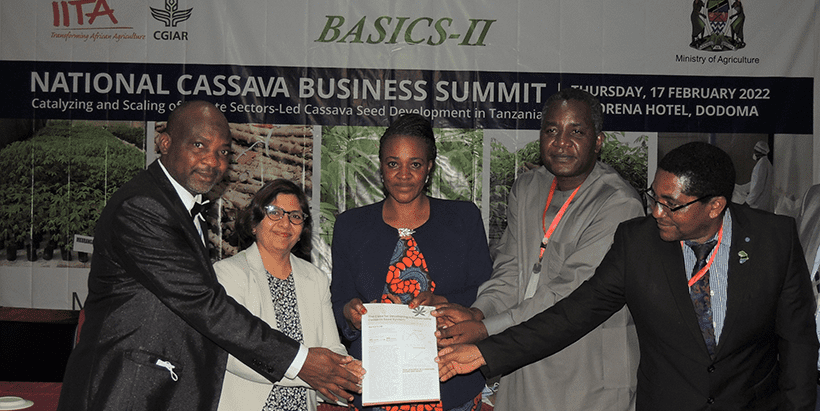
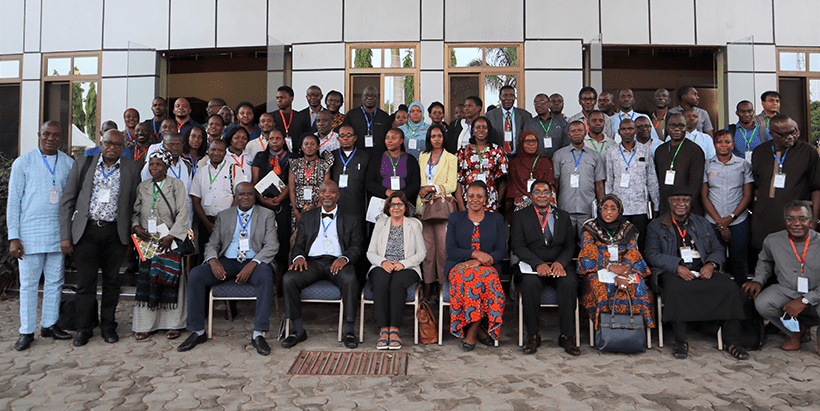
The meeting aimed to catalyze public-private partnership sector-led investment in the cassava seed value chain, bringing together about 100 participants from the public and private sectors, NGOs, institutions, entrepreneurs, farmers, and other key cassava stakeholders.
In her opening remarks, the IITA Eastern Africa Hub Director, Leena Tripathi, noted that cassava is at the heart of IITA’s works and lauded the government for its efforts in developing the crop for commercialization through launching the National Cassava Development Strategy (2020-2030) in 2021.
“I am glad that Tanzania and Nigeria are comparing notes on developing the cassava sector,” she said.
Tripathi also noted that IITA has multidisciplinary experts in breeding, disease management, and tools such as Nuru and SeedTracker, agronomy, and postharvest management. IITA is ready and willing to share its expertise and technologies for agricultural sector development.
The representative of the Minister of Agriculture, Eng. Anna Mwangamulo, advised scientists to research based on market needs so that the solutions could cater to the consumers’ needs. Also, she urged the cassava stakeholders to implement the cassava strategy in their activities to develop the whole cassava sector.
“I appreciate the efforts from IITA and TARI in releasing 25 improved cassava varieties,” Mwangamulo said.
During the meeting, the participants attended interactive presentations and impactful plenary sessions to tackle the challenges within the cassava seed sector, finding solutions to boosting profitability and efficiency in the cassava seed systems, and making the entire cassava value chain more productive and private-investment friendly.
“If we adopt the BASICS model, we will improve production, increase productivity, and enhance livelihoods through increased income and employment,” advised Godwin Atser, BASICS-II Advocacy, Promotion & Outreach Lead at IITA. He also noted that Tanzania needed to increase productivity to attract investments, and the seed system is a massive opportunity for farmers to explore.
Mwantumu Mahiza, the Chairperson of Tanzania Cassava Producers and Processors Association (TACAPPA), urged financial institutions to have feasible youth-friendly loan regulations to attract professional youth into the agriculture sector.
Cassava stakeholders shared their experiences and showcased their activities across the cassava value chain. “When I started working on machine designs for cassava processing, many thought I was wasting my time. But seeing how cassava has become a focal crop and people want to develop the sector, they have started to understand my perspective.” reflected Peter Chisawilo, Processing Machines Manufacturer at Intermech.
Mama Antonia did not believe the cassava seed business was profitable when she started, but after receiving training on cassava seed production from the Building Economically Sustainable Cassava Seed Systems in Tanzania (BEST Cassava) project, she has learned and managed to have a successful, sustainable, productive business. “Through this business, I have taken my children to school, built modern houses, and increased food security in my family,” Antonia testified.
Prof Lateef Sanni, Project Manager for BASICS-II, said the burgeoning private investments in cassava processing across Africa put a demand for improved cassava seeds, and growers are now aiming to satisfy industries.
He noted that the changing narrative was an opportunity for growers, especially the private sector, to take advantage of the seed sector.
BASICS-II, which IITA leads, aims to provide farmers with access to affordable, quality-assured seed of cassava varieties in demand by local food and processor markets by strengthening a commercially viable seed value chain operating across breeder, basic, and commercial/certified seed levels. This value chain will enable more efficient dissemination and adoption of superior varieties to improve productivity, increase the incomes of cassava growers and seed entrepreneurs, improve gender equity, and contribute to inclusive agricultural transformation in Tanzania and Nigeria.
In Tanzania, BASICS-II builds on BEST, a recently concluded project, which worked with 641 registered Cassava Seed Entrepreneurs (CSEs) from 11 regions. About 1068 hectares under cassava seed production were certified and accessed for seeds by farmers. The project officially released five improved varieties. Four initially released varieties for the Coastal lowland were extended countrywide, and CSEs produced their seed. Tanzanian partners under BASICS-II include MEDA, Tanzania Agriculture Research Institute (TARI), and Tanzania Official Seed Certification Institute (TOSCI).
Contributed by Gloriana Ndibalema
Contributed by
Recent stories