
Training agricultural researchers to be more gender-responsive
September 17, 2016
Peter Kulakow, IITA breeder and Elizabeth Parkes, HarvestPlus breeder are part of a 16-person training panel for 11 teams of 33 researchers from four continents participating in a training on “Gender Responsive Root, Tuber, and Banana Breeding,” 12-21 September in Kampala, Uganda.
 This is the first of seven training on the theory and practice of gender-responsive research organized by agricultural theme and offered in a joint Cornell University and Makerere University educational project called GREAT, or Gender-responsive Researchers Equipped for Agricultural Transformation.
In GREAT, researchers who work in sub-Saharan Africa learn how to identify the needs of both women and men when setting agricultural project priorities, implementing projects, and measuring and communicating outcomes.
“In sub-Saharan Africa, the livelihood and food security of a majority of people depends to some extent on roots, tubers and bananas, especially in rural areas,” said Margaret Mangheni, an associate professor at Makerere University who has more than 20 years’ experience with gender-sensitive agricultural development projects in sub-Saharan Africa, and leads the project at Makerere. “GREAT training will improve the outcomes of agricultural research for smallholder women farmers, entrepreneurs and farmer organizations across sub-Saharan Africa.”
In the “Gender Responsive Root, Tuber and Banana Breeding,” or RTB course, research teams focus on challenges like banana bunchy top disease, banana xanthomonas wilt, cassava breeding and processing, potato production, banana breeding, micronutrient enhanced cassava, and sweet potato improvement.
“GREAT works to equitably extend the benefits of agricultural research to both women and men,” said Hale Ann Tufan, adjunct professor with International Programs in Cornell University’s College of Agriculture and Life Sciences, who leads the five-year project at Cornell. “Our goal is for agricultural researchers working across sub-Saharan Africa to improve the livelihoods of smallholder farmers by considering gender and prioritizing gender equality goals in their work.”
Researchers in the RTB course represent a mix of projects and institutions: IITA in Cameroon, Bioversity International in Burundi, the Centre de Coopération International en Recherche Agronomic in France, HarvestPlus, NEXTGEN Cassava Breeding in Uganda and Nigeria, the Program for Emerging Agricultural Research Leaders in Ghana, the West Africa Center for Crop Improvement in Ghana, the International Potato Center in Colombia, and the Savanna Agricultural Research Institute in Ghana.
Kulakow commended the organizers of the training and said that the lessons were important to IITA’s research. “This is a really good program. It will make a difference in our ability to do gender research that can help many IITA projects.”
By 2020, GREAT expects to have trained eight cohorts with up to 10 research project teams each, or more than 200 researchers representing at least 30 national and international research institutions in sub-Saharan Africa.
Subsequent training to create more inclusive and effective agricultural systems will be offered on the themes of grain and legume breeding; small ruminant breeding; dairy and legume value chains; nutrition and food systems; knowledge exchange (extension); and agricultural mechanization.
To help sustain the initiative, GREAT will create a center of excellence for gender responsive agricultural training at Makerere. Over the life of the project, GREAT content will be integrated into spin-off short courses and current agricultural degree programs at Makerere.
GREAT is funded by a $5M grant from the Bill & Melinda Gates Foundation.
This is the first of seven training on the theory and practice of gender-responsive research organized by agricultural theme and offered in a joint Cornell University and Makerere University educational project called GREAT, or Gender-responsive Researchers Equipped for Agricultural Transformation.
In GREAT, researchers who work in sub-Saharan Africa learn how to identify the needs of both women and men when setting agricultural project priorities, implementing projects, and measuring and communicating outcomes.
“In sub-Saharan Africa, the livelihood and food security of a majority of people depends to some extent on roots, tubers and bananas, especially in rural areas,” said Margaret Mangheni, an associate professor at Makerere University who has more than 20 years’ experience with gender-sensitive agricultural development projects in sub-Saharan Africa, and leads the project at Makerere. “GREAT training will improve the outcomes of agricultural research for smallholder women farmers, entrepreneurs and farmer organizations across sub-Saharan Africa.”
In the “Gender Responsive Root, Tuber and Banana Breeding,” or RTB course, research teams focus on challenges like banana bunchy top disease, banana xanthomonas wilt, cassava breeding and processing, potato production, banana breeding, micronutrient enhanced cassava, and sweet potato improvement.
“GREAT works to equitably extend the benefits of agricultural research to both women and men,” said Hale Ann Tufan, adjunct professor with International Programs in Cornell University’s College of Agriculture and Life Sciences, who leads the five-year project at Cornell. “Our goal is for agricultural researchers working across sub-Saharan Africa to improve the livelihoods of smallholder farmers by considering gender and prioritizing gender equality goals in their work.”
Researchers in the RTB course represent a mix of projects and institutions: IITA in Cameroon, Bioversity International in Burundi, the Centre de Coopération International en Recherche Agronomic in France, HarvestPlus, NEXTGEN Cassava Breeding in Uganda and Nigeria, the Program for Emerging Agricultural Research Leaders in Ghana, the West Africa Center for Crop Improvement in Ghana, the International Potato Center in Colombia, and the Savanna Agricultural Research Institute in Ghana.
Kulakow commended the organizers of the training and said that the lessons were important to IITA’s research. “This is a really good program. It will make a difference in our ability to do gender research that can help many IITA projects.”
By 2020, GREAT expects to have trained eight cohorts with up to 10 research project teams each, or more than 200 researchers representing at least 30 national and international research institutions in sub-Saharan Africa.
Subsequent training to create more inclusive and effective agricultural systems will be offered on the themes of grain and legume breeding; small ruminant breeding; dairy and legume value chains; nutrition and food systems; knowledge exchange (extension); and agricultural mechanization.
To help sustain the initiative, GREAT will create a center of excellence for gender responsive agricultural training at Makerere. Over the life of the project, GREAT content will be integrated into spin-off short courses and current agricultural degree programs at Makerere.
GREAT is funded by a $5M grant from the Bill & Melinda Gates Foundation.
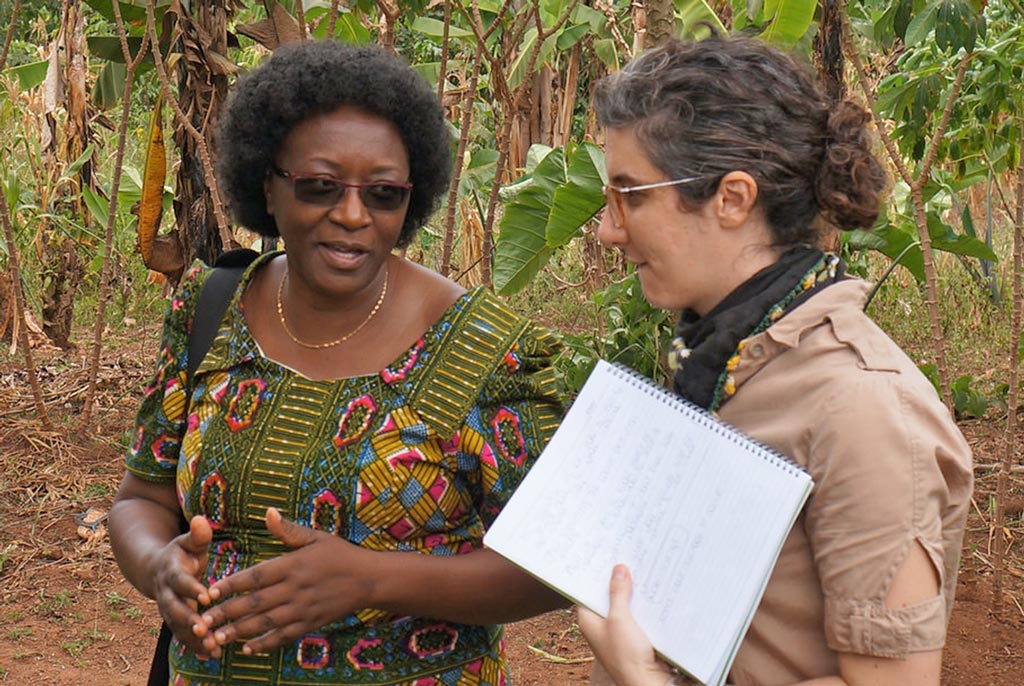
Margaret Mangheni of Makerere University in Uganda and Hale Tufan of Cornell University co-lead the GREAT training course in Uganda. Photo by D. Torrington, Cornell.
Contributed by
Recent stories
No items found