
IITA NEWS

Banana can protect coffee from the effects of climate change
December 11, 2012

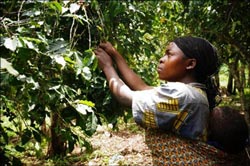
ImageDar es Salaam. Growing coffee and banana together not only generates more income for small-holder farmers, compared to growing either crop alone, but it can also help coffee production to better cope with the effects of climate change, a recent study has shown.

The study, which sought to underst and the potential impact of climate change on coffee-based livelihoods in the East African highl ands, found that the areas suitable for growing Arabica coffee will drastically decrease in the future leading to losses in the region that may exceed US$100 million annually. This is not only a threat to the countries’ foreign revenue, but it also puts at risk the livelihoods of millions of small-holder farmers depending on the crop.

The researchers from the International Institute of Tropical Agriculture (IITA) in collaboration with those from the Colombian-based International Center for Tropical Agriculture (CIAT), used climate models and climate analogues to predict the impact of climate change on coffee production. The researchers walked down the slopes of Rwenzori Mountains, in Ug anda, where the lower one goes, the temperatures get progressively warmer and drought stress becomes a more serious problem—similar to walking into a “future climate”.

The approach illustrated that areas below 1300 m may well become completely unsuitable for Arabica coffee production. In areas between 1300-1700 m, coffee will be severely affected if current farming practices that use traditional varieties and make limited use of water conservation and shade technologies remain unchanged.

In Ug anda, coffee is the most important export crop generating approximately 20% of the foreign exchange earnings. One-third of the coffee export value is from Arabica coffee, which requires a particularly cool tropical climate that is only found at higher altitudes, generally above 1400 m. Arabica is therefore very sensitive to a rise in temperature induced by climate change. Coffee is also among the top three commodity exports in Ethiopia, Rw anda, Burundi, and Tanzania.

Shade provided by shade trees or banana can help coffee to cope with the warmer climate and with drought shocks. Research has shown that shade can reduce the temperature in the understory plants by up to 2º C or more. Past research by IITA also showed that growing coffee and banana together increased the farmers’ income – the coffee yield remained the same despite creating room for the banana and the farmer gained additional income from selling the banana. This study strengthens the case for growing coffee and banana together as it provides both short- and long- term benefits to farmers.

“Strategies to help farmers cope with climate change will often be more successful if farmers are also able to see the immediate benefit of their investment. By growing banana and coffee, in a year’s time, the farmers will be earning extra money from selling banana,” says Dr Piet van Asten, an agronomist with IITA based in Ug anda and one of the researchers. “And if coffee fails, then bananas will still provide the farmer with food and income. It is a perfect win-win situation for both crops and the farmers.”

The researchers also interviewed farmers in the region who said the climate was already changing—the droughts were becoming longer, rainfall was becoming more erratic, and the rainy seasons were becoming shorter. This negatively affected the flowering of coffee and reduced the sizes of the berries.

The farmers had also observed that pests and diseases such as leaf miners, coffee berry borers, mealy bugs, and leaf rust were on the rise. However, the study found that leaf rust incidences were 50% lower in coffee that was shaded by banana compared to the unshaded plants.

The findings are supported by another study by Aless andro Craparo from the University of Witwatersr and with support from IITA, CIAT, and CGIAR Consortium Program on Climate Change and Agricultural Food Security (CCAFS) and the Tanzania Coffee Research Institute (TaCRI) that is looking at the influence and impact of climate change variability on Arabica coffee in the Mt Kilimanjaro area. It found that every minimum temperature increase of 1º C would lead to a yield loss of almost 100 kg/ha, representing 20% of the current yield.

The only drawback to adding shade to coffee is that it dem ands more nutrients and farmers will have to invest in maintaining the soil fertility.

“The downside of adding shade or shade crops to a coffee system is that it increases competition among the different plants for water, nutrients, and light. This competition needs to be managed by using good agronomic practices such as integrating fertilizers and organic nutrient inputs, appropriate plant density and canopy management, and good soil and water conservation practices to adapt successfully to climate change,” Dr Van Asten said.

The studies on impact of climate change on coffee systems in Ug anda received support from Climate Change, Agriculture and Food Security (CCAFS), the Consortium for Improving Agriculture-based Livelihoods in Central Africa (CIALCA) project, Oxfam, USAID, Wageningen University (WUR), and a wide range of coffee sector partners in the region.

###

For more information, please contact:

Catherine Njuguna (c.njuguna@cgiar.org)
IITA East Africa Hub
Dar es Salaam, Tanzania

Oliver Jeffrey, O.Jeffrey@cgiar.org
IITA hub for Southern Africa
Lusaka, Zambia

Godwin Atser g.atser@cgiar.org
IITA-hub for West Africa
Ibadan, Nigeria

About IITA

Africa has complex problems that plague agriculture and people’s lives. We develop agricultural solutions with our partners to tackle hunger and poverty. Our award-winning research for development (R4D) is based on focused, authoritative thinking anchored on the development needs of sub-Saharan Africa. We work with partners in Africa and beyond to reduce producer and consumer risks, enhance crop quality and productivity, and generate wealth from agriculture.

IITA is an international non-profit R4D organization established in 1967, governed by a Board of Trustees, and supported primarily by the CGIAR.

www.iita.org

The CGIAR is a global agriculture research partnership for a food secure future. Its science is carried out by the 15 research centers who are members of the CGIAR Consortium in collaboration with hundreds of partner organizations. www.cgiar.org


Contributed by

Recent stories

No items found

Leave a Reply

Your email address will not be published. Required fields are marked *

Scroll to Top
Olaosebikan, Olamide

Olamide Deborah Nwanze is a Senior Research Associate specializing in gender mainstreaming research to inform participatory and inclusive breeding, variety development, and seed systems policies regarding root, tuber, and banana (RTB) crops in the International Institute of Tropical Agriculture Headquarters, Ibadan, Nigeria. She is a PhD candidate at the University of Ibadan and holds an MSc and B. Agric in Agricultural Extension and Rural Development. Olamide is a fellow of the African Women in Agricultural Research and Development – Gender Responsive Agricultural Systems Policy (AWARD-GRASP) and the Gender Responsive Researchers Equipped for Agricultural Transformation (GREAT). She seeks to apply her gender-mainstreaming learnings, gender-responsive research, and policy development, and review expertise to facilitate women, youth, children, and vulnerable social group’s access to and adoption of agricultural Innovations that guarantee food, nutrition, income, and livelihood security in Africa. Her current roles include mentoring research fellows, development of guides and training manuals, implementation and adaptation of gender frameworks and tools, value chain actors’ engagement as citizen science partners, policy review and redesign, data management, and analysis. Her current research explores mixed methods and participatory and interdisciplinary approaches to capture and highlight gender dynamics, needs, preferences, and challenges stakeholders face within the agricultural livelihood value chain to prioritize gender-inclusive strategies in breeding programs, policy design, and implementation.

At IITA, she contributes to the implementation of the CGIAR Accelerated Breeding Initiative and Genetic Innovation Programs; participatory and gender research within the NextGen CassavaHarvestPlusRTBFoods, and Tricot-ClimMob 1000Farms Projects; and gender knowledge communication via the G-LENS webinar series, video documentary, policy briefspublications, and blogs.


Recent publications

de Sousa, K., van Etten, J., Manners, R. Bello, A., Teeken, B., Olaosebikan, O., et al. 2024. The tricot approach: an agile framework for decentralized on-farm testing supported by citizen science. A retrospective. Agron. Sustain. Dev. 44, 8. https://doi.org/10.1007/s13593-023-00937-1

Madu, T., Onwuka, S., Nwafor, S., Onyemauwa, N., Ejechi, M., Ofoeze, M., Ukeje, B., Eluagu, C., Olaosebikan, O., Okoye, B., 2024. Gender-Inclusive Consumer Studies Improve Cassava Breeding in Nigeria in: Frontiers in Sociology, volume 9, number: 1224504, doi: 10.3389/fsoc.2024.1224504

Olaosebikan, O.; Bello, A.; Utoblo, O.; Okoye, B.; Olutegbe, N.; Garner, E.; Teeken, B.; Bryan, E.; Forsythe, L.; Cole, S.; Madu, T. 2023.  Stressors and Resilience within the Cassava Value Chain in Nigeria: Preferred Cassava Variety Traits and Response Strategies of Men and Women to Inform Breeding. Sustainability 15, 7837. https://doi.org/10.3390/su15107837

Okoye, B., Ofoeze, M., Ejechi, M., Onwuka, S., Nwafor, S., Onyemauwa, N., Ukeje, B., Eluagu, C., Obidiegwu, J.*, Olaosebikan, O., Madu, T.* 2023. Prioritizing preferred traits in the yam value chain in Nigeria: a gender situation analysis in: Frontiers in Sociology, volume 8, number: 1232626, pages 1 – 9, ISSN 2297-7775, 2023. https://www.frontiersin.org/articles/10.3389/fsoc.2023.1232626/full

Olaosebikan, O., Bello, A. A., de Sousa, K., Ndjouenkeu, R., Adesokan, M., Alamu, E. O., Agbona, A., van Etten, J., Kegah, F. N.*, Dufour, D., Bouniol, A., Teeken, B. 2023. Consumer acceptability of cassava gari-eba food products across cultural and environmental settings using the triadic comparison of technologies approach (tricot) in: Journal of the Science of Food and Agriculture,

Teeken, B., Olaosebikan, O., Bello, A. A., Madu, T.*, Cole, S. M. 2023. Qualitative assessment on the positionality and preferences of dyads in relation to cassava-related activities: working with tricot trial citizen scientists https://hdl.handle.net/10568/138326 Type: Manual

Bouniol, A., Ceballos, H., Bello, A. A., Teeken, B., Olaosebikan, O., Owoade, D., Agbona, A., Fotso Kuate, A., Madu, T.*, Okoye, B.*, Ofoeze, M.*, Nwafor, S.*, Onyemauwa, N.*, Adinsi, L.*, Forsythe, L., Dufour, D. 2023. Varietal impact on women’s labour, workload and related drudgery in processing root, tuber and banana crops: focus on cassava in sub-Saharan Africa in: Journal of the Science of Food and Agriculture, pages 1 – 25, ISSN 0022-5142,

Bello, A. A., Agbona, A., Olaosebikan, O., Edughaen, G., Dufour, D., Bouniol, A., Iluebbey, P., Ndjouenkeu, R.*, Rabbi, I. Y., Teeken, B. 2023. Genetic and environmental effects on processing productivity and food product yield: drudgery of women’s work in: Journal of the Science of Food and Agriculture, pages 1 – 32, ISSN 0022-5142, 5

Cavicchioli, M., Zimbiti, T., Teeken, B., Nwanze, D.O., Liani, M., Parkes, E. & Bello, A. 2023. IITA-Gender Responsive Breeding Training Report. Genetic Resources Center, IITA-HQ, Ibadan, 21-23 September, 2022. Ibadan, Nigeria: IITA, (34 p.).https://hdl.handle.net/10568/131368

Agbona, A. Peteti P., Teeken B., Olaosebikan O. Bello, A. A., Parkes, E., Rabbi, I. Y., Mueller, L., Egesi, C., Kulakow, P. 2022. Data Management in Multi-disciplinary African RTB Crop Breeding Programs. In: Williamson, H.F., Leonelli, S. (eds) Towards Responsible Plant Data Linkage: Data Challenges for Agricultural Research and Development. Springer, Cham. https://doi.org/10.1007/978-3-031-13276-6_5

Lora Forsythe, Pricilla Marimo, Sarah Mayanja, Olamide D. Olaosebikan, Esme Stuart, Bela Teeken, Benjamin Okoye, Tessy Madu, (2021). Cross-product Gender Analysis of RTBfoods Step 2 Gendered Food Mapping on RTB Products. Understanding the Drivers of Trait Preferences and the Development of Multi-user RTB Product Profiles, WP1. London, UK: RTBfoods Field Scientific Report, 30 p.

Teeken, B., Garner, E., Agbona, A., Balogun, I., Olaosebikan, O., Bello, A., Madu, T., Okoye, B., Egesi, C., Kulakow, P. and Tufan, H.A. 2021. Beyond “Women’s Traits”: Exploring How Gender, Social Difference, and Household Characteristics Influence Trait Preferences. Frontiers Sustainable Food Systems 5:740926. https://doi.org/10.3389/fsufs.2021.740926

Teeken, B., Agbona, A., Bello, A., Olaosebikan, O., Alamu, E., Adesokan, M., Awoyale, W., Madu, T., Okoye, B., Chijioke, U., Owoade, D., Okoro, M., Bouniol, A., Dufour, D., Hershey, C., Rabbi, I., Maziya‐Dixon, B., Egesi, C., Tufan, H. and Kulakow, P. (020. Understanding cassava varietal preferences through pairwise ranking of gari‐eba and fufu prepared by local farmer–processors. Int J Food Sci Technol. https://doi.org/10.1111/ijfs.14862

Bela Teeken, Olamide Olaosebikan, Ireti Balogun, Benjamin Okoye, Tessy Madu, Steven Cole, Abolore Bello, Elizabeth Parkes. (2020). Piloting the G+ customer and product profile tools for gender-responsive cassava breeding in Nigeria. Nigeria: International Institute of Tropical Agriculture (IITA). https://hdl.handle.net/20.500.11766/13000