
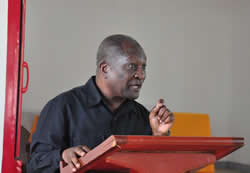
The Babati District in North Eastern Tanzania is one of the intervention areas of the IITA-led Africa RISING project. Project partners and the Babati District Council have launched the Babati District research-for-development (R4D) platform to support the uptake of the project’s innovations, help research priority setting, and ensure the sustainability of the project. This was at a two-day meeting attended by over 60 participants including farmers, local and regional government officials, national and international research institutions, extension workers, nongovernmental organizations, private sector representatives, and policy makers. Each group selected two members to represent them on the R4D Platform Management Committee.
The launch event was officially opened by the Manyara Regional Commissioner, Hon. Erastus Mbwilo. He assured the project of his support as its aim of improving the livelihoods of small-holder farmers in the region was well in line with the government’s development goals.
He was particularly happy to note that the Africa RISING project was working to improve the productivity of both crops and livestock through modern farming methods.
“Livestock is very important for our farmers in Babati. There are over 1.4 million heads of cattle in the district without counting the goats, the donkeys and the chickens. Unfortunately, many development partners often neglect livestock and focus on crops only. Therefore, the livestock sector faces many challenges including pests and diseases, poor breeds, lack of feed and overstocking, and the farmers are not able to maximize on their livestock to increase their income,” he said. “If these challenges are tackled through these research efforts, then, the project will surely make a difference in improving the livelihoods of the farmers in Babati.”
He further commended the Africa RISING approach of conducting research together with the farmers through demonstration plots which he said will ensure that the new technologies developed get to the farmers. He urged for the research findings to be scaled up and out beyond Babati District to include the whole of Manyara Region.
Also speaking during the official opening of the workshop, Irmgard Hoeschle-Zeledon, Africa RISING Program Coordinator, said the R4D platform was very important in ensuring the sustainability of the project’s impacts. She noted that the platform will help solve some of the factors that limit the uptake and adoption of new technologies by farmers and which are beyond the project scope.
“Africa RISING alone is not able to tackle all the challenges faced by farmers in their livestock and crop production. Hence, the need for an R4D platform. Furthermore, significant change in farm productivity will not happen through a few individual farmers who will adopt the technologies developed. Rather, it will depend on the simultaneous changes in all interdependent stakeholders including farmers, extension agents, research institutions, policy makers, finance institutions, market agents, and representative of different local and regional authorities among others,” she said.
For more information, please contact: Irmgard Hoeschle-Zeledon, Africa RISING Coordinator, i.zeledon@cgiar.org
About IITA www.iita.org
The International Institute of Tropical Agriculture (IITA) is one of the world’s leading research partners in finding solutions for hunger, malnutrition, and poverty. Its award-winning research for development (R4D) approach addresses the development needs of tropical countries. IITA works with partners to enhance crop quality and productivity, reduce producer and consumer risks, and generate wealth from agriculture. IITA is a non-profit organization founded in 1967 in Nigeria and governed by a Board of Trustees. IITA works on the following crops: cowpea, soybean, banana/plantain, yam, cassava, and maize. IITA is a member of CGIAR, a global agriculture research partnership for a food secure future.
Contributed by
Recent stories