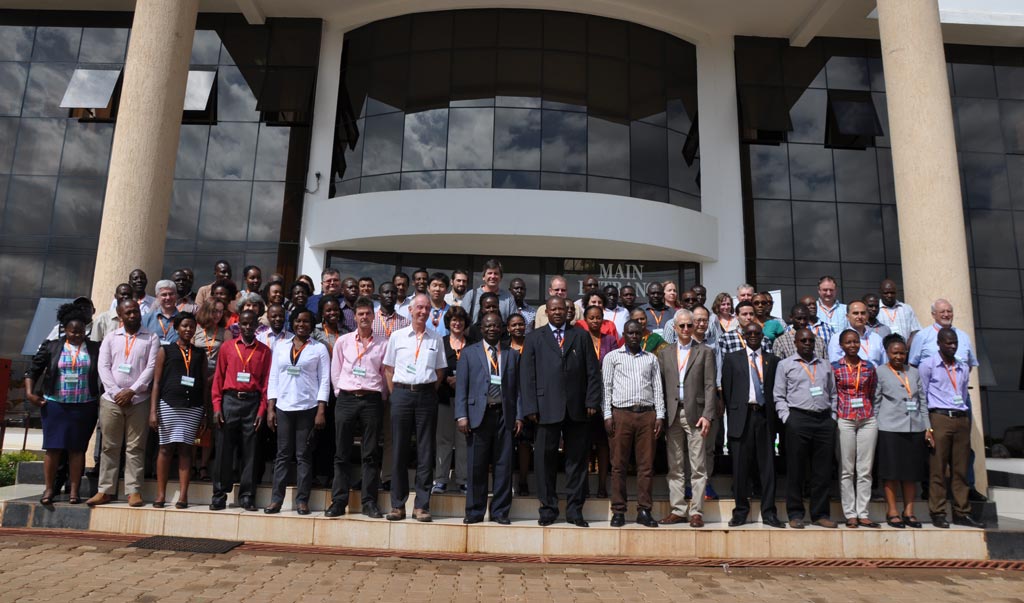
International experts on banana improvement meet in Uganda to strengthen breeding efforts in the region
April 24, 2017
Kampala, Ug anda, 24 April 2017. A team of international researchers are, this week, 24-26 April 2017, meeting in Ug anda to review progress and plan for future activities of a five-year project that seeks to improve the production and productivity of banana in Ug anda and Tanzania.
International researchers at banana improvement meeting
To support the banana improvement program in these two countries, the project brings together experts from banana breeding programs across the globe including Australia, Belgium, Brazil, Czech Republic, India, Kenya, Malaysia, South Africa, Sweden, Tanzania, Ug anda, and the USA.
The meeting is hosted by the Ug andan National Agriculture Research Organisation (NARO) and the International Institute of Topical Agriculture (IITA).
“The project aims to bolster and strengthen the banana breeding programs in Ug anda and Tanzania. By the end of the five years, the team expects to develop hybrid banana varieties with a 30% higher yield and a 50% higher resistance to at least three of the major pests and diseases, compared to the current varieties grown by the farmers under the same on-farm conditions. The new varieties will also meet over 90% of the quality traits for consumers found in the current varieties”, said Prof Rony Swennen, Banana Breeder at IITA and the project’s Team Leader.
The project focuses on the two most popular cooking bananas in the region―East Africa Highl and banana (EAHB) also known as Matooke in Ug anda and Mchare grown in Tanzania. It is addressing the two major diseases attacking the crop in the two countries―Fusarium Wilt and Black Leaf Streak diseases (Sigatoka disease), and two major pests―parasitic nematodes (microscopic worms) and weevils.
“Bananas are immensely important in Ug anda and the region but are being heavily attacked by pests and diseases. This project is enabling us to link with other breeding programs across the world, to exchange banana varieties, and use the best material in our breeding program. This is the first time this has happened on such a scale,” says Jerome Kubiriba, Head of the Banana Program, NARO, and team leader for the project’s breeding activities in Ug anda.
“Through this project, we will have a more efficient, faster, and more vibrant banana breeding system across East Africa that can better respond to our immediate and future challenges, especially now in the face of climate change,” he adds.
The project’s breeding activities are being conducted at the Ug anda Banana Breeding Programme of NARO, at Kaw anda and Sendusu, Ug anda, and at the Nelson M andela African Institution of Science and Technology (NM-AIST) in Arusha, Tanzania, in close collaboration with regional agriculture research institutes in the banana-growing areas.
“The project has got off to a flying start and is ahead of schedule in a number of activities. We are happy to report that we have so far selected 48 Matooke hybrids resulting from crosses made in this project to advance for yield assessment, well above and ahead of our year 3 target,” says Danny Coyne, IITA Soil Health Scientist and the project’s manager.
Past successes
This is not the first time NARO and IITA have teamed up. They successfully developed the first ever hybrids of the East African Highl and Banana, named NARITA, 20 of which are being evaluated and promoted by the project in Ug anda and Tanzania for local suitability and acceptance by farmers. There are 27 NARITAs, two of which were formally released by NARO in 2010 in Ug anda and are now being grown in at least 15% of the banana farms in Ug anda.
“It took 18 years to generate these hybrids which was a major milestone in breeding banana varieties in the region. But they can still be improved on, in particular in respect to pest and disease resistance. This new project is building on this success to take banana breeding to the next level,” says Swennen.
Banana are among the most difficult crops to breed due to the sterile nature of the crop, low seed set, and low germination rates of the seeds.
For more information:
Rony Swennen, Banana Breeder, IITA E-mail: r.swennen@cgiar.org
Jerome Kubiriba, Head of the Banana Program, NARO, E-mail: jkubiriba@kari.go.ug
Also visit project website: http://bananabreeding.iita.org/
Olamide Deborah Nwanze is a Senior Research Associate specializing in gender mainstreaming research to inform participatory and inclusive breeding, variety development, and seed systems policies regarding root, tuber, and banana (RTB) crops in the International Institute of Tropical Agriculture Headquarters, Ibadan, Nigeria. She is a PhD candidate at the University of Ibadan and holds an MSc and B. Agric in Agricultural Extension and Rural Development. Olamide is a fellow of the African Women in Agricultural Research and Development – Gender Responsive Agricultural Systems Policy (AWARD-GRASP) and the Gender Responsive Researchers Equipped for Agricultural Transformation (GREAT). She seeks to apply her gender-mainstreaming learnings, gender-responsive research, and policy development, and review expertise to facilitate women, youth, children, and vulnerable social group’s access to and adoption of agricultural Innovations that guarantee food, nutrition, income, and livelihood security in Africa. Her current roles include mentoring research fellows, development of guides and training manuals, implementation and adaptation of gender frameworks and tools, value chain actors’ engagement as citizen science partners, policy review and redesign, data management, and analysis. Her current research explores mixed methods and participatory and interdisciplinary approaches to capture and highlight gender dynamics, needs, preferences, and challenges stakeholders face within the agricultural livelihood value chain to prioritize gender-inclusive strategies in breeding programs, policy design, and implementation.
de Sousa, K., van Etten, J., Manners, R. Bello, A., Teeken, B., Olaosebikan, O., et al. 2024. The tricot approach: an agile framework for decentralized on-farm testing supported by citizen science. A retrospective. Agron. Sustain. Dev. 44, 8. https://doi.org/10.1007/s13593-023-00937-1
Madu, T., Onwuka, S., Nwafor, S., Onyemauwa, N., Ejechi, M., Ofoeze, M., Ukeje, B., Eluagu, C., Olaosebikan, O., Okoye, B., 2024. Gender-Inclusive Consumer Studies Improve Cassava Breeding in Nigeria in: Frontiers in Sociology, volume 9, number: 1224504, doi: 10.3389/fsoc.2024.1224504
Olaosebikan, O.; Bello, A.; Utoblo, O.; Okoye, B.; Olutegbe, N.; Garner, E.; Teeken, B.; Bryan, E.; Forsythe, L.; Cole, S.; Madu, T. 2023. Stressors and Resilience within the Cassava Value Chain in Nigeria: Preferred Cassava Variety Traits and Response Strategies of Men and Women to Inform Breeding. Sustainability 15, 7837. https://doi.org/10.3390/su15107837
Okoye, B., Ofoeze, M., Ejechi, M., Onwuka, S., Nwafor, S., Onyemauwa, N., Ukeje, B., Eluagu, C., Obidiegwu, J.*, Olaosebikan, O., Madu, T.* 2023. Prioritizing preferred traits in the yam value chain in Nigeria: a gender situation analysis in: Frontiers in Sociology, volume 8, number: 1232626, pages 1 – 9, ISSN 2297-7775, 2023. https://www.frontiersin.org/articles/10.3389/fsoc.2023.1232626/full
Olaosebikan, O., Bello, A. A., de Sousa, K., Ndjouenkeu, R., Adesokan, M., Alamu, E. O., Agbona, A., van Etten, J., Kegah, F. N.*, Dufour, D., Bouniol, A., Teeken, B. 2023. Consumer acceptability of cassava gari-eba food products across cultural and environmental settings using the triadic comparison of technologies approach (tricot) in: Journal of the Science of Food and Agriculture,
Teeken, B., Olaosebikan, O., Bello, A. A., Madu, T.*, Cole, S. M. 2023. Qualitative assessment on the positionality and preferences of dyads in relation to cassava-related activities: working with tricot trial citizen scientists https://hdl.handle.net/10568/138326 Type: Manual
Bouniol, A., Ceballos, H., Bello, A. A., Teeken, B., Olaosebikan, O., Owoade, D., Agbona, A., Fotso Kuate, A., Madu, T.*, Okoye, B.*, Ofoeze, M.*, Nwafor, S.*, Onyemauwa, N.*, Adinsi, L.*, Forsythe, L., Dufour, D. 2023. Varietal impact on women’s labour, workload and related drudgery in processing root, tuber and banana crops: focus on cassava in sub-Saharan Africa in: Journal of the Science of Food and Agriculture, pages 1 – 25, ISSN 0022-5142,
Bello, A. A., Agbona, A., Olaosebikan, O., Edughaen, G., Dufour, D., Bouniol, A., Iluebbey, P., Ndjouenkeu, R.*, Rabbi, I. Y., Teeken, B. 2023. Genetic and environmental effects on processing productivity and food product yield: drudgery of women’s work in: Journal of the Science of Food and Agriculture, pages 1 – 32, ISSN 0022-5142, 5
Cavicchioli, M., Zimbiti, T., Teeken, B., Nwanze, D.O., Liani, M., Parkes, E. & Bello, A. 2023. IITA-Gender Responsive Breeding Training Report. Genetic Resources Center, IITA-HQ, Ibadan, 21-23 September, 2022. Ibadan, Nigeria: IITA, (34 p.).https://hdl.handle.net/10568/131368
Agbona, A. Peteti P., Teeken B., Olaosebikan O. Bello, A. A., Parkes, E., Rabbi, I. Y., Mueller, L., Egesi, C., Kulakow, P. 2022. Data Management in Multi-disciplinary African RTB Crop Breeding Programs. In: Williamson, H.F., Leonelli, S. (eds) Towards Responsible Plant Data Linkage: Data Challenges for Agricultural Research and Development. Springer, Cham. https://doi.org/10.1007/978-3-031-13276-6_5
Lora Forsythe, Pricilla Marimo, Sarah Mayanja, Olamide D. Olaosebikan, Esme Stuart, Bela Teeken, Benjamin Okoye, Tessy Madu, (2021). Cross-product Gender Analysis of RTBfoods Step 2 Gendered Food Mapping on RTB Products. Understanding the Drivers of Trait Preferences and the Development of Multi-user RTB Product Profiles, WP1. London, UK: RTBfoods Field Scientific Report, 30 p.
Teeken, B., Garner, E., Agbona, A., Balogun, I., Olaosebikan, O., Bello, A., Madu, T., Okoye, B., Egesi, C., Kulakow, P. and Tufan, H.A. 2021. Beyond “Women’s Traits”: Exploring How Gender, Social Difference, and Household Characteristics Influence Trait Preferences. Frontiers Sustainable Food Systems 5:740926. https://doi.org/10.3389/fsufs.2021.740926
Teeken, B., Agbona, A., Bello, A., Olaosebikan, O., Alamu, E., Adesokan, M., Awoyale, W., Madu, T., Okoye, B., Chijioke, U., Owoade, D., Okoro, M., Bouniol, A., Dufour, D., Hershey, C., Rabbi, I., Maziya‐Dixon, B., Egesi, C., Tufan, H. and Kulakow, P. (020. Understanding cassava varietal preferences through pairwise ranking of gari‐eba and fufu prepared by local farmer–processors. Int J Food Sci Technol.https://doi.org/10.1111/ijfs.14862
Bela Teeken, Olamide Olaosebikan, Ireti Balogun, Benjamin Okoye, Tessy Madu, Steven Cole, Abolore Bello, Elizabeth Parkes. (2020). Piloting the G+ customer and product profile tools for gender-responsive cassava breeding in Nigeria. Nigeria: International Institute of Tropical Agriculture (IITA). https://hdl.handle.net/20.500.11766/13000