IITA-associated technologies among two of top three innovations to reduce postharvest losses in Africa
May 25, 2017
What do an affordable and effective biocontrol product to reduce aflatoxin contamination in maize and groundnut and a technology to convert fresh cassava peel into high-quality livestock feed have in common?
Both aim to reduce postharvest losses and were declared winners during the postharvest innovation challenge at the first All Africa Postharvest Congress & Exhibition held 28-31 March, in Nairobi, Kenya. Secondly, IITA has been involved in developing both technologies, working alongside various partners. Each technology received a certificate and a cash prize of US$5000.
The innovation challenge sought to highlight emerging postharvest technologies and innovations that make a significant difference in reducing postharvest losses and that have high potential for scaling up.
Transforming cassava peel into livestock feed
IITA is collaborating with the International Livestock Research Institute (ILRI) to develop technologies to convert fresh cassava peel into high-quality livestock feed. Processing cassava generates millions of tons of peel, which go to waste.
“The technology is being piloted in Nigeria where 14 million tons of cassava peel is generated annually. The fresh cassava peel is grated finely, the water extracted using presses, and then sun dried. They are then milled finely or coarsely for feed for cows, chickens, and goats among other livestock,” said Iheanacho Okike, former ILRI country representative in Nigeria and who received the award on behalf of the team.
The team is also developing other products such as pellets and silage from grated and whole cassava peel. Other partners in the project are CIP, CGIAR Program on Roots and Tubers, and CGIAR program on Livestock and Fish.
Commercialization of the technology is under way with Niji Foods―a cassava-processing firm, which was selected to set up three cassava peel processing units with financial assistance from USAID.
Aflasafe–making food safe from deadly cancer-causing aflatoxins
Aflatoxin is a toxic and cancer-causing poison produced by certain types of the green fungus, Aspergillus flavus that naturally occur in the soil. It is a threat to food security, health, and incomes of smallholder farmers.
It renders food and feed unfit for human and livestock consumption, untradeable, and requires additional cost for disposal.
Aflasafe is an effective biocontrol product developed by IITA in partnership with the United States Department of Agriculture (USDA) to reduce aflatoxin contamination in maize and groundnut.
It makes use of non-aflatoxin producing strains of the green mold which is able to outcompete and displace the toxin producers.
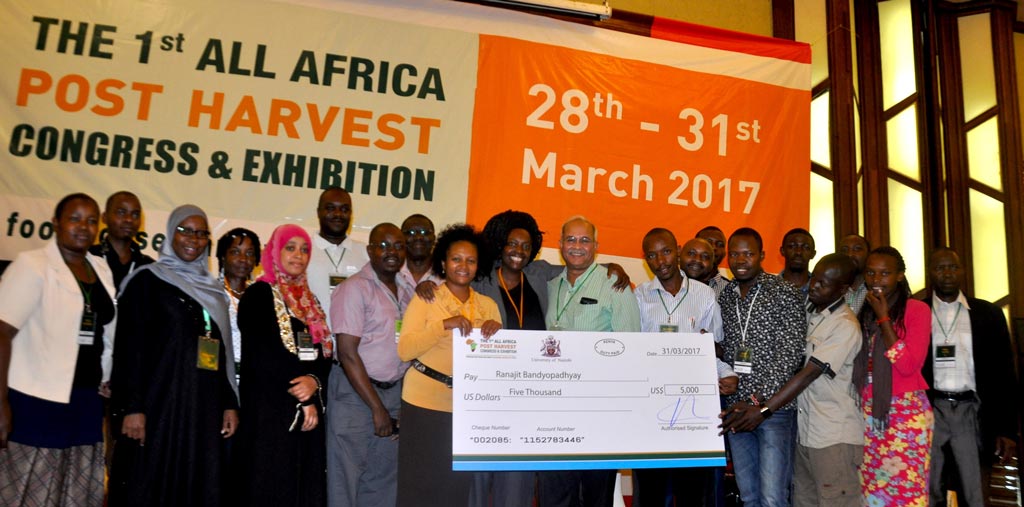
Aflasafe was ranked as the third top technology of the innovation challenge. Ranajit B andyopadhyay, IITA Principal Plant Pathologist who has been leading efforts to develop the technology, pitched the technology to the congress participants.
He also collected the award certificate and money on behalf of the team.
“The Aflasafe technology, which has been found to effectively reduce aflatoxin contamination by between 80 and 98%, was developed by Peter Cotty in the United States. At IITA, working with many partners, we have adapted it for and are rolling it across many Africa countries,” he said.
“Aflasafe has been registered in four countries―Nigeria, Kenya, Senegal, and The Gambia― and is at various stages of development in nine others,” said B andyopadhyay.
In Nigeria, commercial production of Aflasafe is taking place at a model plant constructed at IITA’s Business Incubation Platform while construction of similar plants is under way in Kenya and will begin in Senegal in 2017.
Group photo of aflasafe team
Overall winner
The overall winner of the postharvest innovation challenge was the DryCard developed by the Horticulture Innovation Lab and the University of California at Davies (UC Davies).
It is a low-cost and easy-to-use technology that uses colored strips to measure moisture levels in grain.
High moisture levels in stored grain lead to attack by mold and spoilage as well as aflatoxin contamination, if attacked by the aflatoxin-producing mold. DryCard was developed by UC Davis scientists Michael Reid and James Thompson.
Olamide Deborah Nwanze is a Senior Research Associate specializing in gender mainstreaming research to inform participatory and inclusive breeding, variety development, and seed systems policies regarding root, tuber, and banana (RTB) crops in the International Institute of Tropical Agriculture Headquarters, Ibadan, Nigeria. She is a PhD candidate at the University of Ibadan and holds an MSc and B. Agric in Agricultural Extension and Rural Development. Olamide is a fellow of the African Women in Agricultural Research and Development – Gender Responsive Agricultural Systems Policy (AWARD-GRASP) and the Gender Responsive Researchers Equipped for Agricultural Transformation (GREAT). She seeks to apply her gender-mainstreaming learnings, gender-responsive research, and policy development, and review expertise to facilitate women, youth, children, and vulnerable social group’s access to and adoption of agricultural Innovations that guarantee food, nutrition, income, and livelihood security in Africa. Her current roles include mentoring research fellows, development of guides and training manuals, implementation and adaptation of gender frameworks and tools, value chain actors’ engagement as citizen science partners, policy review and redesign, data management, and analysis. Her current research explores mixed methods and participatory and interdisciplinary approaches to capture and highlight gender dynamics, needs, preferences, and challenges stakeholders face within the agricultural livelihood value chain to prioritize gender-inclusive strategies in breeding programs, policy design, and implementation.
de Sousa, K., van Etten, J., Manners, R. Bello, A., Teeken, B., Olaosebikan, O., et al. 2024. The tricot approach: an agile framework for decentralized on-farm testing supported by citizen science. A retrospective. Agron. Sustain. Dev. 44, 8. https://doi.org/10.1007/s13593-023-00937-1
Madu, T., Onwuka, S., Nwafor, S., Onyemauwa, N., Ejechi, M., Ofoeze, M., Ukeje, B., Eluagu, C., Olaosebikan, O., Okoye, B., 2024. Gender-Inclusive Consumer Studies Improve Cassava Breeding in Nigeria in: Frontiers in Sociology, volume 9, number: 1224504, doi: 10.3389/fsoc.2024.1224504
Olaosebikan, O.; Bello, A.; Utoblo, O.; Okoye, B.; Olutegbe, N.; Garner, E.; Teeken, B.; Bryan, E.; Forsythe, L.; Cole, S.; Madu, T. 2023. Stressors and Resilience within the Cassava Value Chain in Nigeria: Preferred Cassava Variety Traits and Response Strategies of Men and Women to Inform Breeding. Sustainability 15, 7837. https://doi.org/10.3390/su15107837
Okoye, B., Ofoeze, M., Ejechi, M., Onwuka, S., Nwafor, S., Onyemauwa, N., Ukeje, B., Eluagu, C., Obidiegwu, J.*, Olaosebikan, O., Madu, T.* 2023. Prioritizing preferred traits in the yam value chain in Nigeria: a gender situation analysis in: Frontiers in Sociology, volume 8, number: 1232626, pages 1 – 9, ISSN 2297-7775, 2023. https://www.frontiersin.org/articles/10.3389/fsoc.2023.1232626/full
Olaosebikan, O., Bello, A. A., de Sousa, K., Ndjouenkeu, R., Adesokan, M., Alamu, E. O., Agbona, A., van Etten, J., Kegah, F. N.*, Dufour, D., Bouniol, A., Teeken, B. 2023. Consumer acceptability of cassava gari-eba food products across cultural and environmental settings using the triadic comparison of technologies approach (tricot) in: Journal of the Science of Food and Agriculture,
Teeken, B., Olaosebikan, O., Bello, A. A., Madu, T.*, Cole, S. M. 2023. Qualitative assessment on the positionality and preferences of dyads in relation to cassava-related activities: working with tricot trial citizen scientists https://hdl.handle.net/10568/138326 Type: Manual
Bouniol, A., Ceballos, H., Bello, A. A., Teeken, B., Olaosebikan, O., Owoade, D., Agbona, A., Fotso Kuate, A., Madu, T.*, Okoye, B.*, Ofoeze, M.*, Nwafor, S.*, Onyemauwa, N.*, Adinsi, L.*, Forsythe, L., Dufour, D. 2023. Varietal impact on women’s labour, workload and related drudgery in processing root, tuber and banana crops: focus on cassava in sub-Saharan Africa in: Journal of the Science of Food and Agriculture, pages 1 – 25, ISSN 0022-5142,
Bello, A. A., Agbona, A., Olaosebikan, O., Edughaen, G., Dufour, D., Bouniol, A., Iluebbey, P., Ndjouenkeu, R.*, Rabbi, I. Y., Teeken, B. 2023. Genetic and environmental effects on processing productivity and food product yield: drudgery of women’s work in: Journal of the Science of Food and Agriculture, pages 1 – 32, ISSN 0022-5142, 5
Cavicchioli, M., Zimbiti, T., Teeken, B., Nwanze, D.O., Liani, M., Parkes, E. & Bello, A. 2023. IITA-Gender Responsive Breeding Training Report. Genetic Resources Center, IITA-HQ, Ibadan, 21-23 September, 2022. Ibadan, Nigeria: IITA, (34 p.).https://hdl.handle.net/10568/131368
Agbona, A. Peteti P., Teeken B., Olaosebikan O. Bello, A. A., Parkes, E., Rabbi, I. Y., Mueller, L., Egesi, C., Kulakow, P. 2022. Data Management in Multi-disciplinary African RTB Crop Breeding Programs. In: Williamson, H.F., Leonelli, S. (eds) Towards Responsible Plant Data Linkage: Data Challenges for Agricultural Research and Development. Springer, Cham. https://doi.org/10.1007/978-3-031-13276-6_5
Lora Forsythe, Pricilla Marimo, Sarah Mayanja, Olamide D. Olaosebikan, Esme Stuart, Bela Teeken, Benjamin Okoye, Tessy Madu, (2021). Cross-product Gender Analysis of RTBfoods Step 2 Gendered Food Mapping on RTB Products. Understanding the Drivers of Trait Preferences and the Development of Multi-user RTB Product Profiles, WP1. London, UK: RTBfoods Field Scientific Report, 30 p.
Teeken, B., Garner, E., Agbona, A., Balogun, I., Olaosebikan, O., Bello, A., Madu, T., Okoye, B., Egesi, C., Kulakow, P. and Tufan, H.A. 2021. Beyond “Women’s Traits”: Exploring How Gender, Social Difference, and Household Characteristics Influence Trait Preferences. Frontiers Sustainable Food Systems 5:740926. https://doi.org/10.3389/fsufs.2021.740926
Teeken, B., Agbona, A., Bello, A., Olaosebikan, O., Alamu, E., Adesokan, M., Awoyale, W., Madu, T., Okoye, B., Chijioke, U., Owoade, D., Okoro, M., Bouniol, A., Dufour, D., Hershey, C., Rabbi, I., Maziya‐Dixon, B., Egesi, C., Tufan, H. and Kulakow, P. (020. Understanding cassava varietal preferences through pairwise ranking of gari‐eba and fufu prepared by local farmer–processors. Int J Food Sci Technol.https://doi.org/10.1111/ijfs.14862
Bela Teeken, Olamide Olaosebikan, Ireti Balogun, Benjamin Okoye, Tessy Madu, Steven Cole, Abolore Bello, Elizabeth Parkes. (2020). Piloting the G+ customer and product profile tools for gender-responsive cassava breeding in Nigeria. Nigeria: International Institute of Tropical Agriculture (IITA). https://hdl.handle.net/20.500.11766/13000