
Nigeria launches plan to end hunger by 2030
January 16, 2017
The plan tagged: “Synthesis Report of the Nigeria Zero Hunger Strategic Review” articulates what Nigeria needs to do to achieve Sustainable Development Goal 2 (SDG2)—one of the global goals that seeks to “end hunger, achieve food security and improved nutrition, and promote sustainable agriculture” by 2030.
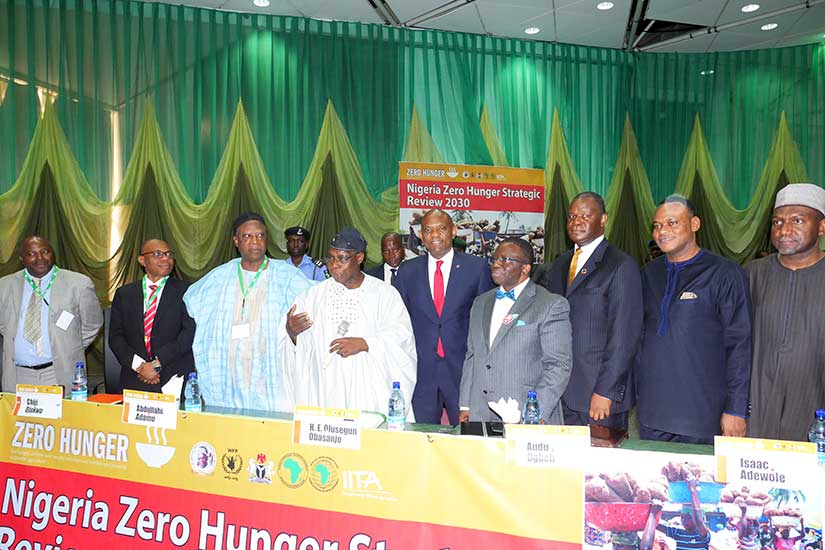 The 60-page home-developed document reflects Nigerians’ perspectives of steps needed to be taken to win the battle against hunger and malnutrition.
Former Nigerian President Olusegun Obasanjo, who chairs the development of the Synthesis Report said, “The report would support and encourage the government to implement the policies, strategies, plans, and programs that have been formulated over many years, and to do so with a focus on achieving Zero Hunger by 2030, if not earlier.”
To tap its rich agricultural potential and lift over 13 million people from hunger, Nigeria in 2015 endorsed a set of 17 Sustainable Development Goals (SDGs) as part of efforts to achieve sustainable development in general.
Former President Obasanjo said the launch of the Synthesis Report provided a framework that would “unlock the potential of our nation and emancipate our dear country from the shackles of hunger and poverty.”
He noted that the establishment of the Nigeria Zero Hunger Forum based at IITA, would ensure that recommendations contained in the Synthesis Report and the individual Subcommittee reports are implemented.
“We must do all we can so that this effort does not suffer the fate of previous endeavors,” he stressed.
The former President commended President Muhammadu Buhari for endorsing the Nigeria Zero Hunger Strategic Review. He lauded Ertharin Cousin, Executive Director of the World Food Programme (WFP) for funding and requesting that the review be conducted, and gave special thanks to the African Development Bank (AfDB) for providing most of the funds, which financed the Review.
The Director of Policy and Program, WFP, Stanlake Samkange, commended Nigeria for developing the strategic document, emphasizing that the Report was the first in West Africa and would be a guide for other countries to emulate. He reiterated that the task of ending hunger cannot be solved by a single organization and lauded the collaboration of the different actors in the development of the Report.
The inauguration of the Synthesis Report will be backed with immediate implementation in four states of the federation—Benue, Ebonyi, Ogun, and Sokoto beginning this January.
By January 2019 eight more states will be added and by January 2021, all 36 States plus the FCT will be included.
The Director General of IITA, Nteranya Sanginga, said the Synthesis Report was a departure from other previous reports in the sense that it would be backed by immediate action.
According to him, IITA would continue to support states with relevant technologies cutting across crops such as cassava, maize, cowpea, yam, soybean, banana, and plantain. The launch of the Synthesis Report received commendation from the Minister of Health, federal legislature, state governments, United Nations agencies, the AfDB, and the private sector, among others.
The 60-page home-developed document reflects Nigerians’ perspectives of steps needed to be taken to win the battle against hunger and malnutrition.
Former Nigerian President Olusegun Obasanjo, who chairs the development of the Synthesis Report said, “The report would support and encourage the government to implement the policies, strategies, plans, and programs that have been formulated over many years, and to do so with a focus on achieving Zero Hunger by 2030, if not earlier.”
To tap its rich agricultural potential and lift over 13 million people from hunger, Nigeria in 2015 endorsed a set of 17 Sustainable Development Goals (SDGs) as part of efforts to achieve sustainable development in general.
Former President Obasanjo said the launch of the Synthesis Report provided a framework that would “unlock the potential of our nation and emancipate our dear country from the shackles of hunger and poverty.”
He noted that the establishment of the Nigeria Zero Hunger Forum based at IITA, would ensure that recommendations contained in the Synthesis Report and the individual Subcommittee reports are implemented.
“We must do all we can so that this effort does not suffer the fate of previous endeavors,” he stressed.
The former President commended President Muhammadu Buhari for endorsing the Nigeria Zero Hunger Strategic Review. He lauded Ertharin Cousin, Executive Director of the World Food Programme (WFP) for funding and requesting that the review be conducted, and gave special thanks to the African Development Bank (AfDB) for providing most of the funds, which financed the Review.
The Director of Policy and Program, WFP, Stanlake Samkange, commended Nigeria for developing the strategic document, emphasizing that the Report was the first in West Africa and would be a guide for other countries to emulate. He reiterated that the task of ending hunger cannot be solved by a single organization and lauded the collaboration of the different actors in the development of the Report.
The inauguration of the Synthesis Report will be backed with immediate implementation in four states of the federation—Benue, Ebonyi, Ogun, and Sokoto beginning this January.
By January 2019 eight more states will be added and by January 2021, all 36 States plus the FCT will be included.
The Director General of IITA, Nteranya Sanginga, said the Synthesis Report was a departure from other previous reports in the sense that it would be backed by immediate action.
According to him, IITA would continue to support states with relevant technologies cutting across crops such as cassava, maize, cowpea, yam, soybean, banana, and plantain. The launch of the Synthesis Report received commendation from the Minister of Health, federal legislature, state governments, United Nations agencies, the AfDB, and the private sector, among others.
L-R DG Sanginga, Chiji Ojukwu (AfDB), Sen. Abdullai Adamu, Former President Olusegun Obasanjo, Tony Elumelu, Prof. Isaac Adewola, Stanlake Samkange, and Deputy Governor Kelechi Igwe.
Contributed by
Recent stories
No items found