Nigeria Zero Hunger Forum suggests actions to end hunger and create wealth
March 13, 2018
Coming from its third quarterly meeting in Maiduguri, the Borno State capital, the Nigeria Zero Hunger Forum (NZHF) has issued key recommendations and resolutions for immediate implementation towards the attainment of Zero Hunger by the year 2025 in its five pilot states of Benue, Borno, Ebonyi, Ogun, and Sokoto.
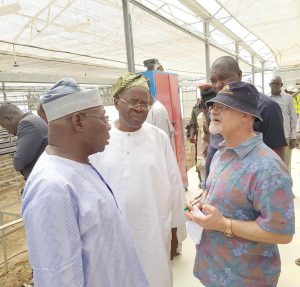
L-R—Chair of the Nigeria Zero Hunger Forum, Chief Obasanjo; Managing Director, Yintab Strategy Consults, Dr Babafemi Badejo, and Deputy Director General, Partnerships for Delivery, IITA, Dr Kenton Dashiell during a tour of facilities at the NZHF meeting in Borno.
The recommendations and resolutions formed part of the communiqué presented by Dr Kenton Dashiell, Deputy Director General (Partnerships for Delivery), International Institute of Tropical Agriculture (IITA).
The communiqué was signed by Chief Olusegun Obasanjo, Nigeria’s former President and chair of the NZHF, and the Governor of Borno State, Alhaji Kashim Shettima on 9 March.
According to the communiqué, members of the Forum agreed on several resolutions and recommendations, which included among others:
States need to focus on crops/livestock where they have a comparative advantage. States were encouraged to select at most three crops and one livestock for which they should give priority.
Attention also be given to small and medium agro-industries as a linkage between smallholder farmers and large industries.
The Forum recognized the efforts of the Nigerian Government through the Central Bank of Nigeria (CBN) and Bank of Industry to address financial constraints faced by farmers. Consequently, it was agreed that an invitation be extended to the CBN to attend subsequent NZHF meetings.
The Forum commended the CBN for the financial assistance offered to a private sector player in Benue, Titus Agbecha, for operating his soybean processing factory.
The investment of Borno State Government in mechanization was well received. Forum members called on the State to set up appropriate mechanisms that would ensure farmers’ access to machines, such as the establishment of agro-service centers using the public‒private sector approach to ensure sustainability. The need for training operators and mechanics was also emphasized.
Efforts on manufacturing of drip irrigation equipment by Borno State were applauded, and the Forum urged the State Government to market the technology to other states in Nigeria generally, and within its zone in particular.
The Forum identified cassava as a poverty fighter that could help the State create jobs for youth and women. Consequently, the Forum proposed that the State Government should invest in the cassava value chain.
To attain sustainable development and continuity of programs, the Borno State Government was strongly advised to create a window for the inclusion of public‒private partnerships in all its development interventions, and to establish a small laboratory for analysis and quality assurance.
The Forum commended IITA for its engagement with states through technical backstopping on various projects such as weed management in cassava, yam aeroponics, and the donation of seeds. Other partners that received commendation were the World Food Program (WFP) and the African Development Bank (AfDB).
The proposal by the Food and Agriculture Organization (FAO) to join forces and support the NZHF was well received and appreciated.
The Forum commended the presentations from all the states on the progress being made towards the attainment of Zero Hunger, and the steps Ebonyi State is taking to address the issues raised by the Forum during the previous meeting.
Inaugurated in 2017, the NZHF is a peer review/advisory mechanism initiated by former President Obasanjo with IITA as a technical partner in response to calls by the United Nations for countries to achieve Zero Hunger by 2020.
The meeting in Borno was attended by representatives of the five pilot states as well as Bauchi, Enugu, Nasarawa, and Oyo states.
Other participants comprised the technical partner to the NZHF, IITA; the WFP, FAO, the private sector, farmer groups, members of the Borno State traditional council, and the Federal Ministry of Agriculture and Rural Development.
State executives at the meeting included the Governor of Borno State, H.E. Kashim Shettima; Deputy Governor of Borno State, H.E. Maman Usman Durkwa; Deputy Governor of Ebonyi State, H.E. Kelechi Igwe; and the Deputy Governor of Ogun State, H.E. Yetunde Onanuga. The Governor of Benue State was represented by the State’s Commissioner of Agriculture, Mr James Abua.
Each of the pilot states made presentations on what they are doing towards achieving Zero Hunger, and how the previous NZHF meetings in Benue and Ebonyi had influenced their actions. The meeting also heard a testimony from a private sector player (a soybean processor in Benue State), Titus Agbecha, on how the NZHF’s meeting in Benue had had a positive impact on the operations of his factory.
A field visit was conducted to the Farm Center, Seed Multiplication Center, Machinery Shade, Drip Manufacturing Center, Girls’ Schools, Industrial Layout, and the State’s University. A 20-minute video that presented information on achievements included a new Internally Displaced Persons (IDP) camp with drip irrigation for additional food production, poultry production, fish production, and special programs for youth and women in agriculture.
For more information, please contact: Godwin Atser, Communication & Knowledge Exchange Expert, g.atser@cgiar.org or Katherine Lopez, Head of Communication, k.lopez@cgiar.org
Olamide Deborah Nwanze is a Senior Research Associate specializing in gender mainstreaming research to inform participatory and inclusive breeding, variety development, and seed systems policies regarding root, tuber, and banana (RTB) crops in the International Institute of Tropical Agriculture Headquarters, Ibadan, Nigeria. She is a PhD candidate at the University of Ibadan and holds an MSc and B. Agric in Agricultural Extension and Rural Development. Olamide is a fellow of the African Women in Agricultural Research and Development – Gender Responsive Agricultural Systems Policy (AWARD-GRASP) and the Gender Responsive Researchers Equipped for Agricultural Transformation (GREAT). She seeks to apply her gender-mainstreaming learnings, gender-responsive research, and policy development, and review expertise to facilitate women, youth, children, and vulnerable social group’s access to and adoption of agricultural Innovations that guarantee food, nutrition, income, and livelihood security in Africa. Her current roles include mentoring research fellows, development of guides and training manuals, implementation and adaptation of gender frameworks and tools, value chain actors’ engagement as citizen science partners, policy review and redesign, data management, and analysis. Her current research explores mixed methods and participatory and interdisciplinary approaches to capture and highlight gender dynamics, needs, preferences, and challenges stakeholders face within the agricultural livelihood value chain to prioritize gender-inclusive strategies in breeding programs, policy design, and implementation.
de Sousa, K., van Etten, J., Manners, R. Bello, A., Teeken, B., Olaosebikan, O., et al. 2024. The tricot approach: an agile framework for decentralized on-farm testing supported by citizen science. A retrospective. Agron. Sustain. Dev. 44, 8. https://doi.org/10.1007/s13593-023-00937-1
Madu, T., Onwuka, S., Nwafor, S., Onyemauwa, N., Ejechi, M., Ofoeze, M., Ukeje, B., Eluagu, C., Olaosebikan, O., Okoye, B., 2024. Gender-Inclusive Consumer Studies Improve Cassava Breeding in Nigeria in: Frontiers in Sociology, volume 9, number: 1224504, doi: 10.3389/fsoc.2024.1224504
Olaosebikan, O.; Bello, A.; Utoblo, O.; Okoye, B.; Olutegbe, N.; Garner, E.; Teeken, B.; Bryan, E.; Forsythe, L.; Cole, S.; Madu, T. 2023. Stressors and Resilience within the Cassava Value Chain in Nigeria: Preferred Cassava Variety Traits and Response Strategies of Men and Women to Inform Breeding. Sustainability 15, 7837. https://doi.org/10.3390/su15107837
Okoye, B., Ofoeze, M., Ejechi, M., Onwuka, S., Nwafor, S., Onyemauwa, N., Ukeje, B., Eluagu, C., Obidiegwu, J.*, Olaosebikan, O., Madu, T.* 2023. Prioritizing preferred traits in the yam value chain in Nigeria: a gender situation analysis in: Frontiers in Sociology, volume 8, number: 1232626, pages 1 – 9, ISSN 2297-7775, 2023. https://www.frontiersin.org/articles/10.3389/fsoc.2023.1232626/full
Olaosebikan, O., Bello, A. A., de Sousa, K., Ndjouenkeu, R., Adesokan, M., Alamu, E. O., Agbona, A., van Etten, J., Kegah, F. N.*, Dufour, D., Bouniol, A., Teeken, B. 2023. Consumer acceptability of cassava gari-eba food products across cultural and environmental settings using the triadic comparison of technologies approach (tricot) in: Journal of the Science of Food and Agriculture,
Teeken, B., Olaosebikan, O., Bello, A. A., Madu, T.*, Cole, S. M. 2023. Qualitative assessment on the positionality and preferences of dyads in relation to cassava-related activities: working with tricot trial citizen scientists https://hdl.handle.net/10568/138326 Type: Manual
Bouniol, A., Ceballos, H., Bello, A. A., Teeken, B., Olaosebikan, O., Owoade, D., Agbona, A., Fotso Kuate, A., Madu, T.*, Okoye, B.*, Ofoeze, M.*, Nwafor, S.*, Onyemauwa, N.*, Adinsi, L.*, Forsythe, L., Dufour, D. 2023. Varietal impact on women’s labour, workload and related drudgery in processing root, tuber and banana crops: focus on cassava in sub-Saharan Africa in: Journal of the Science of Food and Agriculture, pages 1 – 25, ISSN 0022-5142,
Bello, A. A., Agbona, A., Olaosebikan, O., Edughaen, G., Dufour, D., Bouniol, A., Iluebbey, P., Ndjouenkeu, R.*, Rabbi, I. Y., Teeken, B. 2023. Genetic and environmental effects on processing productivity and food product yield: drudgery of women’s work in: Journal of the Science of Food and Agriculture, pages 1 – 32, ISSN 0022-5142, 5
Cavicchioli, M., Zimbiti, T., Teeken, B., Nwanze, D.O., Liani, M., Parkes, E. & Bello, A. 2023. IITA-Gender Responsive Breeding Training Report. Genetic Resources Center, IITA-HQ, Ibadan, 21-23 September, 2022. Ibadan, Nigeria: IITA, (34 p.).https://hdl.handle.net/10568/131368
Agbona, A. Peteti P., Teeken B., Olaosebikan O. Bello, A. A., Parkes, E., Rabbi, I. Y., Mueller, L., Egesi, C., Kulakow, P. 2022. Data Management in Multi-disciplinary African RTB Crop Breeding Programs. In: Williamson, H.F., Leonelli, S. (eds) Towards Responsible Plant Data Linkage: Data Challenges for Agricultural Research and Development. Springer, Cham. https://doi.org/10.1007/978-3-031-13276-6_5
Lora Forsythe, Pricilla Marimo, Sarah Mayanja, Olamide D. Olaosebikan, Esme Stuart, Bela Teeken, Benjamin Okoye, Tessy Madu, (2021). Cross-product Gender Analysis of RTBfoods Step 2 Gendered Food Mapping on RTB Products. Understanding the Drivers of Trait Preferences and the Development of Multi-user RTB Product Profiles, WP1. London, UK: RTBfoods Field Scientific Report, 30 p.
Teeken, B., Garner, E., Agbona, A., Balogun, I., Olaosebikan, O., Bello, A., Madu, T., Okoye, B., Egesi, C., Kulakow, P. and Tufan, H.A. 2021. Beyond “Women’s Traits”: Exploring How Gender, Social Difference, and Household Characteristics Influence Trait Preferences. Frontiers Sustainable Food Systems 5:740926. https://doi.org/10.3389/fsufs.2021.740926
Teeken, B., Agbona, A., Bello, A., Olaosebikan, O., Alamu, E., Adesokan, M., Awoyale, W., Madu, T., Okoye, B., Chijioke, U., Owoade, D., Okoro, M., Bouniol, A., Dufour, D., Hershey, C., Rabbi, I., Maziya‐Dixon, B., Egesi, C., Tufan, H. and Kulakow, P. (020. Understanding cassava varietal preferences through pairwise ranking of gari‐eba and fufu prepared by local farmer–processors. Int J Food Sci Technol.https://doi.org/10.1111/ijfs.14862
Bela Teeken, Olamide Olaosebikan, Ireti Balogun, Benjamin Okoye, Tessy Madu, Steven Cole, Abolore Bello, Elizabeth Parkes. (2020). Piloting the G+ customer and product profile tools for gender-responsive cassava breeding in Nigeria. Nigeria: International Institute of Tropical Agriculture (IITA). https://hdl.handle.net/20.500.11766/13000